Summer Breeze

There’s nothing as delightful as a summer breeze.  It’s especially welcome after a long hot and humid spell, when the wind suddenly swings to the north dropping the temperature by over ten degrees.

My childhood bedroom faced south and I have memories of waking up on a June morning to a cool breeze, blowing the white curtains into the room like billowing ghosts.   I still like the sight of gauzy curtains dancing in an open window. 

curtains blowing in the breeze

Yes, back in the days before A/C, we used to sleep with the windows open all summer.   The upstairs bedrooms in our old farmhouse would get pretty hot in the dog days of August, but I don’t remember it being brutally hot all summer like it is now.   I put the A/C on the third week of May, and except for a few cooler days in June when I could open the windows and air out the house, it will stay on until late September.

On July 1, Canada Day, what’s more symbolic of patriotism than a flag snapping in the wind, beside a maple tree.

Canadian flag

Oh Canada!

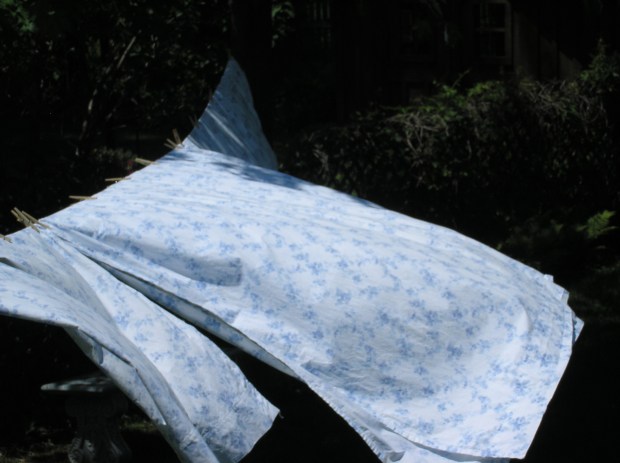
The sight of sheets flapping in the breeze is a lovely thing, with the added bonus of that wonderful fresh-air sun-drenched smell when you drift off to sleep.

sheets on the line

While I may get refreshing north breezes on my back deck, I have to move under the shade trees if the winds are from the south – a perfect spot for dining alfresco.   (table photo from Pinterest but see The Corona Diaries next week for my latest scavenger find)table under shade trees

Add in some poetry:

Victoria poem Bliss Breeze

Poem from Victoria July 1999 issue

And some music:   (The lyrics of this oldie but goodie paint a perfect picture – “Sweet days of summer, the jasmine’s in bloom.  July is dressed up and playing her tune”)     

And you have the ingredients for a perfect summer day.   As Henry James proclaimed,  “Summer afternoon, summer afternoon, to me those have always been the two most beautiful words in the English language.”

A swing or hammock gently swaying in the breeze can lull you to sleep while you’re reading. 
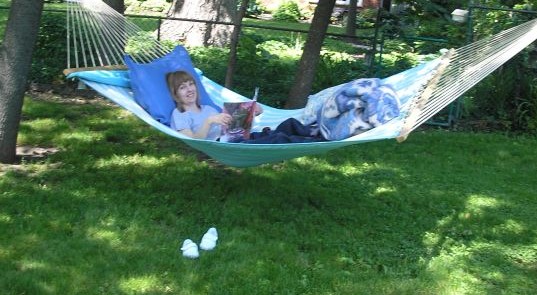
Hammock

A cool breeze on a hot day at the beach makes for awesome waves.

Beach Waves on the water

Seagull

Surf’s Up!

And what’s a sail without a good stiff south wind.  

sailboat river

I was surprised they held the annual sailboat race this year, although there weren’t as many entries.   The music and food festivals were all cancelled, but spectators could still line the shore and watch the parade of boats go by.

sailboat race

Sailboats social distancing….

Finally, there’s nothing like sitting on the deck with a cold one when the heat of the day is over and an evening breeze descends to cool everything off. 

Root Beer float

An old-fashioned root beer float…

Wherever you are, may the rest of your summer be a breeze!   

Lyrics:  “Summer Breeze”  1972 Seals and Croft

See the curtains hangin’ in the window
In the evening on a Friday night
A little light a-shinin’ through the window
Lets me know everything’s all right


Summer breeze makes me feel fine
Blowin’ through the jasmine in my mind
Summer breeze makes me feel fine
Blowin’ though the jasmine in my mind

See the paper layin’ on the sidewalk
A little music from the house next door
So I walk on up to the doorstep
Through the screen and across the floor

Summer breeze makes me feel fine
Blowin’ through the jasmine in my mind
Summer breeze makes me feel fine
Blowin’ through the jasmine in my mind

Sweet days of summer, the jasmine’s in bloom
July is dressed up and playing her tune
And I come home from a hard day’s work
And you’re waitin’ there
Not a care in the world

See the smile awaitin’ in the kitchen
Through cookin’ and the plates for two
Feel the arms that reach out to hold me
In the evening when the day is through

Summer breeze makes me feel fine
Blowing through the jasmine in my mind
Summer breeze makes me feel fine
Blowing through the jasmine in my mind


The Lavender Blues

It’s been a bountiful year for lavender.   I don’t remember ever seeing so many buds on my plants before – the bees are certainly rejoicing!  

Lavender

Lavender is an easy-care perennial, sun loving but can tolerate some shade, does well in drought and poor soil – exactly my kind of plant.  I have about twelve bushes but admit the ones in the shady back yard,

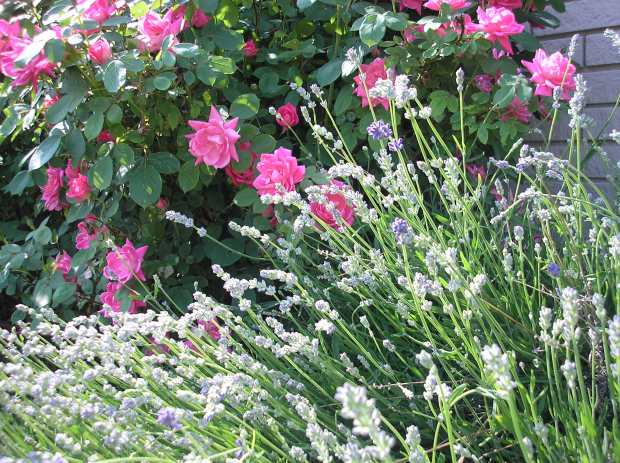
roses and lavender

are not as lush as the ones in the sunny facing front.  Lavender

I’ve grown lavender for years as the fragrant smell has always appealed to me.   It’s inexpensive at $5 a pot, and once established, it’s beauty can last for years.   I usually plant English lavender as it is the more cold-hardy species.  My few attempts at growing French lavender were not successful as it did not survive overwintering here in our Canadian climate.   I also prefer the sweeter English lavender smell, whereas the French has a sharper Rosemary-like scent.   French lavender has a longer bloom time and a darker purple flower.  Someone brought me back some from Provence once and while it was nothing at all like mine, it would still be lovely to see someday. 

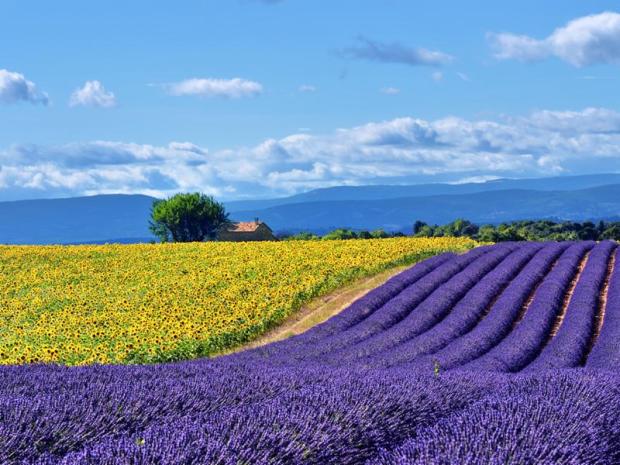
Lavender field in France

(Colors of France photo)

These photos from my garden show the progression of color with the season, from the palest shade early on, 

roses and lavender

Lavender

Lavender

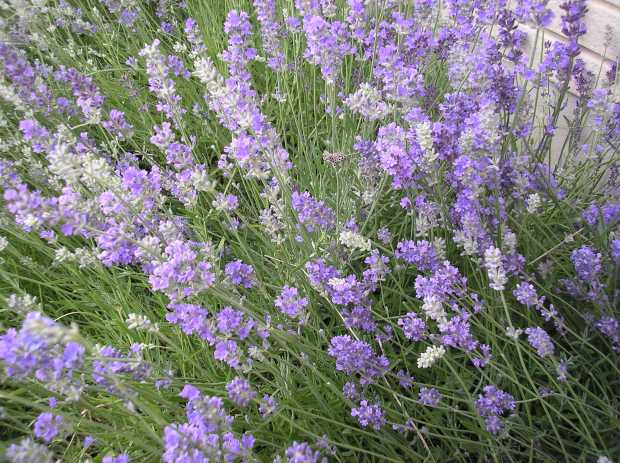
gradually darkening to a more vibrant purple. 

Lavender

In certain lights it can take on a blue tone,

Lavender

but the softer light of early evening really makes the purple color pop.   

Lavender

Usually by the end of July, the buds are dried out but there are always a few spears still growing in September.  Cutting them back is supposed to encourage a second flowering – I’ve never tried this but might this year as it is so abundant.   While some people like to harvest early for best fragrance and dry their lavender bundles upside down, I prefer to enjoy the beauty of the plant and and strip the dried buds off later.      

Lavender in a Blue Pot

If you don’t have a garden, a pot of lavender is a nice alternative.  

Lavender

Lavender has long been known for it’s calming fragrance.   Add a few drops of lavender oil to the bath water after a stressful day for instant relaxation.   

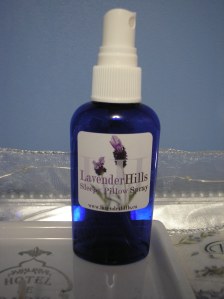
Lavender Spray

Lavender Pillow Spray

For sleep-inducing properties, use a lavender spray or tuck a lavender sachet under your pillow.   I often give sachets away as presents and one year my cute little 5 yr old neighbor insisted on taking one home for her shift-worker dad.   Lavender can also be used in cooking, adding a subtle fragrance to baked goods like cakes and cookies.   While I’ve never baked with it, I used to  drink a brand of lavender flavored Earl Gray tea before I gave up caffeine. 

Earl gray Lavender tea

One year I tried to make my own lavender oil, with disastrous results.  There were two methods suggested – the first extracting the oil with oil required  steeping the leaves and flowers in a crock of olive oil and repeatedly pressing, straining and adding more buds every 24-48 hrs, repeating the process 6 to 8 times.  The second method, solvent distillation, which involved extracting the oil with alcohol to make a tincture, sounded much easier.  They recommended ethyl alcohol, but if you couldn’t find it, vodka was acceptable (but not rubbing alcohol).   For a non-drinker like me this required a trip to the liquor store where I was surprised to find even the smallest bottle of vodka cost $20.   The lavender buds were soaked in the alcohol in a jar, in a process called maceration, meaning steep or rest, an old pharmaceutical term I remember from my school days, as in the extraction of a drug by allowing it to stand in contact with a solvent.   The jar was placed in a dark cupboard, with instructions to agitate it once a day.   I missed a week while I was away unexpectedly, but it just looked darker and murkier.  After several weeks (2-6 wks), you drained the liquid off by straining it through a cheesecloth filter and froze it in a suitable container.  The lavender oil was supposed to congeal on top of the alcohol, which does not freeze, and could then be scraped off and placed in a glass bottle.   I ended up with about 3 ml (half a teaspoon), of a strong lavender-like but somewhat foul smelling brown liquid, not enough to fill even half my dropper bottle, which eventually got thrown out during one of my cleaning binges.   My advice – drink the vodka instead and just buy a good quality essential oil.   Some products have fake lavender scents, but I’ve found this to be one of the better brands, and at $12 it’s reasonably priced.       

Lavender oil Now

Storing a lavender spray in the fridge to spritz on a hot summer day is a refreshing trick. 

Lavender mist spray

The calming scent of lavender soap can help you pause and relax while performing that all important frequent hand-washing activity. 

Lavender Soap

 It’s nice to scent your drawers with a lavender sachet.   Wedding favor bags from the party store are great for this purpose.  

Lavender sachets

Lavender sachets

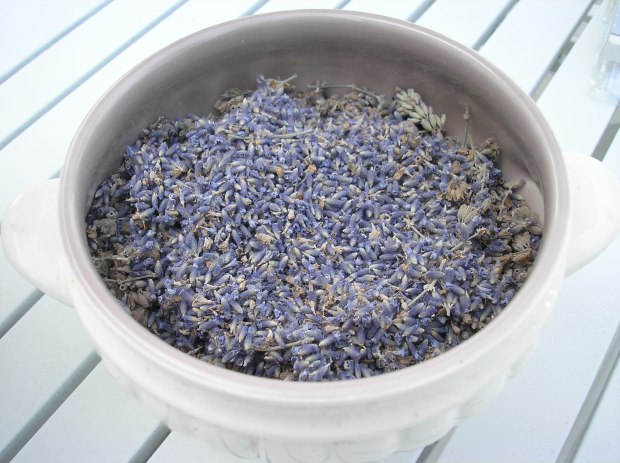
I admit the lavender bushes aren’t quite as pretty when the season is over and they’re brown and dried out, but the smell is still lovely, especially after a summer rain.

Lavender harvest

My lavender is almost ready harvest.   With such a bumper crop this year I may have to hire help!   

Book of the Day:

The Unlikely Lavender Queen: A Memoir of Unexpected BlossomingThe Unlikely Lavender Queen: A Memoir of Unexpected Blossoming by Jeannie Ralston

Visiting a lavender farm has long been on my bucket list, preferably one in Provence but even here would do.  For those who dream of living such an idyllic life, a memoir of the reality by a New York city writer who moved to Texas with her National Geographic photographer husband to start a lavender farm.   I read this when it was first published in 2008 when I was interested in making scented products.   As I recall, they lasted about ten years, including time to get the plants established, before they gave up and moved to Mexico.   (Rating 3/5 stars.)        

Song of the Day:  (and Source of Blog Title)  Lavender’s Blue                      

This song is stuck in my brain after watching a Disney movie last week (2015 Kenneth Branagh version).   I always liked Lily James as Rose in Downton Abbey and she did a credible job  as Cinderella.   Okay, I wasn’t really watching it, but it was on TV while I was editing photos.   An old English nursery rhyme/folk song from the 17th century, it seems faintly familiar.

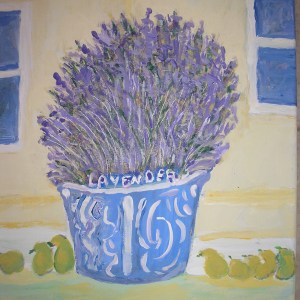
And last but not least, one of my mother’s paintings:

Pears & Lavender -AMc-Aug/17

.

Garden Treasures

This is the first year I haven’t bought any garden flowers – no hanging baskets, no geraniums, absolutely nothing.   It was cold with snow flurries until mid-May so the pop up nurseries had a pathetic selection of small and withered looking plants.   We went straight into hot humid weather and I was waiting for them to go on sale but then never made it to any of the big box stores or nurseries. 

On the plus side I don’t have to water, especially welcome in this record breaking heat.   On the minus side, I miss the beauty of having baskets, even the humble geraniums, but I’m trying to focus on my hardy perennials.  Due to the late spring it was a bad year for lilacs (exactly 3 blooms) and peonies (a poor showing, only one or two on the new bushes) and some of the rose bushes did not fare well.  The ones on the north side are very sparse and two had to be dug out entirely.   On the other hand, the rest of the roses were abundant and the lavender was so plentiful it deserves it’s own blog.     

Here’s a recap since May.    A carpet of blossoms on my daily walk.

cherry blossom carpet

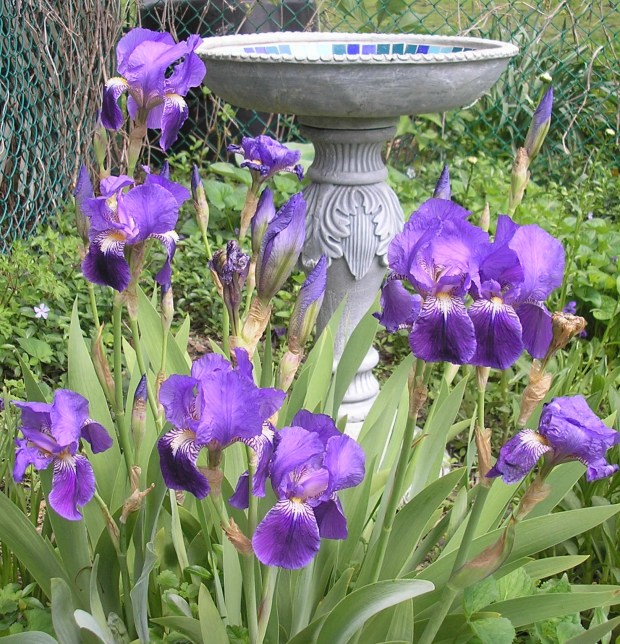
My 50 cent purple iris was a beautiful bargain once again.

purple iris

purple iris

The daisies showed up early.

Daisies

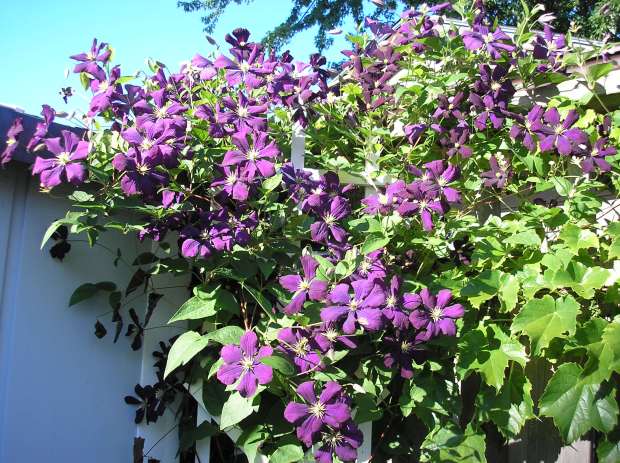
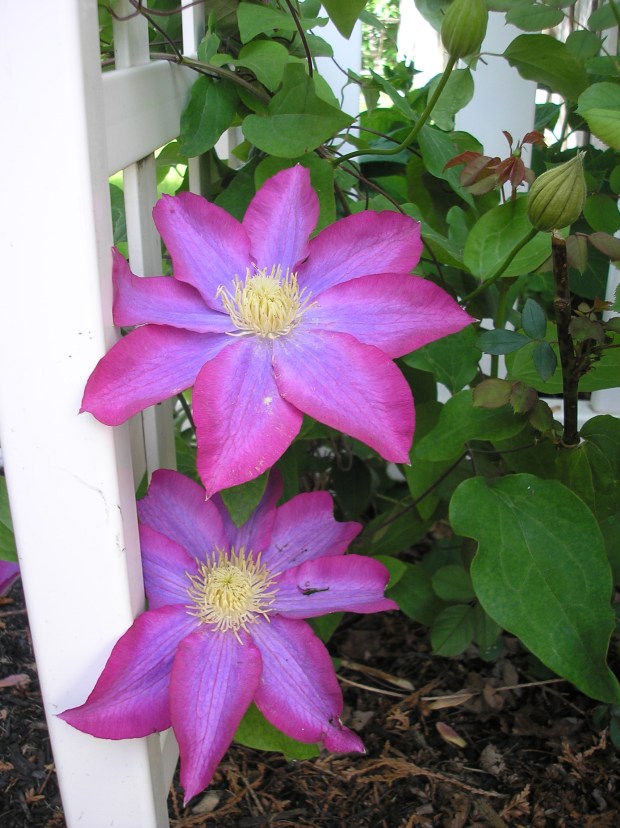
Second year for the prolific purple clematis.

purple clematis

The older purple clematis is still hanging in there.

purple clematis

The fuchsia clematis.

fuchsia clematis

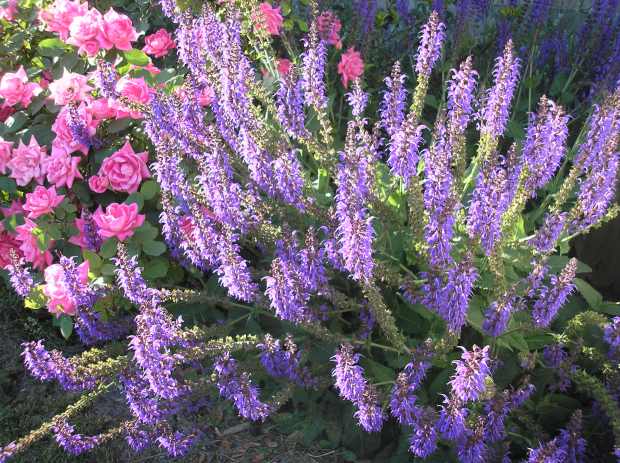
Purple salvia and pink roses make a colorful contrast.

Russian sage and roses

The heirloom roses were bountiful.

roses

fifty year old roses…

And so were the Pink Knock-Outs,

roses and lavender

and the newer lavender bushes are doing well.

roses and lavender

Stay tuned for The Lavender Blues next week…

roses and lavender

And speaking of blues, the hydrangeas were more cooperative this year – some lavender hues and my favorite blue tones, aided by a generous dose of aluminum sulfate to acidic the soil.    I wonder how much you have to add to get that brilliant blue you see in gardening magazines? 

Blue hydrangeas

Blue Clematis

The garden is my backyard oasis, a tranquil respite from this crazy COVID world.   How is your garden growing this year?

Baked Alaska and a Book

Recipe for A Perfect Wife

         This month’s recipe was inspired by a book.   Recipe for a Perfect Wife, by Karma Brown, is a quirky look at the lives of two newly married women living in the same suburban house sixty years apart – Nellie, a typical 50’s housewife, who is trying to get pregnant, and Alice, a reluctantly transplanted New York City writer, who is trying not to.    Told in alternating voices, Nellie 1956 and Alice 2018, with quotes of outdated advice at the beginning of each chapter and lots of 50’s recipes, it’s an interesting look at marriage, then and now.     

Link to the publishers/GoodReads review.   

       This book appealed to me because of it’s unique format, plus I thought it would nice to read about what life was like for my mother’s generation – my mother had 4 children under the age of 7 by 1960.  (It’s exhausting just thinking about that.)   The book was immensely readable, but not quite the light fluffy read I had expected.   While it started out okay, it soon took a dark turn and ended up with a strange ending.   I didn’t really like any of the characters, dishonesty seemed to be a common trait – hard to base a marriage on that, even  back then when people often didn’t know each other well before becoming engaged.    Of course the author was trying to make a point, and it would make an excellent choice for a book club discussion.   You could even make some of the 50’s recipes like Baked Alaska.   I always like it when the book club dessert matches the book club selection.   

       My recent Hermit Cookies blog, sparked a discussion about family cookbooks, Betty Crocker and Fannie Farmer being old favorites, although my mother’s bible was the Purity Flour Cookbook.   Growing up on a farm in the 60’s, my family meals were invariably our own home-grown vegetables and meat, and of course no meal was complete without a potato.    No rice or noodle casserole dishes for us, and spaghetti was simply pasta doused with a can of Campbell’s tomato soup.   My mother did not experiment with recipes like Tuna Noodle Casserole or Chicken A La King because my dad and brothers would simply not have eaten them, and I myself was a picky eater, although she did make a good meatloaf and macaroni and cheese with bread crumbs on top. 

Tuna Noodle Casserole

garnish with a layer of potato chips?

For many modern housewives that era saw the ushering in of convenience foods, instead of made from scratch.   Although we had boxed cake and brownie mixes, my mother made enough homemade pies and tarts to feed a threshing crew and just once that glorious Sixties Desert – Baked Alaska. 

Perhaps I remember this momentous event because of it’s rarity.   It was not for a special occasion, but simply on a summer evening, a couple of hours after supper to ensure that no one was too full for dessert.   If you go to all that trouble, you want to make sure your masterpiece is appreciated.

     For those of you unfamiliar, Baked Alaska is basically a mold of frozen ice cream and cake, smothered with a layer of toasted meringue.

Baked Alaska

Baked Alaska

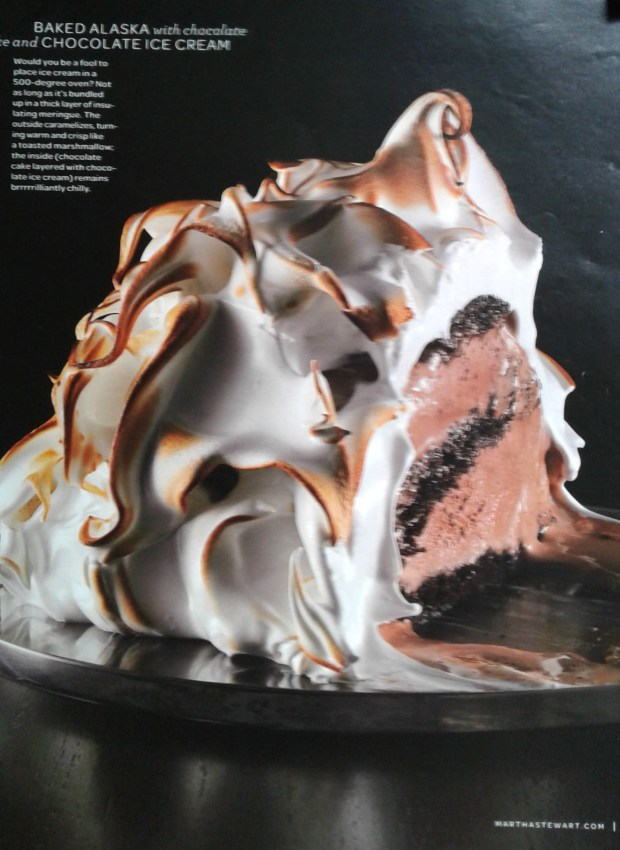
   Although both my (2009 reissued) Purity cookbook recipe and the one in the book, call for white sponge cake and strawberry ice cream, my mothers version was reminiscent of this Martha Stewart creation, with chocolate cake and vanilla ice cream.   

Baked Alaska

It was a marvelous sight to behold, with the meringue all puffy and peaked, and who would believe you could put ice cream in the oven!   Perhaps I also remember it as chocolate cake was always my birthday choice growing up.   

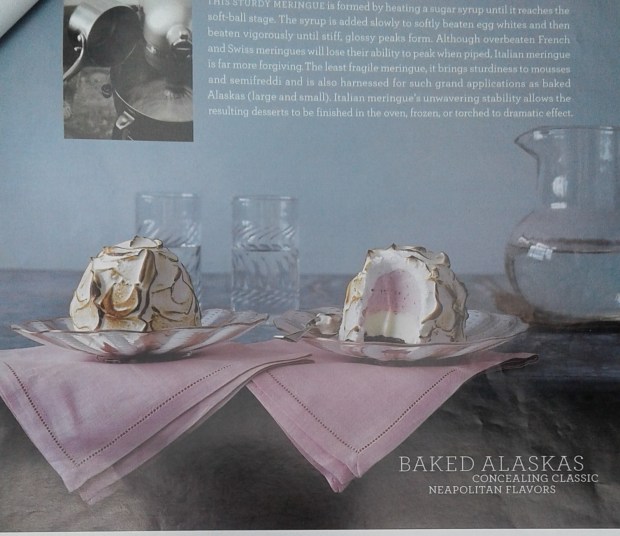
      Baked Alaska can be complicated, if you want to mold it into a perfect dome shape, or use tea cups to make individual portions as in this Martha Steward recipe which calls for strawberry and vanilla gelato and of course, being Martha, she’s making the cake from scratch.   What exactly do you do with all those separated egg yolks? 

Baked Alaska

But it can also be easy if you just cut your cake and ice cream in a slab, layer it up, freeze it hard, and then smother it with meringue, as per this recipe in my mother’s 1965 version of the Purity cookbook.  

Baked Alaska

Maybe not as fancy as the dome-like creation, but wouldn’t it be the same thing?   I even wondered about using a carton of liquid egg whites but some sources said the heat from the pasteurization process would negatively affect the egg proteins.   (Cream of tartar is included as an acidic stabilizer to keep the proteins in the egg whites from sticking together thus enabling a smoother stiffer consistency.   Alternatives are lemon juice or white vinegar.)  

So, I did a grocery run yesterday and bought a carton of liquid egg whites, and decided to experiment last night, and they whipped up just fine.   I used lemon juice as I couldn’t find any Cream of Tartar at the store.

I forgot to buy cake, so I used two portions of Mug Cake mix from the pantry, not the best idea as the shape was not ideal and there wasn’t enough cake.

Baked Alaska

I froze two portions of vanilla ice cream in teacups (a la Martha above), and assembled them over the cake, and then added the meringue. 

It wasn’t bad, but plenty sweet.   I made the mistake of putting the assembled product including the meringue in the freezer for about ten minutes (as it said you could), while I cleaned up the mess, but I wouldn’t do that again, as it made the meringue hard and cold, and then it took too long to brown and by the time I took it out the ice cream was melting.   Better to just put it in the oven as soon as it’s assembled.   Of course I also stopped to take a few pictures, so that didn’t help.  

If I was to make it again for a crowd, I’d do the slab cake, and maybe strawberry and chocolate gelato, which isn’t as sweet.   Maybe when I can have people over again and hold a book club under the trees.   It’s so brutally hot here this week, 35 C (95 F) and 42 (106 F) with the Humidex, that any ice cream served outside would melt lickety-split.  

 Despite my love of all things vintage, especially fashion, I don’t think I would have wanted to live in the fifties –  it seemed very much a man’s world.   I posed that question to my mother, and she said – it seemed okay at the time.  Like many things, some decades are best viewed through a veil of nostalgia.     I’ll leave you with some marriage advice quotes from the book – relics from the past….    

Vintage 50's Marriage Advice

Vintage 50's Marriage Advice

Vintage 50's Marriage Advice

Vintage 50's Marriage Advice


Postscript:   Have you ever made Baked Alaska?

The Literary Salon: Secondhand – To Have and Have Not

Cleaning out – that’s what many of us have been doing, making productive use of our time during our COVID staycations.   No matter that there’s nowhere to take the stuff now that the dump, Goodwill and thrift stores are all closed and the whole idea of holding a garage sale is frankly horrifying.  Somehow the idea of pawing through someone else’s junk/germs is not very appealing, when even the library is quarantining returned books for 72 hours before disinfecting them for re-circulation.  I did my annual house purge back in  snowy January and the stuff is still sitting in the basement and the gardening items are still in the garage, set aside for the spring horticultural sale, long cancelled. 

    So, I wasn’t much interested, when in my first curbside pickup of library books, there was one I had ordered eons ago – Secondhand: Travels in the New Global Garage Sale – by Adam Minter.     But after I had read it, I thought – where were you last winter when I needed you!      

Secondhand: Travels in the New Global Garage SaleSecondhand: Travels in the New Global Garage Sale by Adam Minter

My rating: 4 of 5 stars


Publishers Blurb:

Decluttering. A parent’s death. Sooner or later, all of us are faced with things we no longer need or want. But when we drop our old clothes and other items off at a local donation center, where do they go? Sometimes across the country-or even halfway across the world-to people and places who find value in what we leave behind.

In Secondhand, journalist Adam Minter takes us on an unexpected adventure into the often-hidden, multibillion-dollar industry of reuse: thrift stores in the American Southwest to vintage shops in Tokyo, flea markets in Southeast Asia to used-goods enterprises in Ghana, and more. Along the way, Minter meets the fascinating people who handle-and profit from-our rising tide of discarded stuff, and asks a pressing question: In a world that craves shiny and new, is there room for it all?

Secondhand offers hopeful answers and hard truths. A history of the stuff we’ve used and a contemplation of why we keep buying more, it also reveals the marketing practices, design failures, and racial prejudices that push used items into landfills instead of new homes. Secondhand shows us that it doesn’t have to be this way, and what really needs to change to build a sustainable future free of excess stuff.

 Why I Liked it:   

This is not one of those how to declutter/reorganize/change your life  manuals, but rather it’s an eye-opening look at what really happens to the unwanted stuff you donate.   It certainly motivated me to rethink my “possession of things” in ways that those other books did not.   Maybe it’s the current COVID crises and morbid thoughts of sudden death, but really in the end, it’s all just stuff and you can’t take it with you.   So keep what you use and enjoy and get rid of the rest, and try not to buy as much in the future!

    The author, Adam Minter, has done a great deal of research into the global secondhand industry, and being himself the descendant of junkyard owners,  is well qualified to tell the tale.  He also wrote Junkyard Planet-Travels in the Billion Dollar Trash Trade, a 2013 bestseller. 

    Much of the book involves his travel in places like Mexico, Southeast Asia and Africa – countries where the secondhand economy thrives, and where the stuff which doesn’t sell here is often destined.   That old saying, one man’s junk is another man’s treasure, is true.   While there’s a widely circulated theory that by sending our clothes and electronic waste to third world countries we are harming their homegrown economies, the author debunks that myth.   While undeniably some of it does end up in the dump, much of it is recycled and repaired to be resold to people who would otherwise have nothing.   The author follows a container of discarded computers, cell phones and tube TVs to Africa and it’s thriving electronic repair shops – shops who would much rather have older recycled goods than new cheaper ones because they last longer and are made better.   In one story, Greenpeace installed a GPS tracking device on a discarded TV in a shipment bound from England to Africa and then send a reporter to reclaim it at the other end, thus proving, according to their report, that it was destined for a digital dump.  But it wasn’t – it would have been brought to a repair shop and then resold to someone who had nothing.  

     There’s a chapter on emptying the nest (professional estate cleaning  crews), secondhand clothes, wiping rags (a whole separate industry), and why appliances don’t last, (remind me to buy a Speed Queen if my thirty year old Maytag washer/dryer ever wears out).   Simple fixes such as making manufacturers release repair manuals for older models would do a lot to keep older electronics out of the dump.          

     I once donated an old 80’s radio/cassette player to the St. Vincent de Paul and the clerk thanked me as there were some seasonal workers in the store who were looking for a radio.   They were Mexican, here to help with the pepper harvest.  We smiled at each other.  I was pleased too, as when we drop things off at the thrift shop, we hope they will be reused and appreciated by someone else – if not here than perhaps in some other country.   In this world of have and have not, it’s comforting to know that sometimes happens.   

PS.   I’ve been thinking about my garage sale stuff and wondering – if things continue in recovery mode here and we don’t get a second fall wave – if I could just put some of the stuff out at the end of the driveway on a table some Saturday afternoon with a sign, Free for a Small Donation to COVID relief fund?   That way it won’t sit in my basement until next year.   A lot of what I have is winter stuff, Christmas decorations, wreaths, sweaters, etc.   I only had a garage sale once, (advertised) and I remember people coming really early, like before I was awake!    

Vintage Casablanca poster

Vintage movie posters

French Press Coffee Maker

French Press coffee maker…used once…$35 price sticker still on…coffee not hot enough and too much hassle to clean out the grounds.

red plaid housecoat

Flannel bathrobe with fleece lining…never worn……not suitable for menopausal women….

fake flowers

from my fake flower/wreath making days…

Sparkly Christmas wreaths

Many sparkly Christmas in July things…


Lily of the Valley

Lily of the Valley is one of my favorite garden perennials – it’s delicate white flowers herald a unique fragrance which I always associate with the first days of summer.  The scent is sweet, although not overbearing like that of honeysuckle or wisteria.

Lily of the Valley

A woodland species, lily of the valley is not actually a lily but a member of the asparagus family, and is considered to be poisonous to pets and people. 

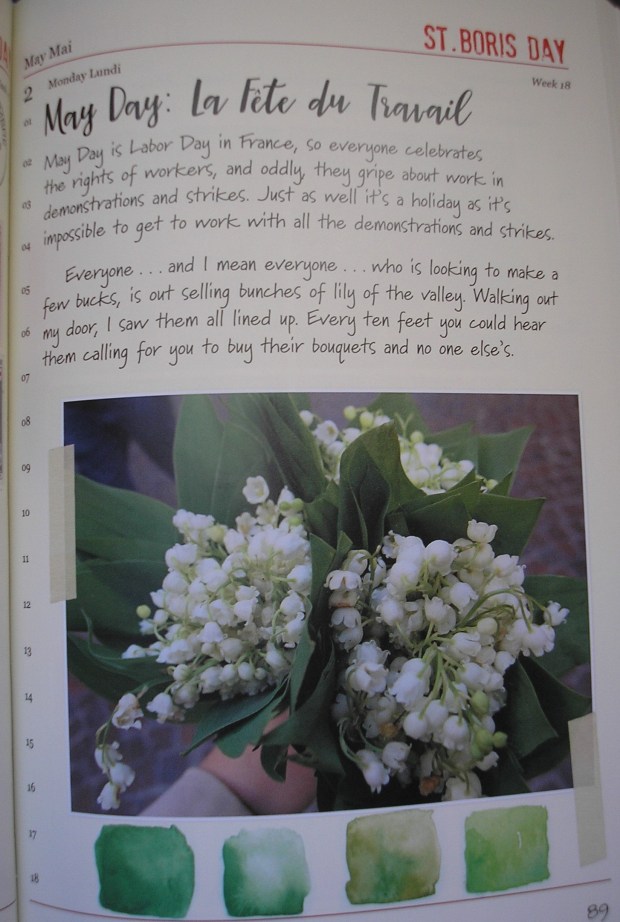
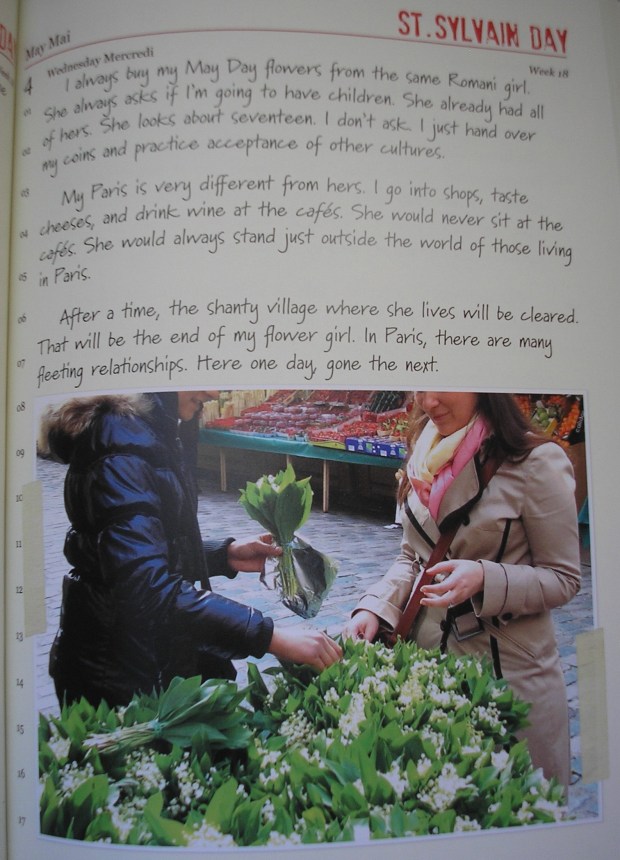
It flowers in June here in Canada, although in other countries earlier in the spring.   In France, May 1 is considered Lily of the Valley day, where vendors set up their stalls in the streets to sell bundles brought in from the countryside.    

Lily of the Valley - Janice MacLeod book

from A Paris Year – by Janice MacLeod

Lily of the Valley - Janice MacLeod book

from A Paris Year – by Janice MacLeod

I inherited my now thriving patch from a free clump given to me by a fellow gardener. 

Lily of the Valley

No social distancing here….

Warning – it is an invasive species, spread through underground rhizomes, something I always appreciate in my garden where so much withers and dies, usually from neglect.   A hardy plant, it can take care of itself, although it prefers a shady spot.

Often a favorite of bridal bouquets, like Kate Middleton’s, even a spray or two adds a delicate touch of white.

Lily of the Valley - Kate Middleton

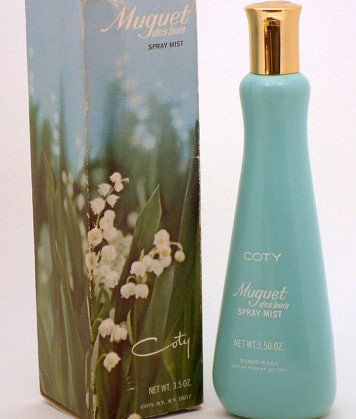
I like to put a few springs in a bud vase and perfume my rooms. Lily of the ValleyWhile the smell may only last a few days, you can recapture the mood with scented products.   I remember wearing a fragrance by Coty called Muguet-des-bois, many years ago.   

Lily of the Valley Coty - Muguet des bois2)

Scented hand soaps are nice too – especially as we’re washing our hands so frequently – a little dose of springtime year round!

Lily of the Valley

In the language of flowers, lily of the valley means the return of happiness, perhaps a signal of sunnier days ahead. 

PS.   The third week of May, this beautiful blue flower bloomed right in front of my lily of the valley. 

Blue flower near Lily of the Valley

I don’t know what it is and don’t even remember planting it – possibly it was from the horticultural sale two years ago — but it’s unfortunate they didn’t bloom at the same time, as blue and white is always a lovely color combination.   It’s nice to know that even in this time of COVID monotony, the garden can still hold surprises.  

PS:  Speaking of old and new, I’m still on the old editor.  When I decline, not now, it allows me to continue with the old, but I’m not sure if this is a permanent thing or if I haven’t been switched yet?   Is anyone else still using the old?   I would have thought they would have migrated everyone by now?  


Hermit Cookies – A Pandemic Recipe

Since many of us are still living like good little hermits these days, I thought Hermits cookies would be a good topic for this weeks blog – which might also be my last blog for awhile depending on how well it goes with the new WordPress editor next week.  I didn’t like the new Block editor when I tried it last spring (see Blockheads post) and am not in the mood for a new learning curve.   Wordpress might think this is a good time to switch (or begin the migration as the Happiness Engineer called it), because we are all stuck at home, but call it computer fatigue or lockdown fatigue or whatever, I need less not more screen time right now.    

Back to the Hermits – Webster’s dictionary defines a hermit as:  “a) one that retires from society and lives in solitude especially for religious reasons : recluse,   b) a spiced cookie.

Hermits are an old-fashioned recipe dating back from to the mid-1800’s in North America, or even earlier, possibly originating in the hermitages of the middle ages.   They refer to any kind of spiced cookie containing dried fruit such a raisins, currants or nuts.  They may have white or brown sugar and come in either bar, square or drop cookie format.  They’re made from  ingredients you might already have in your pandemic pantry, which along with the addition of cinnamon, cloves and spices produces a soft cookie which keeps well.   Nutritionally, their sweetness comes from raisins and dates, and nuts are a good source of omega-3’s and protein. 
There are various theories about the origin of the name.   Some sources say they were called hermits because they looked like a hermit’s brown sack cloth, (the ones containing molasses).   Others say the spices become more distinct with age, making the cookies taste better if they have been hidden away like hermits for several days.   Very likely the oldest recipe goes back to the 12th or 13th century religious hermitages, where the basic ingredients would have been in common use at bakers’ tables.   The terms for those abodes— “hermite” from the Old French or “heremita,” from the medieval Latin — may have been assigned to this treat by their inhabitants.   Another possibility is that the Moravians, a German Protestant religious group known for their thin spice cookies in North Carolina and Pennsylvania, were sometimes called “herrnhutter” in German or Dutch, and that might have sounded like “hermits” to an English-speaking cook.   At any rate, they are spiced cookies based on raisins and nuts…..so let’s get to it!

My recipe today will be from my mother’s bible of country cooking, the Purity CookBook, first published by the Purity Flour Company in 1911.  Her edition dates from 1945 and is well stained, and is in fact held together with that old Canadian standard – duct tape.  

As well as main courses and desserts, it contains a large section on canning  vegetables and making various jams and jellies.   Nothing of course is low in fat or calories as those were not deemed important back then.   When it was re-issued in 2009, I bought a copy for myself, which you can see is still in quite pristine condition. 

Purity recipe cookbook new

Here’s the recipe:

Hermit cookie recipe

Hermit recipe

This did not make 5 dozen….more like 30 cookies….

and the ingredients…nothing fancy, although this version includes dates. 

Hermit cookie ingredients

I used butter instead of shortening, and not as much, 1/3 cup.   My Allspice container said it was a mixture of cloves, cinnamon and nutmeg, but allspice can also be a spice (from a plant berry) on its own.   If Allspice is not in your spice rack, Google has plenty of references for substitutes, including one on one cloves, but I find cloves strong, so best not to overdo it. 

 The finished product:

Hermit cookies

My mother was not much of a cookie baker, as my dad preferred pies and cakes, so I don’t remember her making these very often when I was growing up but I always enjoyed them when she did.  (She was more likely to make peanut butter or chocolate chip).    Back in the 1990’s, I worked at a rural hospital where the dietary department still made much of the hospital food from scratch.   Hermits were often on the cafeteria menu for morning coffee break, as were scones and homemade cinnamon buns.  I hadn’t had hermits in years, so imagine my delight on seeing them at the bakery in my  local grocery store last year.   They’re baked up fresh, although from a mix ordered in, according to one of the staff, and they have regular customers, mostly older folks like me who remember them from childhood.           

Hermit cookies Of the three versions I’ve sampled, they’ve all have been a bit different, mainly in the spices department, but I think the bakery’s is the best, and probably comparable in price to homemade, ($5.49 for 12 large cookies), nuts and raisins being fairly expensive here unless you go to one of those bulk bin places.  The key is the right combination of spices.  Despite buying two dozen from the bakery, we ran out before the next grocery run, so I had to resort to making them from scratch.   Mine did not taste the same as the last time I made them but I suspect my nutmeg was too old.   That would have required a trip to the store, and I’m more like a hermit crab these days, scurrying around doing my essential errands quickly so I can return to the safety of my own home. 

Hermit crab

Stay in your home and stay safe!

We all might be getting a little crabby these days from too much sheltering in place, but a sweet treat always helps!   Remember to savor – according to the Petsmart website, hermit crabs take small bites and eat very slowly, usually at night.   Enjoy! 

Postscript:   Do you have a favorite cookbook you use or may have inherited?


A History Lesson – Throwback Thursday

1918 flu ladies with masks

A friend sent me this in an email so I can’t credit the source, but it’s deja vu a hundred years later.   In 1720 there was the plague, in 1820 a cholera epidemic, in 1918-20 – The Spanish Flu, and now 2020 COVID-19 Coronavirus.  It seems history repeats itself every hundred years.

Spanish flu

Spanish flu

Spanish flu

Spanish flu