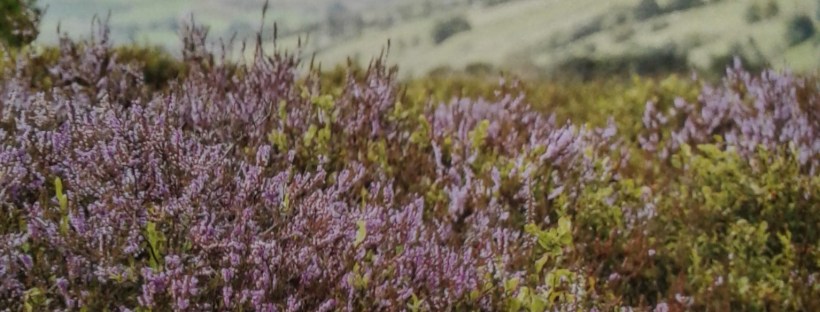
Heathcliff is dead……again. This is the third time I have tried to grow heather, but alas, it was not meant to be. I have resigned myself to the fact that you can not grow heather in North America, there is a reason it is only to be found in abundance on the windswept moors of the UK. Here is a photo of Heathcliff (the-Plant-formerly-known-as-Heather), from last June, all healthy and blooming and alive.
 And here is a picture of him in September at his funeral.

I arranged a few red maple leaves around his skeletal remains, for a more poetic look, otherwise he might have been mistaken for a stringy birds nest which had fallen to the ground. I had planted him in the same kind of poor rocky soil I imagined on the moors, and basically neglected him for the rest of the summer. Heather likes full sun, (see care sheet), but the days were cloudy and melancholy and he took up drinking and drowned his roots in sorrow, (kind of like Branwell). I must console myself though, that while we were not meant to be, he died young at the end of the rainiest season ever. It was nothing personal, he just did not like our Canadian soil or climate.

While doing some postmortem research, I discovered too late that heather likes well-drained acidic soil, and mine is clay and clumpy, so once again I had been lured in by a pot of pretty flowers. I had thought they were more hardy souls (like lavender), who would grow anywhere. Apparently there are many different types, and this Better Homes and Gardens article says anyone can grow heather and heaths……well perhaps not the truly heartbroken gardener like myself who may never fully recover.

I have occasionally seen heather for sale in nurseries here in early spring, sometimes with pinkish flowers. One July I bought some half-dead half-price specimens from the bargain bin. I knew when I bought them they were probably beyond CPR, but they were only a dollar. I planted them one week and dug them up the next. My other futile attempt involved a specimen which the nursery clerk told me was the only heather they stocked. It lived one short season, spread out a bit, produced 2 or 3 purplish blooms, then died off never to be seen again. I knew it was not real heather because the foliage was too soft. A friend who used to visit Scotland regularly, brought me back a piece of heather once as a souvenir – lucky for him the plant police did not catch him as smuggling plants is generally against the law. I was surprised by how coarse it was. I had expected from the pictures that it would be softer to the touch.
The moors must be beautiful in the summer and early fall, with all that heather blooming and the sky a bright blue, very Wuthering Heightish.

Before Heathcliff, my only exposure to heather was from the window of an tour bus in a downpour. I was in Ireland in September where it rained every day – so why did my poor heather not survive? The Irish heather (which was near a bog where they were cutting turf), was not nearly as stunning as the English heather in Downton Abby, the last episode of Season Five where they pack up the whole household and go grouse hunting at a castle on the moors and Mary and Edith meet their future husbands. (You see, heather does inspire romance). That was a beautifully filmed scene and inspired my mother to paint a picture called The Moors, which she included in her last art exhibit, (but then she has been known to paint shipwrecks from Poldark too).

The Moors
Victoria magazine is one of my favorite sources for inspiration, and in this past September issue they had a feature on Exploring the Bronte Legacy and the village of Haworth where they lived. (September is always the British issue and there was also a Susan Branch picnic party in the Lake District for any Beatrice Potter fans).

Here are some of the pages, including the famous heather.

We have Emily to thank for the popularity of heather, as we will forever associate it with her descriptions of the moorland in Wuthering Heights, as this quote attests, “I have fled my country and gone to the heather.” Although I have never been to England, I hope some day to put those words into action, as a literary tour is definitely on my bucket list.
No wonder the Bronte sisters wrote such wonderful books, having that lovely vista to gaze at during their daily constitutional on the moors. (Although no matter the scenery, I find that after a particularly fruitful writing session, a little walk can be beneficial for mulling things over).
Below, the steep cobblestoned streets of the small village of Haworth.

Here’s the dining room table where they wrote their works of art and paced and plotted how to find a publisher, and no doubt discussed what to do about Branwell. 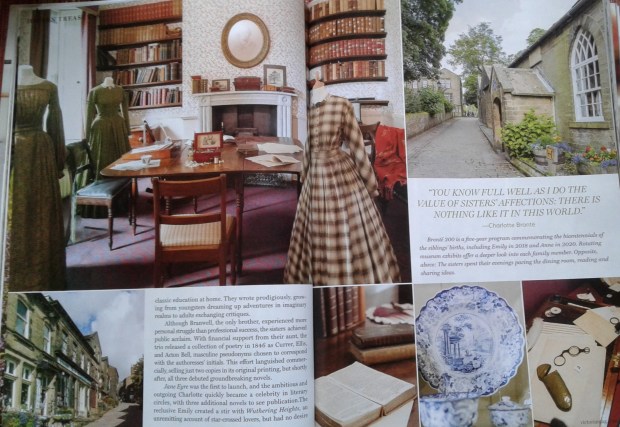
The magazine article mentioned the 2017 PBS movie, To Walk Invisible, the story of the Bronte’s, which I watched and was somewhat disappointed in, although it is certainly worthwhile for any Bronte fan. In truth I found the movie as dark and dreary as the moors must be on an overcast winter’s day. There did not seem to be much joy in that household, but maybe I am confusing their rather bleak existence with that of the moors.
I thought Charlotte and Anne well-cast, Emily miscast, and Branwell just plain annoying. The movie ends with them walking on the moors after Branwell’s death, so it is not as depressing as if they had ended it later after they had all died. But then their story is not a happy one. I wonder if they would have traded their fame for more happiness and a longer life.
This year is the bicentenary of Emily’s birth in 1818. Here is Emily’s small and cozy room with a wonderful window view, as befitting a genius at work.
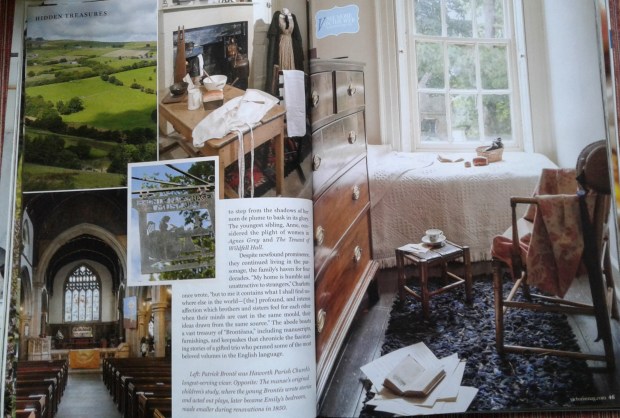
Emily remains the most puzzling one, so reclusive, yet the creator of such a stormy and passionate tale. No doubt she drew inspiration from her beloved moors but perhaps it’s very wildness was a reaction to their isolated existence. She had a lot of time to think and imagine. Her novel was considered dark and disturbing and somewhat shocking at the time, while Charlotte’s more conservative Jane Eyre was the more popular. In the movie there was a scene where Emily was talking about where she got the idea for Wuthering Heights, but she spoke so quickly I could not follow, and I have since tried to research it to no avail. Although googling did reveal plenty of theories about Asperger’s syndrome, as it seems popular these days to slap anyone the least bit anti-social with that label (think Doc Marten). There are plenty of books about Charlotte, (see postscript), but not so many about Emily or Anne (who I think of as the forgotten middle child). After seeing disheveled, weak, whiny immature Branwell it seems unlikely he could have been the muse for such a strong character as Heathcliff. (But would any sane woman want a Heathcliff in real life? All that anger and rage and jealousy just creates a whole lot of drama and angst, and wasn’t he a bit too possessive? Somewhat stalkerish? Better to marry someone more stable and level-headed if you want a happy home life, but I suppose if a wild passionate affair is your aim, then Heathcliff is your man).
The movie contained nothing new, if you have already read such bio’s before, including the usual dose of family dynamics. The ending was well done, three bright suns who were expected to dim their literary lights and walk invisible, in order to prevent embarrassment for the male heir of whom much had been expected, but little produced. As for the issue of addiction so rampant in our modern world, that too is an age old question. Their clergyman father could not decide whether to give in and supply his feckless son with drinking/opium money or just say no – the parent’s universal dilemma, to be an enabler or an enforcer of tough love? In the end, it didn’t matter anyway – TB won out. Tuberculosis caused by a drafty old parsonage and those windblown moors. Unfortunately, he took his two sisters with him.
I have to admit the part I found most disappointing in the movie was the cinematography of the moors. They must have filmed the outdoor scenes in winter for there was no heather to be seen, just a bleak and brown landscape and overcast skies. Perhaps they didn’t have a choice, or more likely they wanted that gloomy depressing atmosphere, for it all looked as dull and dreary as a November day.
Now that we are in late November, the weather has grown chilly and darkness descends early, and tonight the winds are howling and there is sleet against the windowpane. The perfect night to settle in by the fire with a cup of tea, and re-read Wuthering Heights, Emily Bronte’s masterpiece. Although, I noticed that her name is not even on the cover of my 1984 copy, one of those classic editions with the fancy gold edging that are hard to find anymore.

I must confess, it has been a long time since that high school book report, and I cannot recall much of the story, other than it was a sad tale with a layered multi-generational plot. But I do remember the descriptive imagery of those famous windswept moors, and the tragic ending of Cathy and Heathcliff, two star-crossed lovers who were never meant to be, but who remain immortalized forever between a marble and gilt cover.
Postscript: Most likely Charlotte, Anne or Emily never dreamt at the time that their books would still be bestsellers over 150 years later. I wonder how those classics would fit into the Best Seller Code, which I will be blogging about next week.
Postscript: A goodreads review of Charlotte Bronte: A Fiery Heart
 Charlotte Brontë: A Fiery Heart by Claire Harman
My rating: 4 of 5 stars
This latest 2016 biography of Charlotte Bronte is well worth the read, even if I do wonder why Charlotte always gets all the attention. I enjoyed it so much, I bought a bargain bin copy. A good choice for fans, both old and new.

Bronte Country


 The last tractor my dad bought came equipped with air conditioning and a few years after he died, they had CD players, now they are steering themselves. While farming may be mostly mechanized now, organic vegetable farming is still labor intensive, especially during the harvest. It’s not a job many people want to do, and often the farmers must hire seasonal workers from Mexico or Jamaica to help out.















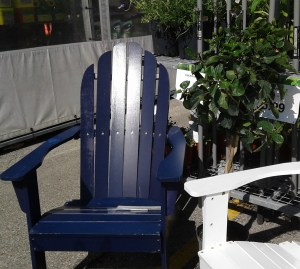
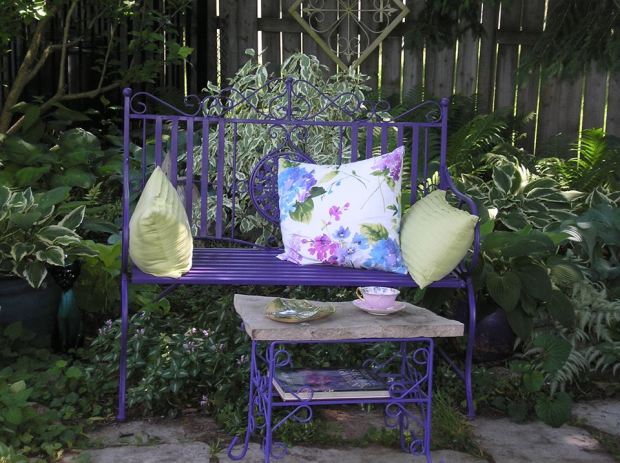 While purple and green are not colors that I would ever have thought of for a garden bench, the combination was eye-catching, and I believe the homeowner was ahead of the trend, or maybe I was two years behind as usual. It wasn’t something I thought would work in my predominately pink garden, but I did steal their idea for the birdcage with the ivy flowing from it.
  (Check Michael’s end of summer sale for birdcage bargains). My ivy did not fare as well being exposed to too much sun, so this year I tried wave petunias which also did not do well either in the small space. Maybe next year a fake ivy plant from the thrift store? Would anyone notice?


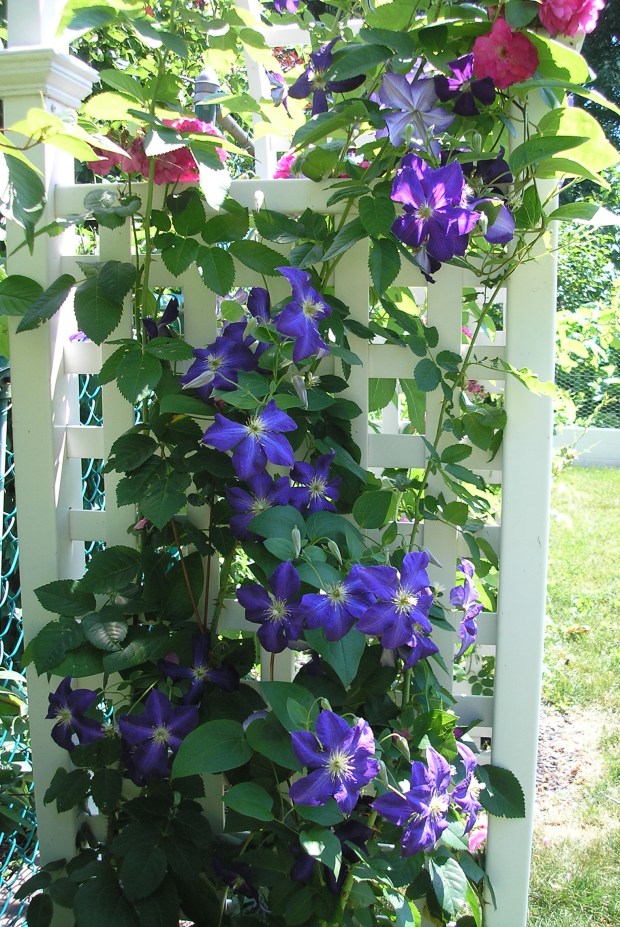

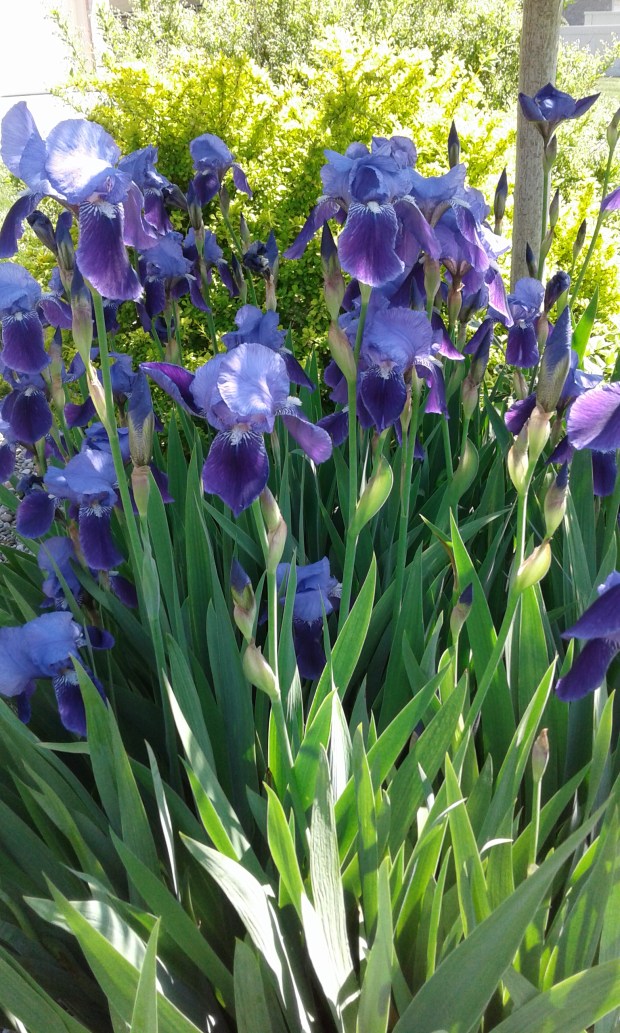
 It can be a mixture of both dark and lighter shades as in this Purple Iris belonging to a neighbor. I bought two clumps of this at the horticultural plant sale in May anticipating next spring.
  Or it can be a pale lavender shade as in this Russian Sage,
  and Rose of Sharon.
 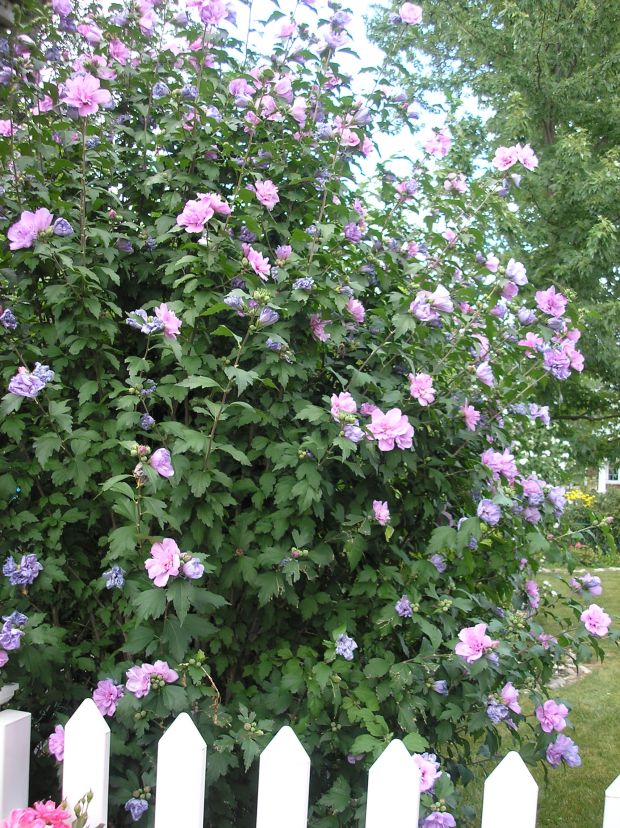 The Russian sage has been in for five years now and is thriving at over three feet tall. It is drought resistant. The Rose of Sharon, eight years old and covered with blooms every year, was another wise choice.


 Then there were the mistakes. Not every shade of purple is attractive. These foxglove seedlings from the farmer’s market came up a fuchsia color I did not care for at all as I was expecting a rosy pink.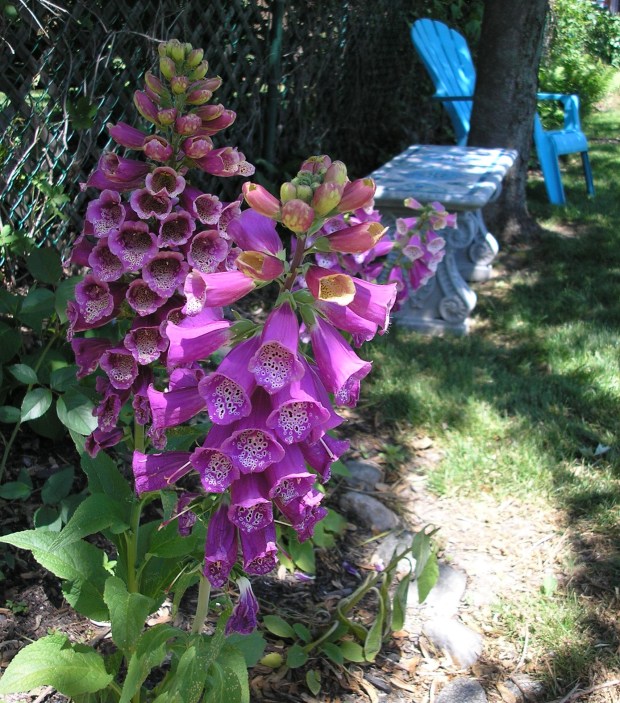
 lovely in it’s own way but clashing with the bubblegum pink of the rose bush beside it. It’s unfortunate these two fuchsia friends could not be together but one is in the side yard and one at the back. Some days I swear I will never buy anything again unless it is in flower and able to speak the truth.
  I suspect the rabbits who lounge in my backyard in the evenings have been munching them for desert. (They were upset because they couldn’t get at all those glorious carrots in
 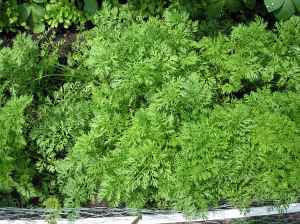 I was pleasantly surprised to see how much purple I actually have in my garden, but as every gardener knows there is always room for more and that neglected corner was telling me to buy a purple clematis to go with the lime green cart, and to think it all started with a garden tour…..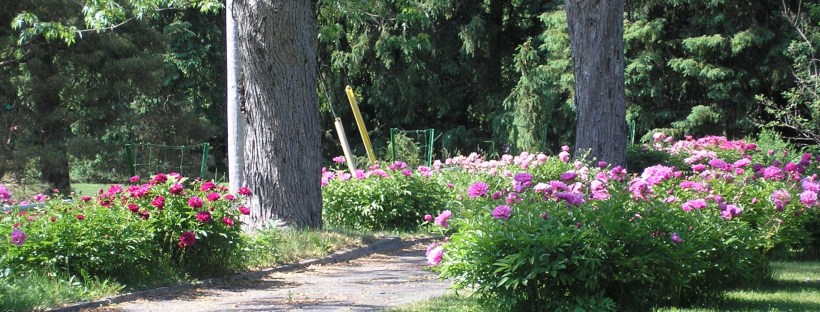

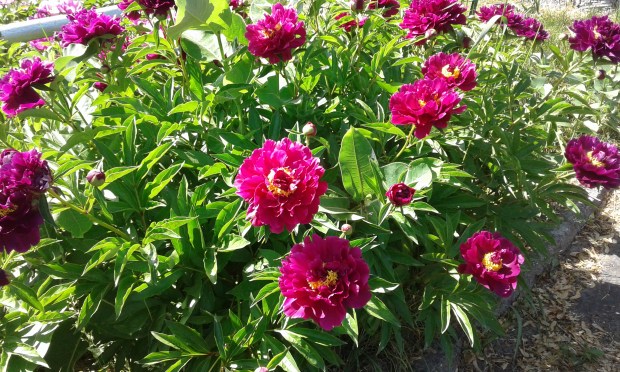

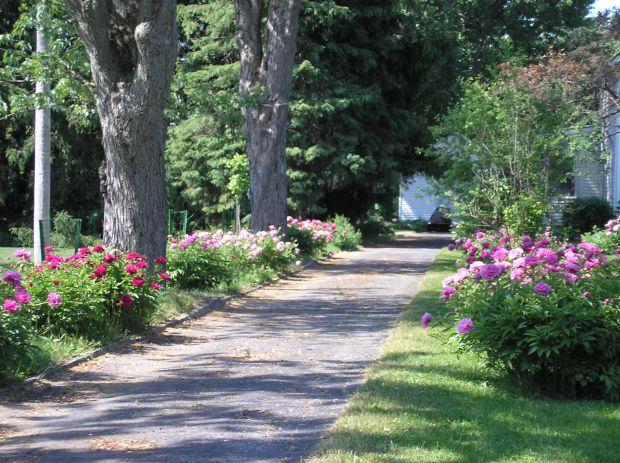 The house was on the outskirts of a small town, which must have been farmland at one time due to it’s deep lot and wide expanse of front lawn. Being a novice gardener and knowing next to nothing about flowers, one day I decided to stop and inquire what kind of shrubs they were.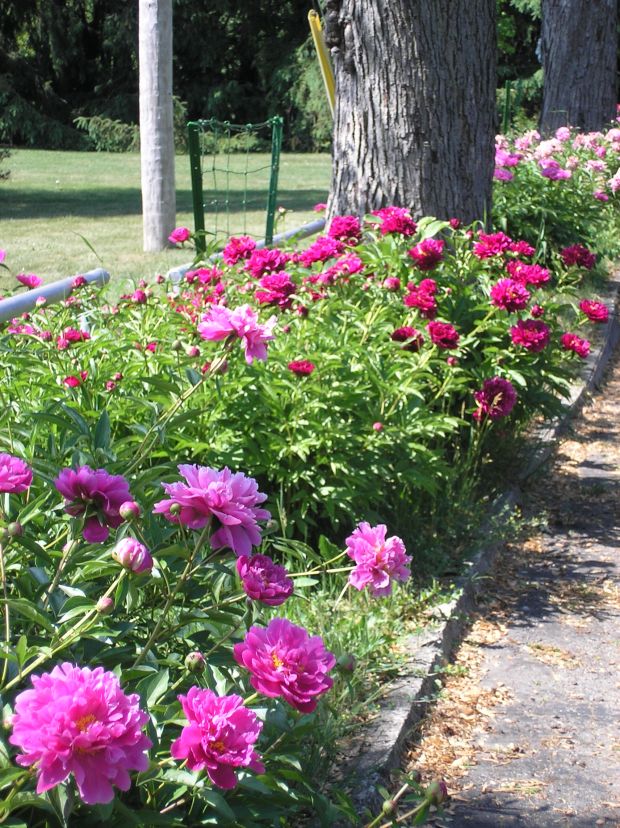

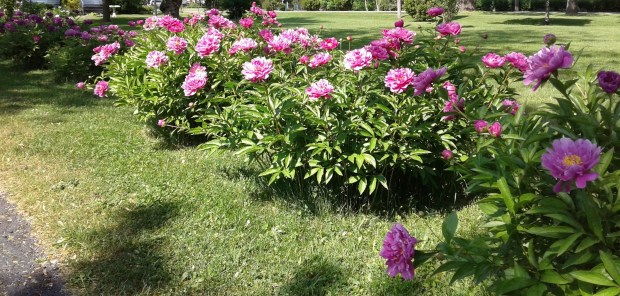 I never went back in the fall to dig them up, but the next time I was at a nearby nursery I asked the owner for some peony bushes just like Mr. Peony Lane’s. She was familiar with the house, so I requested one medium pink and one darker one, expecting to wake up to a riot of color in the spring.

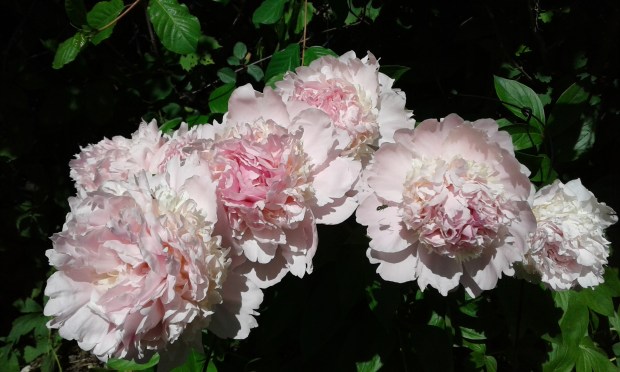
 Postscript: Should you wish to take a walk down peony lane, the video below was taken this past June while driving through the town. (It is my first time posting video so it may or may not work, so I posted lots of pretty pictures). Lest you think I am the kind of person who randomly invades other peoples property, I only ventured a short distance up the lane and tried to focus on the bushes using the zoom lens. I considered knocking on the door, but my initial visit was ten years ago, and I wasn’t sure the elderly man still lived there, plus I had my mother in the car who was tired from an afternoon out. It was a lovely early June day, sunny and warm but with a nice breeze, the kind of day you wish would stay all year. It was cool under the shade of those giant trees – peonies like sun, but will tolerate light shade – a perfect vista of a summer day. Maybe next fall, I will take a shovel and go back….


 which almost always put on a glorious show, although they can be very late in the year, (see








 but the squirrels have great fun transplanting them and they eventually end up lonely as a cloud.


