March has always been a crazy month – volatile, unpredictable, kind of like the stock market at the moment. You can expect snow, sleet, rain, howling winds, warm breezes, sunny days, gray skies or all of the above. Despite the Rodent and Company’s optimistic predictions for an early spring we have not had very many warm days and the few we did have were overcast. In fact March came in like a lion with a big snowstorm, so hopefully it will go out like a lamb. (It did not….3 C – 37 F today).
Thankfully, the snow melted quickly, like the wicked witch of the west – revealing snow drops a few days later.
I have a lovely view from my kitchen window as my neighbor has about ten clumps of them scattered around the base of an old tree, like a little fairy woodland.
The daffodil shoots were up the first week, growing by leaps and bounds.
Our imaginations can leap forward to this vista of sunny yellow.
On St. Patrick’s Day we had grocery shelves reminiscent of the great Potato Famine,
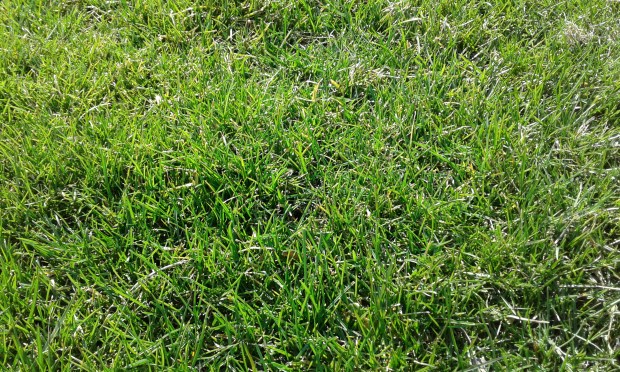
but a spring rain changed the grass to Shamrock green overnight,
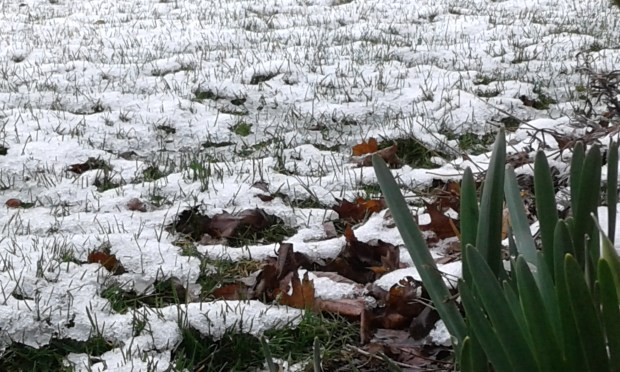
which was then covered up by more snow on March 23….ugh….
This is Spring?
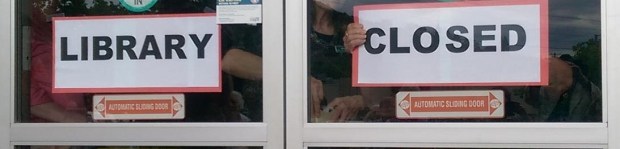
The library might be closed due to COVID-19,
but the crocuses in front of it were open for business.
The robins were back,
and the tundra swans crossed the border early because our Prime Minister had ordered all international travelers home!
They winter in Chesapeake Bay and rest at the Thedford Bog, an Ontario marshland, before flying on to their breeding grounds in the Arctic.
The March winds were brisk and perfect for kite flying. There were rare sightings of children in the park trying this ancient activity, well their dad was trying. They looked too young and seemed more interested in examining the ground as toddlers like to do, while the dad was busy untangling the string. (No picture as he couldn’t get it airborne).
“Airborne” by Joni’s mom
I’ve never seen so many people out walking before, entire families have taken up the joy of exercise and their dogs are happy too. I met Millie a Golden Retriever puppy who was ecstatic at being in The Great Outdoors, but at 12 weeks soon tired of walking and had to be carried home.
We might be out of bread and soup,
but they will return, just like these old faithful perennials.
These dandelions need to practice social distancing….
On March 25, there was finally a day warm enough to sit on the front porch, sheltered from the wind, with a magazine and a mug of tea. It’s so nice to feel the sun on your face after a long cold lonely winter (the Beatles).
While the stores and restaurants may be closed and the grocery shelves empty, we can replenish our souls with nature and rejoice! May the Gods of Spring place a pox on COVID-19!
PS. As other people have observed, this crisis may be the Earth’s way of healing from all the climate change, by calling a time out – a message from Mother Nature.
One of the few things I miss about work is that the daily commute guaranteed me an hour of music every day, half an hour in the morning to rev up and half an hour after to wind down. As I drove along a rural highway with no stop signs I could set the car to auto-pilot and zone out. Now the only dose of music I get is my on my I-Pod if and when I walk – not a good track record so far this year although I enjoy it if I do. My playlist might be classical, big band, oldies but goodies, 60/70/80’s, country, or musicals but that small dose of music always lifts my spirits. If I’m in the car running errands I don’t even turn the radio on as I don’t like much of what’s played. I have an older model Honda, so no Apple Car Play or Sirius, nor do I Spotify, stream or bark instructions to Alexa at home. I guess I’ve gotten out of the habit of listening to music.
While cleaning out the basement this past winter I came across a stack of old records, which I searched through recently for a copy of Tapestry by Carole King – there was a tribute show at the theater which had sold out. Every teenage girl in the 70’s owned this record, but it must have belonged to my sister with whom I shared a room growing up (although there was a line dividing said room), as no copy was to be found.
Included in this treasure trove of oldies but goodies are three albums dating from the fifties which belonged to my mother.When I say albums, this is what I mean,
leather bound books with sleeves containing individual 78’s. For those of you unfamiliar, 78’s were the old thick breakable records which only held one song. There was an A side and a less popular B side. Looking through them, I remember a few of the songs, but I have no idea if they are worth anything now or even what to do with them.
78’s were eventually replaced by 45’s (smaller versions with one song and a plastic thing which fit the hole in the middle), and 33 LP’s which were the extended play albums with many songs which the boomers may remember growing up. While I’ve been on a few Is-Your-Record-Worth-Anything sites, they all want you to register and list and describe your gems which must be in pristine condition. My memory of these is that they were worn and scratchy even then – they certainly look well-used.
I thought I might listen to a few for old times sake, as I still have one of those Sears Record/Tape/CD combo units in the basement somewhere, but apparently you can ruin the stylus on a 33 record player by playing an old 78. I’m also somewhat ashamed to admit that my Pioneer turntable and speakers from university is down there too. My parents bought it for me in second year as they had bought one for my older sister, but I had 32 hours of classes and labs and was hardly ever in my room other than to sleep and study. The Pioneer set-up cost a pretty penny back then, roughly the same price as tuition I recall. Some years ago I had some interest in it from a younger colleague whose hobby was frequenting record-stores – in retrospect I should have sold it to him, as there it sits in the original boxes taking up space, large speakers and all.
I promised JP, a fellow blogger (link to JP’s blog) that I would report on my basement findings, so here goes. Now I should mention that JP is a jazz/music expert, as well as being a lawyer and a contrarian (his words). The Button Up Your Overcoat song on my recent coat blog, served as the muse for his post on the many recordings of that song from 1929 to the present day. Although I’m not much of a jazz person, I particularly enjoy JP’s dry sense of humor. His posts Dear Queen Elizabeth, in which he writes a letter to the Queen suggesting that he and his Mrs. change places with Harry and Megan, No Fair, in which he once again fails to attend his state fair despite living a few miles away, and the brilliantly written Quitting the Newspaper, a step by step guide to cancelling a subscription, are among the funniest I’ve ever read. As we all need more humor and music in this time of COVID craziness, be sure to check out his blog.
No pressure, JP – I don’t think any of these ancient relics are jazz – except maybe Baubles, Bangles and Beads (Side A) and Somebody Bad Stole Da Wedding Bell (Side B).
Although I’ve never heard of Georgia Gibbs, I vaguely remember this song, so it must have been one of the ones we played a lot, plus it looks quite beat up.
There’s some Gene Autry – Have I Told You Lately That I Love You/Someday You’ll Want Me to Want you, and of course Rudolph the Red-Nosed Reindeer/If It Doesn’t Snow on Christmas. These were so popular, they can hardly be worth anything, kind of like Michael Jackson’s Thriller – everyone had them. Many copies means less money, honey.
Then there’s old Bing. Silver Bells/That Christmas Feeling, Silent Night/Adeste Fideles/Oh Come All Ye Faithful, and Dear Hearts and Gentle People/Mule Train, from a movie soundtrack, Chattanoogie Shoeshine Boy/Bibbidi-Bobbii-Bo – was that from Cinderella?
And of course, Bing reminds me of Rosemary Clooney. I always loved her in White Christmas, but the best we can do is This Ole House – something which would have come in handy when I was renovating. Hey There is on the flip side.
Tennessee Waltz, but alas not by the popular Patti Page, but by Jimmie and Leon Short. Long Gone Daddy is on the B side.
Burl Ives – Blue Tail Fly and I’m Going Down the Road and other side Big Rock Candy Mountain, again from a musical Sing Out Sweet Land. I only know Burl Ives from his Christmas classics.
I do remember I’ve Got a Lovely Bunch of Coconuts, (Fred Heatherton), but my version was from a seedy bar, The Brunswick, which we would occasionally frequent near campus. Beer was 50 cents in the more upscale upstairs and the downstairs entertainment by one of the regular patrons dressed in a long grass skirt, was well – best not described but you can imagine from the lyrics, and this was long before the days of karaoke.
Here’s another one I remember, the alphabet song, A – Your Adorable – Perry Como, When is Sometime on B side.
That’s it for what I recognize. The rest are: Old Shep/My Queen of Prairies, The Life and Death of John Dillinger/Awaiting the Chair (both Wilf Carter), The Cry of the Wild Goose/The Donkey Serenade (Tennessee Ernie), Riders in the Sky/Single Saddle (Vaughn Monroes), Soldiers Joy/Flowers of Edinburg (Don Messier), Anniversary Song (Larry Douglas), Peg of My Heart (Floyd Sherman), Deck of Cards/Somebody Else Not me (Phil Harris), Bouquet of Roses/Texarkana Baby (Eddy Arnold), Cruising Down the River/Sunflower (Russ Morgan). There’s A Bluebird on your Windowsill (Elizabeth Clark). Blue Skirtz Waltz/Charlie was a Boxer (Frankie Yankoose and his Yanks). Many of these are backed by orchestras, and others sound like country and western, but I don’t remember my parents listening to much C&W, well not until Kenny Rogers. My mother has no recollection of any of these. They didn’t have much money in their early married years, so perhaps these were bargain bin finds or one hit wonders. She does remember watching Hit Parade on Saturdays nights, and there is one record that just says Popular Hit Parade – Go On With the Wedding/Lullaby of Birdland and Why Do Fools Fall in Love/Chain Gang, with no singer’s name. I find it odd that none of the records are dated, although many of them were minted in Canada, often Montreal, and certainly there are no album covers to provide clues as they are stored in individual sleeves.
I do remember most of the children’s music, probably because I was not yet in school but in charge of keeping my younger brother entertained. I have a vague memory of these being played on a small portable record player which even a young child could operate. Later when in the 60’s we had a tabletop record player with built-in speakers, and later still one of those big wooden stereo cabinets with an 8 track player.
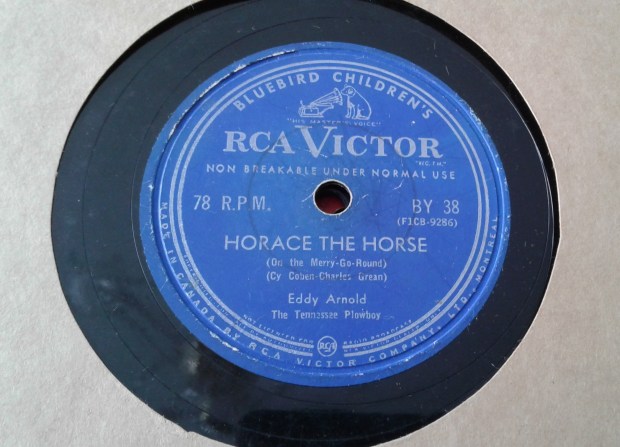
Horace the Horse was always fun, as it’s all about perspective folks. Poor Horace was sad that he was the last horse on the merry-go-round, but when he turned around, he saw he was actually the first! (link to song)
Pete Petersen’s House, was also a favorite – I remember it as a fast-paced tune. Did You ever See a Lassie, On Top of Old Smokey, Oh Susanna, Clementine – the names alone bring back a flood of memories.
Cue forward to the 60’s and the first album I bought with my own money – Oliver – I wore that record out. Music musicals were big that decade.
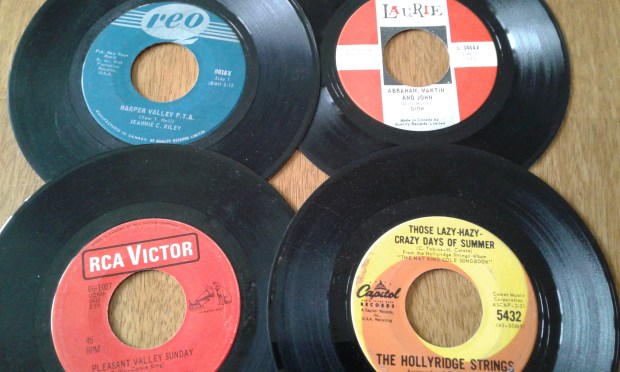
We bought 45’s as they were cheaper, and you didn’t get stuck with a bunch of filler songs you didn’t like. Black Velvet Band – Irish Rovers. This Guy’s in Love – Herb Albert. Harper Valley PTA (the lyrics were considered scandalous). Pleasant Valley Sunday – the Monkees. Abraham, Martin and John (my grade 8 teacher was a hippy and music was her poetry).
My parents listened to adult contemporary:
And who can forget the old Christmas albums, Andy Williams and Sing along with Mitch which came on Saturday nights.
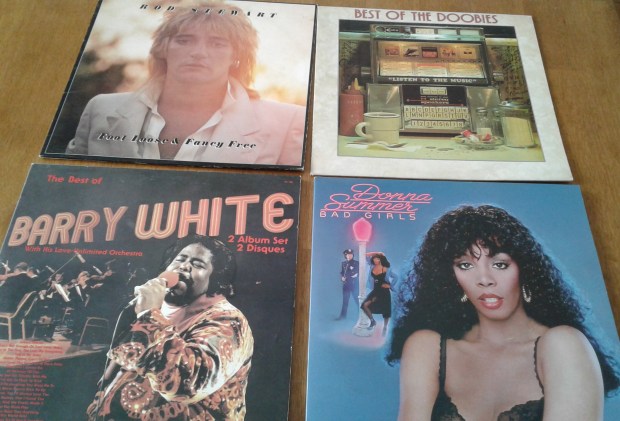
Then came the 70’s and the Cadillac of Stereo Systems which was the envy of all my dorm-mates. On Friday nights if we stayed in we might break out any of these, but more likely they were played during the getting-ready-to-go-out part of the evening.
The 70’s decade started with Rod Stewart and ended with disco.
Thriller was probably the last album I bought.
I know these are worth anything, as visit any record store and there are tons of them. We’ll have to wait another 100 years, I guess.
By the mid-80’s tapes and Sony Walkmans were in and yes, they’re still down there too, along with a box of CD’s. The question is what do I do with all this old stuff that nobody wants? I know I could advertise them online but I try to avoid those Kijiji-like sites ever since that poor man got murdered here trying to sell his truck, and now with social distancing and all. So back down to the basement they all go. In the meantime, this post has reminded me that I need to have more music in my life – “Girl put your records on, tell me your favorite song….”
In view of the current fears about the spread of coronavirus COVD-19 this month’s literary salon will feature a New York times bestseller first published in 2014, The Great Influenza, by John M. Barry. The Spanish Flu pandemic of 1918-19 was first recorded in army training camps in the US in the spring of 1918, spread to Europe with the mobilization of the troops and eventually infected about one-third of the world’s population, killing an estimated 17-50 million people worldwide (mortality rate 2-3%), more than the number who died in the war. While most patients will likely get a mild version of COVID-19 and recover quickly, when you think about the 2-3% mortality rate, the implications are staggering considering how many more people there are in the world today. For more about the 1918 pandemic see Wikipedia link and CDC link.
At the height of WWI, history’s most lethal influenza virus erupted in an army camp in Kansas, moved east with American troops, then exploded, killing as many as 100 million people worldwide. It killed more people in twenty-four months than AIDS killed in twenty-four years, more in a year than the Black Death killed in a century. But this was not the Middle Ages, and 1918 marked the first collision of science and epidemic disease. Magisterial in its breadth of perspective and depth of research and now revised to reflect the growing danger of the avian flu, The Great Influenza is ultimately a tale of triumph amid tragedy, which provides us with a precise and sobering model as we confront the epidemics looming on our own horizon. John M. Barry has written a new afterword for this edition that brings us up to speed on the terrible threat of the avian flu and suggest ways in which we might head off another flu pandemic.
About the Author:
John M. Barry is a prize-winning and bestselling author and noted historian with such an extensive C.V. that I scarcely know how to summarize it. Here’s a link to his website –link.
Observations:
My interest in reading this book in 2014 was sparked by the 100th anniversary of WW1. I was preparing some information for a museum display of the Great War and came across this postcard of a hospital among my great uncle’s war memorabilia.
This eventually led to a blog where I traced his journey from Canada to Britain, France and Germany and back again. Uncle Charlie had caught the Spanish flu in 1919 and was six months recuperating in a British convalescent home before he was well enough to be sent home. His prolonged illness was most likely complicated by being gassed in the war, as those with bad lungs always seem to suffer the most with influenza once it enters the respiratory phase.
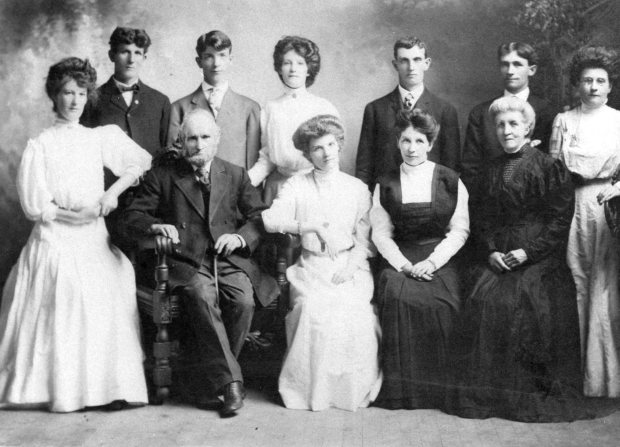
John and Ellen Family Portrait – 1912
As well I had a great aunt, Jenny, (the girl in the middle front row beside her father), who died of the Spanish flu, leaving behind two young children and a grieving husband so angry at God he never darkened the door of a church again. Jenny’s name is engraved on the bell of the parish church as she was one of the young girls who helped to raise the most money for it’s installation.
Having been stricken with the H1N1/swine flu myself in the fall of 2009, one week before the vaccine was available, I am grateful to be retired now. Certainly it was the sickest I’ve ever been in my life, for the longest. Two weeks of misery, off work, followed by four weeks of weakness, while working, although never in any danger of dying despite some SOB, and I do remember exactly the middle aged woman who coughed all over me, as she was wearing flannel PJ’s. I worked one block from a busy ER so we saw a steady stream of patients in for the antiviral Tamiflu,which was provided free by the government, and when the drug company ran out of the suspension for kids we made it from scratch just like in the old days. It annoyed me greatly that I, the Queen of Hand Sanitizers, was the only person in my workplace who came down with it, me and one ER doctor, but H1N1, like the 1918 flu, seemed to strike younger healthy people and could in a perfect cytokine storm (inflammatory overreaction of the immune system) sometimes lead to multi-organ failure. Of course we had antibiotics and ventilators to treat the respiratory complications unlike in 1918. And then there was SARS in 2004, with all of those unnecessary deaths in Toronto as the health care system did not even know what they were dealing with until it was too late.
While I don’t remember the specifics of this book, as it was six long years and many books ago, I do remember it was a fascinating read, but then I’m always up for a good non-fiction book. Of course I may be biased, but you don’t have to have a medical background to enjoy it as it was written for the average lay person. It was evident the author was a noted historian as the book was meticulously researched and presented. It won the National Academies of Science award for the year’s outstanding book on science or medicine and is a highly recommended read, whatever your reasons for wanting to know more about pandemics.
At any rate it might be something interesting to read from a historical point of view, while we are all encouraged to shelter in place. (As all the libraries are now closed here for three weeks, I note that both Amazon (book and kindle version) and the bookoutlet site have it for half price).
I remember thinking at the time well if we do have another pandemic, we’ll be better prepared….and of course we are in some ways, but here we are again, a hundred years later, the best of modern medicine facing off against another smart wily little virus. May science and cool heads prevail. Stay in and stay safe!
My great-great grandparents Patrick and Mary and five of their six children, immigrated from Ireland in 1846 during the Potato Famine. I’ve blogged previously about my Irish roots and a visit to an Irish Graveyard, but today’s post will be about a letter from Ireland.
Patrick and Mary – tintype picture
They came in a party of twenty or more but lost three relatives from typhus on the way over. While in the quarantine station, more of the passengers started to get sick so they decided to jump ship, losing one teenage son in the Quebec bush in the process, who was never found. They later traced him to northern Ontario, but he had moved out west before they could get word to him.
John and Ellen Family Portrait – 1912
Their 14-year-old son John (my great grandfather in his old age, sitting in the chair) had stayed behind because he had the chance to go to school with the overseer’s son, an opportunity too good to pass up. He came two years later through New York and an uncle was sent to pick him up. A family story tells of the letter that was sent from Ireland about his expected arrival.
In the spring of 1847, their second year, a surveyor came through the woods and inquired who they were. He informed them there was a letter for them at a post office near the river, presumably word of where and when their son John was to arrive. Mary, reportedly a tall robust woman, set out walking to collect it. The country was all wilderness then, with no roads, just a blazed trail with trees felled across the swampy areas to walk across. When she got to the post office six miles away, they told her they had sent it on to another hamlet four miles south, so she walked along the river trail to that post office, where they told her that they hadn’t known of any settlers with that name, so they had forwarded it to a larger port to the north. Mary walked along the river to that town and finally got the letter, although it’s unlikely she could read it as she signed the land deed with an X. It began to get dark and Patrick became worried that she had not returned home. He set out along the trail and encountered her carrying a big sack of flour on her head which she had purchased in town. All told she had walked over thirty miles to get the letter! Having already lost one son in the bush, she must have been overjoyed when John finally arrived safe and sound.
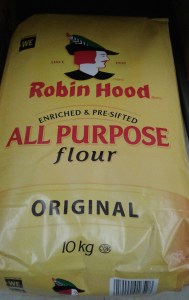
While admiring Mary’s strength and determination to be reunited with her son, what has always struck me about this tale is the sack of flour. In my uncle’s genealogy notes, he writes it was a fifty pound bag, surely an exaggeration as when I tried to hoist a 25lb bag at the grocery store I could barely budge it off the bottom shelf.
10kg = 25 lbs
Admittedly, I am neither robust nor strong, but Mary in the photo above doesn’t exactly look like an Amazon woman either, so I assume that must have been a wee bit of blarney!
In the early days when the land was sparsely populated, grist mills were few and far between. They were usually located on the banks of a fast flowing river or stream and and powered by a water wheel. I took this picture of a flour mill display at a history museum last summer.
Note the cotton flour bags and the heavy grist-stone.
While large grist-stones were associated with commercial mills, many farms had their own smaller grindstones for grain or sharpening instruments. (My brother kept ours from the farm). Once settlers had harvested their grain, they then had to grind it by hand using a mortar and a pestle or a pair of grindstones placed on top of one another, both time consuming methods.
So for Mary to be able to buy a bag of ground flour at a mill in town must have seemed the height of luxury, an endeavor well worth the effort involved in lugging it home. When we toss butter, milk, eggs and flour into our grocery cart, we forget how much of our ancestors time was spend just obtaining the simple necessities of life, although I do sometimes think about this family story when I pull out the flour from my pantry to do some baking.
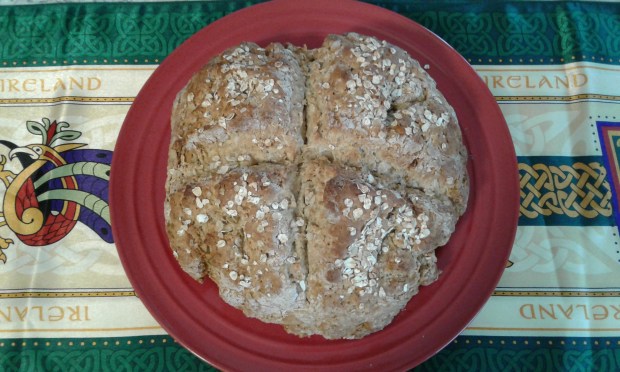
Today we’re going to make Irish soda bread. There are many versions of this bread, some are more scone-like with white flour, sugar and raisins, and some are like the denser darker brown bread traditionally served with orange marmalade at breakfast, but I’m going to experiment with something in between. As I’ve never made any kind of bread before, wish me the luck of the Irish.
Irish soda bread was popular in Ireland as it could be baked in a covered skillet over the fireplace, and did not require an oven or yeast like more traditional breads. It relies on the chemical reaction between the sour milk/buttermilk and the baking soda instead of yeast. Here’s the recipe.
Ingredients:
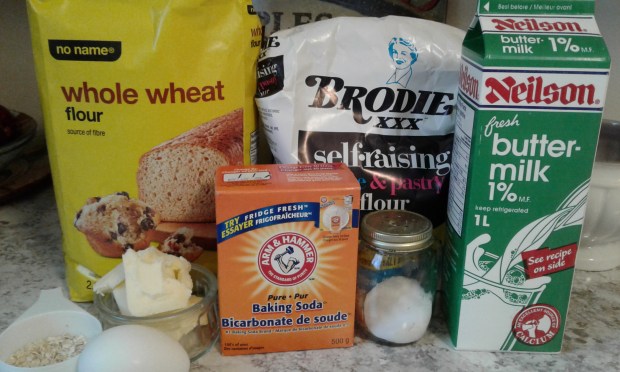
1 3/4 cups whole wheat flour
1 3/4 cups all-purpose white flour
1 teaspoon salt
1 (level) teaspoon baking soda
2 tablespoons cold butter, cubed
1 egg
1 2/3 cups buttermilk
1 tablespoon oats
I made one small change – as I only had self-rising white flour with the salt and baking POWDER already added, I cut the salt back to 1/2 tsp. The baking powder didn’t make any difference, it just made it rise a bit more.
Instructions:
Heat the oven to 425°F (215°C). Mix together the flours, salt and baking soda in a large bowl. (NB: make sure the baking soda is a LEVEL teaspoon otherwise the bread may taste funny and/or turn green!)
Add the butter and rub into the flour mixture with your fingertips until it resembles bread crumbs. (I did not take a picture here, as my hands were too messy. Those food network divas must have their own photographers!)
In a separate measuring jug, whisk the egg and buttermilk together. The egg is optional but makes the batter richer so I added it. Pour 3/4 of the liquid into the centre of the dry ingredients.
Using your hands mix the flour and liquid together to form a loose dough. The dough should be soft, but not too sticky. Add more of the liquid as needed, but try not to overwork it.
Turn onto a floured work surface and bring the dough together into a round shape about 1 1/2 inches thick. (Again, no pictures but I used my new glass kitchen board, new as in found in the basement cleanup. For someone who doesn’t cook that much I seem to have a lot of kitchen stuff).
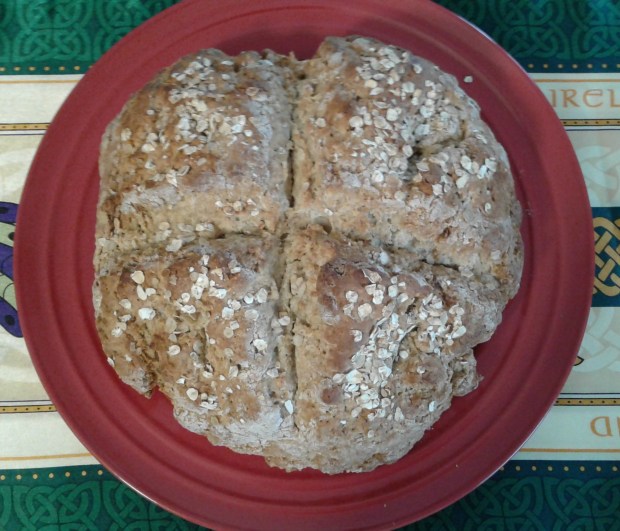
Place formed loaf on a baking sheet dusted with flour. Brush a bit of the left over liquid on the top of the bread and then sprinkle the rolled oats on the top. This gives it a nice rustic-looking appearance.
Now for the most important part. Using a sharp knife, score the bread by blessing it with a deep cross on top. Then poke a hole in the four quarters of the bread to release the fairies and stop them from cursing your bread. Do not skip this last step, unless you wish to incur their wrath!
Bake for 15 minutes at 425 F in order to give it a nice crisp crust, then turn down the oven to 400 F and bake for 30 minutes more. When done the loaf will sound slightly hollow when tapped on the bottom. Remove from the baking sheet and cool on a wire rack.
As I’ve never made anything with buttermilk or whole wheat flour before I have nothing to compare it too, but I was very pleased with the way the bread turned out – the rustic taste, appearance and ease of preparation – and would definitely make it again. I was especially keen on the part about the blessing and the fairies as I like a bit of folklore with my baking.
Serve warm slathered with some chilled fresh butter and enjoy! Goes great with potato soup, but we’ll save that for next year, as we’re already over 1400 words. (It was nice the next day too, served with jam).
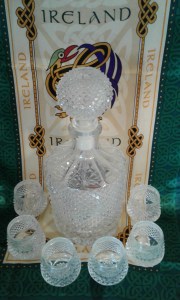
Now, we’ll have a wee small toast to John, using his own crystal decanter and glasses. I think he’d like that it’s whiskey imported straight from his old homeplace, Leitrim County.
Maybe another thimble or two…
I should clean out the basement more often….
For those who don’t drink, I experimented with this no-alcohol low-calorie version of an Irish Coffee, adding an ounce of Skinny Syrup, Irish Cream flavor, to a mug of hot coffee and topping with a squirt of low-fat whipped cream from a can. Magically delicious!











 Thriller was probably the last album I bought.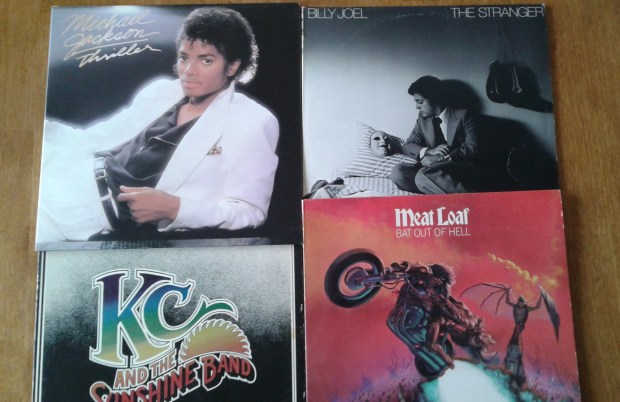





 Note the cotton flour bags and the heavy grist-stone.

 Add the butter and rub into the flour mixture with your fingertips until it resembles bread crumbs. (I did not take a picture here, as my hands were too messy. Those food network divas must have their own photographers!)







 thehomeplaceweb