Imagine being stuck inside, in a small space, for two years, where going out meant risking your life. No, it’s not the pandemic – it’s WW2, and the people in hiding are Jewish.
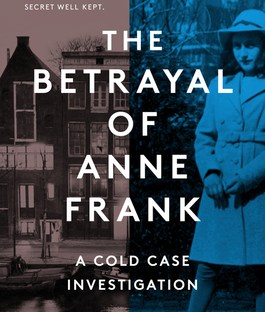
Like many teenage girls of my generation, I read The Diary of Anne Frank, written by a fifteen-year-old Jewish girl in Amsterdam, when I was in grade school. So when I saw The Betrayal of Anne Frank – a Cold Case Investigation by Rosemary Sullivan – on the new releases list, I knew I had to read it, and having read it, I knew I needed to blog about it. The book is a captivating read, and a cautionary one. It’s a timely topic, as with so much political turmoil in the world today, and so much divisiveness and hatred, it seems like history is repeating itself.

Goodreads Publishers Blurb:
Using new technology, recently discovered documents and sophisticated investigative techniques, an international team—led by an obsessed former FBI agent—has finally solved the mystery that has haunted generations since World War II: Who betrayed Anne Frank and her family? And why?
Over thirty million people have read The Diary of a Young Girl, the journal teen-aged Anne Frank kept while living in an attic with her family in Amsterdam during World War II, until the Nazis arrested them and sent Anne to her death in a concentration camp. But despite the many works—journalism, books, plays and novels—devoted to Anne’s story, none has ever conclusively explained how the Franks and four other people managed to live in hiding undetected for over two years—and who or what finally brought the Nazis to their door.
With painstaking care, former FBI agent Vincent Pankoke and a team of indefatigable investigators pored over tens of thousands of pages of documents—some never-before-seen—and interviewed scores of descendants of people involved, both Nazi sympathizers and resisters, familiar with the Franks. Utilizing methods developed by the FBI, the Cold Case Team painstakingly pieced together the months leading to the Franks’ arrest—and came to a shocking conclusion.
The Betrayal of Anne Frank is their riveting story. Rosemary Sullivan introduces us to the investigators, explains the behavior of both the captives and their captors and profiles a group of suspects. All the while, she vividly brings to life wartime Amsterdam: a place where no matter how wealthy, educated, or careful you were, you never knew whom you could trust.
The Author: Rosemary Sullivan is the author of fifteen books, many of which are biographies, and the recipient of many international awards. She is a professor emeritus at the University of Toronto and has lectured worldwide.
Discussion:
I found this book to be a fascinating but disturbing read. Cold cases are always interesting, but a famous cold case which is part of history, even more so, and trying to solve one seventy-five years later when all of the suspects are dead, almost impossible.
Part One, the first hundred or so pages, deals with the background story. For those unfamiliar, Anne Frank and her parents and older sister, along with another Jewish couple and their teenage son, and a local dentist – eight people in total – were hidden for two years in the upper annex of her father’s spice business, with the assistance of four of Otto Frank’s employees who brought them food and supplies. The annex was at the back of the building facing a courtyard with a tree, Anne’s only glimpse of the outdoors for two years. Based on an anonymous tip, the address was raided a few weeks before the liberation of Amsterdam, by a German Gestapo agent and three Dutch policemen. They were all sent to concentration camps, and only her father Otto Frank survived, and later went on to publish Anne’s diary.
Part one introduces us to Anne’s world, and the complex politics of Amsterdam at the time, including the collaborators and the resistance movement. It’s a fascinating look at just how quickly a normal life can deteriorate into one of treachery and survival. It describes the political environment and the raid in detail, and the background and history of the people involved, including the policemen.
Part Two deals with the investigation of who had betrayed them. The investigative team of thirty people, led by the retired FBI detective, narrowed thirty possibilities down to twelve scenarios, and then a further four, until they reached their final theory, based on a random note found in the archives, (no spoilers here) and note it is a theory, as there is no absolute proof which they made clear.
Like any cold case, they looked at three factors – Knowledge, Motive and Opportunity. Knowledge could come from rumors, observations, or resistance people being tortured. Motive could have been for money (there was a bounty of $7.50 guilders or $47 US for each Jew turned in), hatred or self-preservation, trying to stay on the good side of evil. (Which begs the ethical question, could you turn someone else in to save yourself or your own family?) Opportunity was having knowledge and access to the Germans or SD police.
Some suspects could be eliminated as they weren’t in the area at the time. The team systemically went over lists of known collaborators and addresses from extensive war archives, reconstructing a detailed map of the area. They also designed a computer program to handle the masses of data. There was so many archives to wade through that solving the case took several years.
Vince Pankoke, the lead detective said “there was no aha moment to end the investigation – the emergence of the betrayer was a slow coming together of evidence and motive, a jigsaw piece that suddenly undeniably fit. He remarked that there was a weight of great sadness after the case was solved which has stayed with him since.”
Additional Points of Interest:
Originally born in Germany, Otto Frank had served in WW1 but had fled Germany in 1933 and set up a business in Amsterdam, a city known for its tolerance. Yet the Netherlands transported more Jews to their deaths in concentration camps than any other country in Western Europe. Of the 140,000 Jews living there, 107,00 were deported and only 5500 returned. There were an estimated 25,000 in hiding, one third of whom would eventually be betrayed.
We have the greed of the Gestapo agent to thank for the survival of Anne’s diary. During the raid, Anne picked up her father’s briefcase which contained the diary to take with them. The German police officer threw her diary with it’s checkered cover on the floor and filled the briefcase with the valuables and money that Otto and the others had managed to hold onto. Had she taken it with her to the camp, it would have been destroyed. After the raid, the two female employees rescued it and tucked it away for Anne’s return.
It was interesting to note how some of the interviewee’s memories (and their descendants), changed over the years. Sometimes how people remembered things, did not jive with the documented reality, particularly after Anne’s fame grew.
In a particularly poignant section, Otto Frank describes Anne drinking in the natural world that had been denied her for so long, on the last train to Auschwitz. It was summertime and she reveled in the fresh air and sunshine.
In one of the last pages of her diary, Anne writes, “It’s a wonder I haven’t abandoned all my ideals, they seem so absurd and impossible. Yet I keep clinging to them, because I still believe, in spite of everything, that people are truly good at heart.”
It’s something to remember, that feeling of hope, especially at a time when the world seems to be tilting towards intolerance, that things can always be made right again.
One final thought, you don’t have to like someone to help them. My grandmother grew up in a southern rural area of Holland, and I remember her saying that her family had helped refugees during WW1. (The Netherlands remained neutral during WW1 and attracted a flood of refugees.) They were from Turkey, and I also remember her saying that they were not nice people, but they helped them anyway. My grandmother would have been 16 and it is debatable what would constitute not being nice at that age – being made to give up her bed, possibly being leered at, or the fact that they were gypsies, I believe was the word used. Her parents were gone by WW2, although she had many brothers and sisters back home, but I never asked her, to my great regret, for any stories of those years.
PS. You can visit the Anne Frank House and Museum in Amsterdam, (see online website for a one hour history and virtual tour of the annex) but anyone I know who has gone there has not been able to see it because of the long lineups. The Annex was accessed via a secret bookcase, (link to a 2 minute tour) and was fairly small to have housed eight people. Here’s a youtube link to the only known video of Anne Frank on a balcony watching a wedding party.
PS. One of my readers has mentioned that there has since been dissension about the research and conclusion of the book, to the extent that the Dutch and German publishers have suspended publication until they do a further review. Considering their end theory was a shocking revelation, and that Otto Frank (and his secretary) knew who had betrayed them for years and kept silent, and that the Switzerland foundation he set up in her name refused to cooperate in the research, it is not entirely unexpected for the book to be controversial. Readers wishing further information may google for more details.
 thehomeplaceweb