April in Paris – Part One

Move to Paris…..learn French….write a book.   Who hasn’t had that dream someday. Even if we can’t go there ourselves, we can still read about other people’s trips in the delightful little book, A Paris All Your Own.    My Good-reads review below.

A Paris All Your Own: Bestselling Women Writers on the City of LightA Paris All Your Own: Bestselling Women Writers on the City of Light by Eleanor Brown

My rating: 4 of 5 stars

This is an engaging little book of essays about Paris by women writers who have been there, mostly to research their Paris-based books, and like the title says, each one has their own story, some good, some bad, but all are different. I appreciated the honesty of those who said they didn’t enjoy Paris all that much, as it has always been a dream destination of mine and now I don’t feel quite so bad about what I am missing. Expectations are best kept realistic to avoid disappointment…but can anything ever live up to the romantic promise of Paris? I particularly enjoyed the biographies at the end of each section, as I picked up some new authors and books to explore, and their advice on what to see and what to skip will be valuable if I ever do get there some day.

While I was familiar with some of the authors in this book, for example Paula McLean of The Paris Wife, (a novel about Hadley Hemingway), there are some new ones I can add to my to-read list.   I appreciated their candor – while most enjoyed their trips, one went home two weeks early,  one had children who were bored, one’s mother-daughter trip didn’t quite turn out as planned, another just wanted to be left alone to write and declined all invitations to socialize in her writer’s residence.   I could sympathize with that, when you are in the flow you hate interruptions even if the distraction is Paris!  (If Hemingway had done more writing and less socializing he might have kept his first wife).  One writer mentioned that April is not the best month to visit Paris.  It rains a lot, she said, May is better, but the chestnut trees are out in April and then there is that song.

I cannot travel at the moment, and my French is abysmal.   Although Canada is a bilingual country, (we have two official languages so everything is written in both), the reality is most people outside of the province of Quebec do not speak it, and Quebecois french is different than Paris french.   My french is limited to the back of the cereal box.   My education consisted of twenty minutes of french twice a week in grades 7 & 8, mostly concerning the Leduc family – Madame and Monsieur LeDuc and their enfant terrible, Henri.  I recall they were always scolding their chien, so I would know to be careful when walking in the streets, (non chien scooping laws).   They seemed to eat plenty of gateau, so I could probably navigate my way around a confectionaire/pâtisserie too.   My accent was horrible so I abandoned la LeDuc famille in high school as soon as I could.  Today if you want your child to learn french you send them to a french immersion ecole, a much more sensible method. 

While I have no dreams of being Hemingway, I would like to visit Shakespeare & Company as bookstores are my thing, and that stationary store (Melodies Graphiques) mentioned in the book sounds divine too, a whole store devoted to paper and pens and different colored inks.   Some day I hope to visit Paris, and see all the famous paintings, eat bread, take a boat trip along the Seine and visit Monet’s garden.    One of the things about my mother’s late-in-life art career is she is too old to travel and see all the art museums.   You should do your traveling when you are young and poor like Hemingway.   (Quote: “There is never any ending to Paris and the memory of each person who has lived in it differs from that of any other. We always returned to it no matter who we were or how it was changed or with what difficulties, or ease, it could be reached. Paris was always worth it and you received return for whatever you brought to it. But this is how Paris was in the early days when we were very poor and very happy.”)   Then later you can write your memoirs and become rich and famous, if you are very lucky.    Hemingway
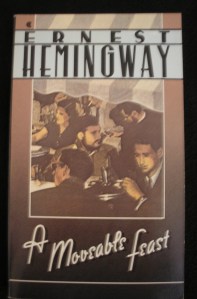
We can’t all be as famous as Hemingway but we can all write a little something, a blog or a journal or a book, (and we don’t have to move to Paris to do it).   I am sure there were times when Hemingway wondered if what he was writing would ever be of interest to anyone, but it is helpful to remember that there is always someone out there reading.   And even if that person is only yourself, you are documenting your life, in the same manner as Janice MacLeod did while in Paris (see Part Two next week).     

One of the nice things about blogging is you can find a blog about anything that interests you anywhere in the world.  In my Word-press travels I have discovered two wonderful blogs on Paris and France.

https://adventuresofananglaise.com/                                                                                                                 an English ex-pat’s blog on her adventures in Paris                                                                            (for armchair travelers to the City of Lights)

https://chomeusewithachou.wordpress.com/                                                                                 unemployed with a cabbage/tot – tales of family life in France                                                 (Jane Austen is reincarnated and living in rural France)                                                            

Au revoir mon cheris….until next week….Part Deux

Song of the Day:  Andrea Bocelli – La Vie en Rose

Quote of the Day:  “If you are lucky enough to have lived in Paris as a young man, then wherever you go for the rest of your life, it stays with you, for Paris is a moveable feast.”    (Ernest Hemingway – A Moveable Feast)

Eiffel Tower - AMc - Feb 2018

Eiffel Tower – Feb 2018

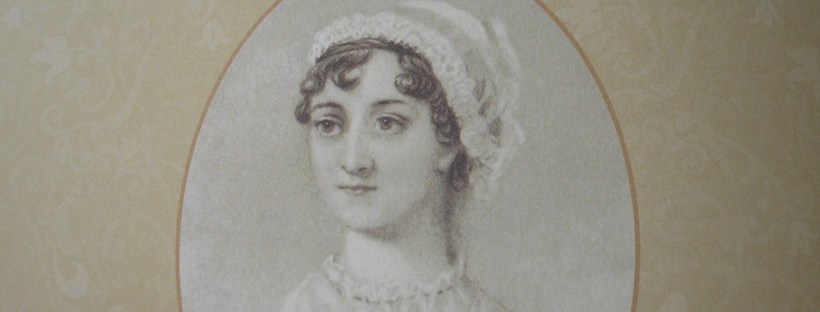
An Interview with Jane Austen

          I’m a Jane Austen fan.   Although I would not consider myself a Janeite, whenever a new book comes out about her life I’m sure to check it out. Recently I saw this one, Jane Austen at Home, on the new releases list, and reviewed it on Goodreads.  

Jane Austen at HomeJane Austen at Home by Lucy Worsley

My rating: 5 of 5 stars

Can there be such a thing as a bad book about Jane Austen – no. Even though we know every detail of her story, and there is really nothing new to be discovered about her life, (excepting the photo of the blue and white egg cup excavated at the Steventon Rectory), Austen fans still find any new book about her fascinating. This is a particularly satisfying read as it focuses more on her quest for a home – after all she is the author who wrote “There’s nothing like staying home for real comfort.” Of course, there are the usual biographical facts, literary and otherwise, seeming to focus more on her personal life, including her five marriage proposals, thus dispelling the myth that she was a lonely old spinster. (Really the woman was so intelligent as to be intimidating, and would she have been happy with any of them?) There is a satisfying number (40 pages or so) of footnotes, always a sign of a good biography, and some photographs, including said egg cup. A lovely read for commemorating the two hundredth anniversary of her death – we remain as captivated as ever.

       A friend gave me The Wit and Wisdom of Jane Austen, (edited by Joelle Herr), for Christmas as she knew I was a fan, and it is full of her famous quotes and observations.   Pride and Prejudice is my favorite Austen book, and then Emma, but some of the others I must admit I have never read, although I have seen the movie versions.  It is her life that I find most intriguing.   I often find authors lives to be as or sometimes more interesting than their books, (check out Margaret Mitchell’s biography for parallels to Gone with The Wind, the character of Rhett Butler was thought to be based on her first husband and Ashley Wilkes on her second).   If you are a writer, you want to know where they got their ideas.   Due to the lack of media back then and the passage of time we have little to base our conclusions upon, and baring someone discovering a cache of old letters in their great house, there is nothing new under the sun about Jane Austen, but we still can’t get enough of her life.   She remains a puzzle, an enigma, we want to figure her out.   A fellow blogger asked me which historical figure I would most like to interview, and my answer was Jane.  And so, as Jane said, indulge your imagination in every possible flight.      

 An Interview with Jane Austen

         Welcome to the BBC show, Portal to the Past.  We would like to welcome renowned British author, Jane Austen.   Even though she has been dead for over two hundred years she has been gracious enough to grant us this exclusive interview, and we thank her for the opportunity, because two centuries later we remain as fascinated by her as ever.  (Cue opening pianoforte music link).    Jane enters, wearing a white flowing Stella McCarthy gown, because a woman can never be too fine while she is all in white.  (Camera man sighs, white is not good for the camera, adjusts lighting).  

 Host:  Welcome Jane.   Would you like some  tea?  

Jane:    (demurely declines refreshments.  She doesn’t want to smear her lipstick – imagine lipstick! Something to make your lips ruby-red and kiss-worthy.  She wonders if she’ll get a free swag bag from Sephora).

Host:   I’m so glad you could join us today.

Jane:   There is nothing like staying home for real comfort, but if adventures will not befall a young lady in her own village, she must seek them abroad.    

Host:  Did you ever imagine when you were sitting at your little writing table in Chawton Cottage, scribbling away about three or four families in a country village, that your novels would still be read two hundred years later? 

Jane:   (smiles sweetly)  Alas, it is only a novel… or, in short, some work in which the greatest powers of the mind are displayed, in which the most thorough knowledge of human nature, the happiest delineation of its varieties, the liveliest effusions of wit and humor are conveyed to the world in the best chosen language.

Host:  Did you ever dream that you would become so famous?

Jane:    I have no talent for certainty, but I always had a quiet confidence in my abilities.   The fame though was quite unexpected, though slight initially it has now has grown to such proportions that I find myself adorning the ten pound note.  (blushes modestly).  Pictures of perfection make me sick and wicked.   I lay the blame on my nephew for that biography he penned.    Fame can be a double-edged sword, for regrettably I have now lost all privacy, and sometimes when I want to pay a visit to Chawton Cottage, there are too many tourists milling about.    

Host:   (surprised)    Are you saying you haunt your old sites?

Jane:   I do enjoy dropping by occasionally, but the tourists, their fashion choices are really quite beyond comprehension.  It would be mortifying to the feelings of many ladies, could they be made to understand how little the heart of man is affected by what is costly or new in their attire, but still…yoga pants and t-shirts.  (shakes head, and thinks silently, for what do we live, but to make sport of our neighbors, and laugh at them in our turn.)   Chawton House was my only true home and I was very content there.   Sometimes I like to sit at my little desk and recollect….or I might visit the kitchen if the new cook is on, because as you know good apple pies were a considerable part of our domestic happiness.   As for my childhood home there is nothing remaining, although I read that a blue and white egg cup was discovered recently in an excavation at Steventon Rectory, but it wasn’t mine, it was Cassandra’s.  An egg cup – really!  Which of all my important nothings shall I tell you first.  It seems like a fair bit of nonsense that people would be interested in such things, but that is the price of fame.    One half of the world cannot understand the pleasures of the other.    

Host:    Are you aware of how many copies of your books have sold, 20 million of Pride and Prejudice alone?

Jane:    Yes it’s quite astonishing to be so immortal, but I wish I had the royalties.  A single woman with a narrow income must be a ridiculous, disagreeable old maid, the proper sport of boys and girls; but a single woman of good fortune is always respectable, and may be as sensible and pleasant as anybody else.

Host:    That portrait of you in the National Gallery, is it a fair likeness, because I’m not seeing too much of a resemblance?    (it might be the makeup and hair blowout, thinks to self, but a little makeup can make even the plainest Jane quite pretty.)

Jane:    I believe it has been photo-shopped too often to be an accurate portrayal.   (ponders uploading a new photo via Instagram for the ten pound note).  To look almost pretty is an acquisition of higher delight to a girl who has been looking plain the first fifteen years of her life than a beauty from her cradle can ever receive.    

Host:  Are you happy with your media image?   The sweet loving demure persona, sunny Jane?

Jane:    I must confess I was a bit annoyed with my sister Casandra for destroying most of my letters, especially the ones full of sarcasm and wit.   The ones that survive make me out to be some sort of vapid ninny.    I suppose she thought she was protecting my reputation…(sigh)…but she destroyed the best ones.   

Host:  You had five marriage proposals and turned them all down, did you ever regret being a spinster?  

Jane:     One should only marry for love.   And the more I know of the world, the more am I convinced that I shall never see a man whom I can really love. I require so much!   You must be the best judge of your own happiness. 

Host:   What do you think of the movie versions of your novels?

Jane:    Some were of more merit than others, but Colin Firth was simply divine as Mr. Darcy.  Such a handsome man.  I wish I had thought of that wet shirt scene but that would have been too risqué for the era.  

Host:   Speaking of Mr. Darcy – who was the model for that darling man?

Jane:   ………………(prolonged silence, that wasn’t in the script, looks extremely annoyed).

Host:   (quickly changes subject).   And  that famous speech, let me tell you how ardently I admire and love you.    Did people really talk like that back then?

Jane:    HA, that speech……(contemplates laughing)…..Said. No. Man. Ever. 

Host:    Jane you seem to be well versed in the ways of the modern world, colloquial speech, photoshop, how do you know about all these things?

Jane:   The afterlife is heaven – there’s plenty of time to read and learn new endeavors.  With a book, you are regardless of time.   You ask yourself, why did we wait for any thing?  Why not seize the pleasure at once? How often is happiness destroyed by preparation, foolish preparation!     There are balls and a fair bit of dancing, and dancing leads to romance, for to be fond of dancing is a certain step towards falling in love.   If one has been forced into prudence in one’s youth, one can learn romance as one grows older.       

Host:   Well that sounds fascinating….romance in heaven.  (eyes camera man signalling time’s up).   Any advice for modern day lovers?

Jane:   Happiness in marriage is entirely a matter of chance.  But don’t settle.  Do anything rather than marry without affection.   Wait for your own Mr. Darcy…..(flutters false eyelashes and smiles coyly)….I have found mine…. 

Host:   Thank you Jane.  (notices camera man motioning cut).   You have delighted us long enough.  Would you like more tea?

Jane:  Thank you, but I must dash to Sephora before the portal closes and I have to return to the past.    

          And so there you have it folks, Jane in her own words.    Like I said, nothing new there…..other than the blue and white egg cup was Cassandra’s.  

(Disclaimer:  I apologize in advance if I have messed up any of the quotes or facts as I am by no means an authority on Jane Austen, merely a fan.  Next up, the Brontes  – Branwell would be on board for sure, Charlotte and Anne might be tempted but Emily would never agree.)


In Praise of Second-Hand Books

   The Rotary Club is holding its annual second-hand book sale, 27,000 volumes are up for grabs, and I am a bit grumpy today because I’m missing it.   A snowstorm descended upon us about the same time the venue opened at 8:30 and as every book lover knows, the best ones go fast.  Normally I’m content to stay inside on such a blustery day, but I’m regretting the bargains I am surely missing, at one or two dollars a book.   But no use crying over lost volumes.   I have resigned myself to going on Sunday, when the remainders are five dollars a bag, but the selection poorer.   Last year I went both Friday and Sunday – the stuff-a-bag day was to stock up on travel/photography/coffee-table books for my mother, the artist AMc, to use for inspiration for her paintings now that she is too old to travel.  (She has an extensive collection of over-sized volumes of Canadian scenery if anyone wants to know what Canada looks like).   We also have a second-hand book store in town, but the hours are erratic and the prices higher, nor have I had much luck with garage sale castoffs, which tend to be mostly romance or paperbacks or both.    Admittedly book sales are always hit and miss, but other people’s discards can turn out to be treasures.   

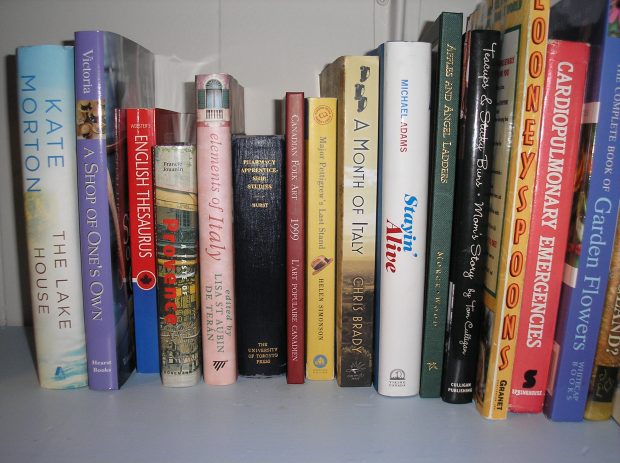
                 The beauty of book sales is you never know what you might find.  Last year’s haul included a Loonyspoons Low Fat cookbook, (which I had always wanted but have not used),  a medical manual of Cardiopulmonary Emergencies, (my dysfunctional heart valve will need repairing some day and I might want more info than WebMd can provide, also not opened),  a thesaurus, (somewhat obsolete but the online version has limitations), a slim volume of pioneer Christmas stories with a pretty cover and a red ribbon, (because I’m a sucker for a book with a ribbon), two novels, The Lake House by Kate Morton (already read but might re-gift, I like to share good books), and Major Pettigrew’s Last Stand (not read, but I enjoyed her latest), Victoria – A Shop of One’s Own, (I collect old Victoria books as well as the decorating magazines),  a calendar day-book of art by Maud Lewis, 

(a Nova Scotia folk artist whose life was recently portrayed in the movie Maudie, because my mother’s paintings have been compared to hers), and an apprentice textbook from U of Toronto 1934 (which I found fascinating because it was full of old chemical formulas and my profession has evolved way beyond how to sterilize bottles), plus three quotation books which turned out to be absolute duds, (I would really like Bartlett’s Book of Quotations, as it would be useful for the blog).

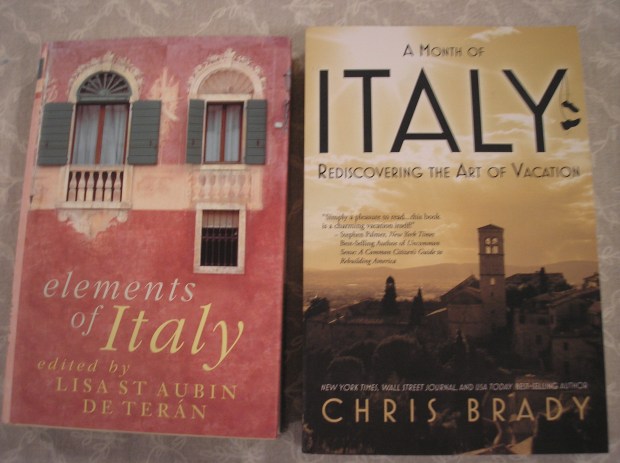
         Book sales are good for travel books if you are an armchair travel like myself.   I scooped up a travel guide to Provence and two books on Italy,  one of which I had already read, Elements of Italy, and the other,A Month in Italy, because it’s my dream someday.   If you can’t go yourself you can enjoy reading about someone else’s adventures and avoid the jet lag and lost luggage, and in the case of Italy, the weight gain.   Speaking of good food, there always seems to be a profusion of cookbooks at book sales, as well as diet fads from years past.  The children’s books always go quickly I am happy to see.  It’s nice to see parents starting a library, and the book-on-every-bed Christmas project is such a good idea to inspire early readers.   

            Last year I came across a young adult book, Robin Kane, The Candle Shop Mystery, which I did not buy because I have the exact same copy in my basement.   What were the chances of that happening, as I don’t remember that series being as popular as Trixie Belden, which I also still possess. 

          I always got a book for Christmas, usually a Trixie Belden, the Nancy Drew-like girl detective of the 1960’s, (here she is searching for dead bodies),

otherwise we went to the library.   I still get the majority of my books from the library, as I read so much it would be prohibitively expensive to buy them all, and our local library is excellent at ordering in anything you might request, plus the librarians there are all such lovely helpful people.   Generally, I only buy what I would re-read, but this year as one of my New Year’s resolutions I decided to start to add to my library again, which is currently three shelves in the basement and den, (see decluttering blog Jan), but only those books which I truly love and would re-read.   When I end up in a nursing home some day I want to be surrounded by my favorites, and not dependent on some volunteer lady bringing around a cart full of Harlequin paperbacks.   

          Now, I haven’t actually opened any of those books I bought last year, (some may end up being recycled), but it gives me comfort to know they are there if I am desperate for something to read.  I once spent a week on Turks and Caicos with a selection of bad books and no store in sight, only a strip mall with one lonely souvenir shop, this was before the island was developed and long before e-readers, which are wonderful for travel, but I would much rather hold a book in my hand.   I am such an avid reader, that I always want to have something in reserve or I get antsy.   What if nothing comes in from the library – it’s either feast or famine – although sometimes having too many books out can be a strange form of retirement stress.   That stack on your bedside table can start to feel like pressure when they are all non-renewable best sellers, and if you return them unread there are sixty-five people ahead of you again.   Buying them solves that problem, as you can read at your own leisurely pace. 

        It’s amazing the weird and wonderful things you can find at book sales, ancient volumes from estates, such as yellowed cloth-worn sets of Poe or Kipling, or outdated encyclopedias.  Did people really read such wordy tombs?  Does anyone want them now and what do they do with them when they don’t sell?  Although it can be interesting to see what people were reading a hundred years ago and to read the inscriptions inside the books.   I have a few old books from the farm attic, but many more got thrown out in the moving process.

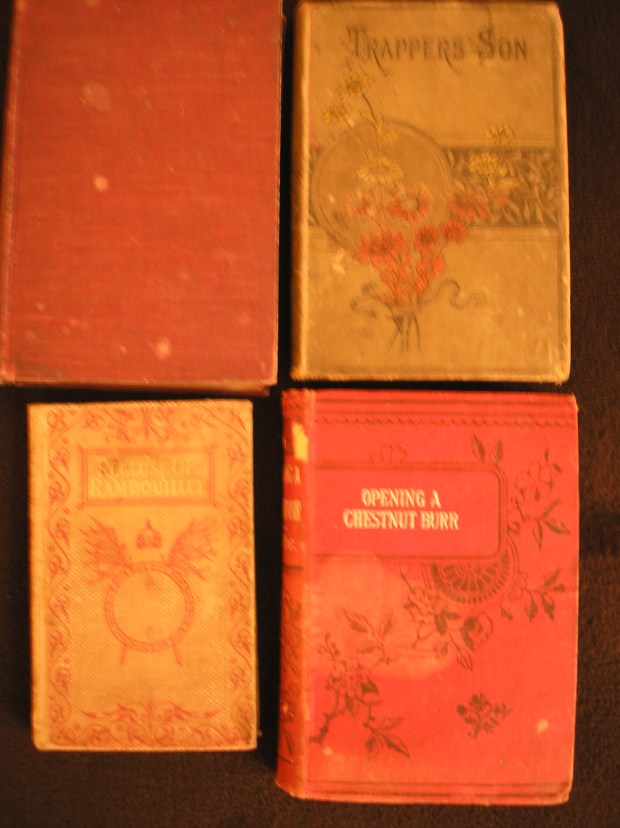
farm attic books

A Trapper’s Son was a gift to Lillie from Grandfather, Birthday Sept 14, 1900. L.M. Hewitt is written inside the flyleaf, as well as my aunt’s name at a later date.   I have no idea who Lillie was but I googled and The Trapper’s Son, A Tale of North America, was published in 1873 and deals with the conversion to Christianity of a boy brought up in the wilderness.   My ancestors were Christian folk, so any religious book was a keeper.   Opening A Chestnut Burr, was inscribed to a Miss Lori Dody, and was published in 1874.   Surprisingly there were two reviews of this book on Goodreads, the first one, a female, said, “A deeply Christian story with a thoroughly delightful ending.  There’s a good bit of romance and outdoors.”  The other reviewer, a man, said, don’t bother.   The romance factor must have far outweighed the outdoors part.   I couldn’t find anything on The Recluse of Rambouillet, (pub.1896), but it appears to be a translation from French about castles and kings.  As my grandmother’s name is inscribed inside, Dec 1899, 3rd prize, 4th class, it was probably some kind of school prize.   Poe’s Tales, (Xmas 1904, from Henry), can join it’s many brethren on E-Bay, but it is nice to know that books were welcome Christmas presents back then too.   Some day I may tackle them, but they seem like relics from some long ago world, full of purple prose as L.M. Montgomery called such grandiose language.   Opening sentence from Poe, “The mental features discoursed of as the analytical, are, in themselves, but little susceptible of analysis.  We appreciate them only in their effects.  We know of them, among other things, that they are always to their possessor, when inordinately possessed, a source of the liveliest enjoyment.”   Perhaps there there is something to be said for being concise, what would Poe think of Twitter’s 140k limit and texting.   Times change and so do tastes.  

             Books can be a portal to another universe, especially if the one you are currently in is snowy and white.    I’m going to read now…happy hunting!

 P.S. What is your favorite book sale find?  

Quote on Reading: “Reading is one of the few things you do alone that makes you feel less alone, it’s a solitary activity that connects you to others.”  (even in the middle of a snowstorm)  Will Schwalbe – Books for Living, author of The End of Your Life Bookclub.  

PS.  This years treasures included, 

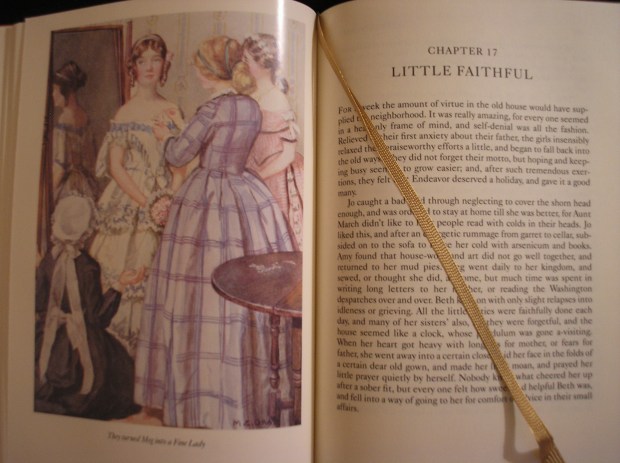
The Christmas book jumped out early, whispering, buy me, I will come in handy for next year, the beloved Bartlett’s only revealed itself late in the hunt in a discarded bin under a table, and the Little Women collector’s edition 1994 caught my attention, because even though I still have my childhood copy, it had a ribbon and such pretty illustrations. OLYMPUS DIGITAL CAMERA

Comfort & Joy: The Danish Art of Hygge (or how to survive January)

Oh the weather outside is frightful, but the fire is so delightful.”  The song, Let It Snow, has all the ingredients for winter comfort and joy – popcorn, snuggling by the fire, snowstorm, and the best part for those who hate winter driving, no place to go.   It’s also the perfect recipe for hygge.

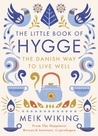
          According to recent surveys, Denmark rates among the happiest countries in the world, and hygge, the Danish art of living well, is a major reason for their sense of wellness.   Hygge, which can be summed up as “cocoa by candlelight”, is the perfect antidote to the cold dark winters and is considered a major survival strategy for January when the hours of daylight are few.   The Little Book of Hygge – The Danish Way to Live Well was written by Meik Wiking, the CEO of the Happiness Research Institute in Copenhagen.    You know that if a country sets out to study happiness they are way ahead of the game.   Here is my book review from Goodreads.

  The Little Book of Hygge: The Danish Way to Live WellThe Little Book of Hygge: The Danish Way to Live Well by Meik Wiking

My rating: 4 of 5 stars

This is a delightful little book, particularly suitable for reading this time of year, preferably during a snow storm. So light some candles, get cozy by the fire with a blanket and a cup of cocoa and prepare to be entertained. Based on the Danish art of living well, it may inspire you to practice a little hygge in your own life…..comes complete with charming pictures too, but warning – the print is very tiny.

         For those of us living in more melancholy nations, what exactly is hygge?  The word hygge derives from a Norwegian word meaning “well-being”.  Hygge is about atmosphere and experiences, not things, (great, I just decluttered, see previous blog post, but I hope I didn’t throw out anything hygge  – is it to late to retrieve those plaid pajama bottoms). 

           In the introduction the author describes a December weekend at a cabin with a group of his friends.  

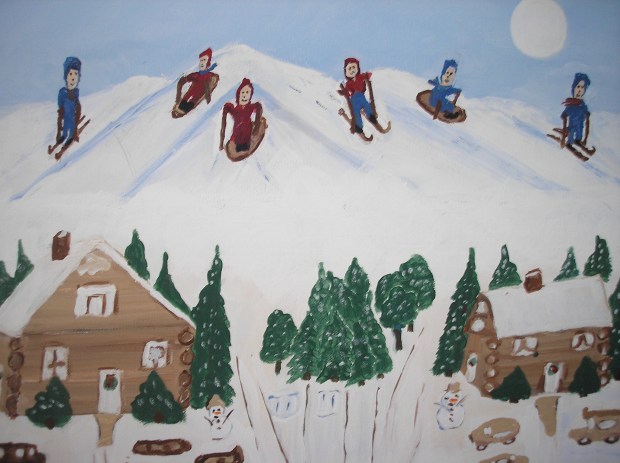
Cabin in the Woods - AMc - 2016
Cabin in the Woods –  2016

Post hiking, they are sitting around the fire, wearing big jumpers and woolen socks, reading or half asleep and the only sound is the stew boiling, the sparks from the fire and someone having a sip of their mulled wine.  One of them breaks the silence and asks, could this be any more hygge, and someone answers, yes, if there was a storm raging outside, they all nod.     This is hygge in a nutshell, except he forgot the candles, (they are big on candles in Denmark as they have seventeen hours of darkness in the winter months), so I would like to add that I hope they ate by candlelight, and had coffee and cake later by the fire, (they are big on coffee and confectioneries too).

         According to the author, Danes have less anxiety and worry in their daily lives due to the cradle to grave social welfare state.  They don’t resent paying high taxes as they consider it investing in society and improving the quality of life.   What’s not to like about a country with paid daycare, where parents of small children must leave work early, and no one works nights or weekends, thus leaving more time for family and friends and all the other hygge-like things to do…..watch tv, read, relax.     

      The concept of hygge includes coziness, candles, coffee, blankets, fireplaces, hot drinks, good food, natural or rustic decor, nooks, soft lighting, comfortable clothing and casual entertaining.   Interestingly, the hygge life-style can be excellent for introverts, as it is a low-key way of being social without being drained or exhausted by too much activity and partying, not to mention being a soothing balm for over-stimulated minds at the end of the work day.   Even their workplaces try to be hygge.  They may have couches instead of desks.  I think I want to move.  I have a vague recollection of one of my first workplaces in the eighties where we had birthday cake during department meetings.  It was a horrible place to work but the cake was good. At my last job we didn’t even get meal breaks.  Or course, a hygge-like state is only possible if it is in contrast to something non-hygge, which tends to be the status quo for modern life.   Life today is a rat-race, stressful and unfair, money and jobs rule.  This book can inspire us to stop occasionally and add a little hygge to our lives, and don’t forget the cake!   (see next blog, How To Make Your Home Hygge).        

 Benjamin Franklin quote:  “Happiness consists more in small conveniences or pleasures that occur every day then in great pieces of good fortune that happen but seldom.”               

Snow - AMC - 2015

Snow Day –  2015

Decluttering 101 Out With The Old

      If decluttering your personal space is one of your New Year’s resolutions then you may be interested in, The Life-Changing Magic of Tidying Up, by Marie Kondo.     

The Life-Changing Magic of Tidying Up: The Japanese Art of Decluttering and OrganizingThe Life-Changing Magic of Tidying Up: The Japanese Art of Decluttering and Organizing by Marie Kondō


  My yoga teacher lent me a copy of this book last year over the Christmas break and I became so motivated by it that cleaning out my house became one of my goals for 2017.   Marie Kondo is a Japanese organizing consultant who is booked three months in advance according to her bio, which surprised me as I think of Japan as a nation of tidy people living in small neat houses, but maybe they are pack-rats like most North Americans.   Her unique approach has now been trade marked as the KonMari method.  The gist of her method is that you are to tidy by category and all at once, by dumping everything of each item from all over your house in the center of the room, shirts for example, and then you are to hold each item in your hand and “if it doesn’t spark joy”, out it goes.  You will then only be surrounded by the things you love.  The author was young and single and lived in a bedroom/apartment when the book was written in 2011, so although it is an interesting premise, some of the suggestions are not quite practical for a larger space shared with other people.   What if something doesn’t bring you joy, (old electronic devices, the hamster cage, hockey equipment), but might bring joy to someone else?  Then there are the things that don’t bring you joy but you need anyway.   My iron doesn’t bring me joy, (I hate ironing, but I hate wrinkles even more), but I don’t plan on throwing it out.  Toys should only be stored in one place?  That might cause a few temper tantrums.   Some of the suggestions border on the bizarre, you should talk to your house and your possessions and thank them for taking care of you? “Thank you for keeping me warm all day.  Thank you for making me beautiful.”  My sad old kitchen which is desperately in need of renovation might feel better if I spoke lovingly to it, but would I sound like George Bailey at the end of It’s A Wonderful Life, joyously greeting the miserable old Building and Loan.   Or empty your purse every night, place wallet, makeup and put everything in it’s assigned place, and then repack it in the morning.  I admire purse minimalists, but I am not one of them, my purse holds everything but the kitchen sink, so that would take over an hour.   She often speaks of inanimate objects as if they had souls and feelings.   What do the things in your house that don’t spark joy actually feel?  They simply want to leave.  Everything you own wants to be of use to you.  It must be a Feng-shui kind of thing.  Does my iron hate me as much as I hate it?       

            Still there was enough in the book to motivate me, so I diligently spent the month of January last year cleaning out my house, and the month of February attempting to clean out my mother’s, and some of March down in the basement, (home of the paper archives), and then it was spring, and I lost interest.    Purging all at once was just not practical for me, a few hours here and there was the best I could do with my three-level house…yes, I broke the rules.   I was less successful with my mother’s house, as she was born in the Depression and so has more of an attachment to empty coffee canisters and plastic storage containers than I do.   (Perhaps that is why Marie is so booked up, it is much easier to get rid of someone else’s stuff than your own).   “Use it up, wear it out, make it do or do without,” was a popular saying in the Depression, which may explain why that generation tends to hoard such things, while the baby boomers, because we didn’t grow up with as much as kids today, were more into acquiring material things, (fine china, mahogany dining room sets), and the millennials are minimalists indeed who would rather have experiences than things, and only buy what they need.    Speaking of psychoanalysis, while some of the book reviews I read unkindly label the author as having OCD, (if I had sold five million copies I wouldn’t care what they called me), there is a sad chapter towards the end of the book where she explains her need to be compulsively tidy since a young age as an attempt to attract her parent’s love and attention and avoid being dependent on other people.  She was a middle child (self-explanatory).            

            Some pointers from the book –  sort all in one shot, by category, not location.  There are only two actions, discarding and deciding where to store things.   Start by discarding, all at once, intensely and completely, then decide where to store things, and keep them only in that place.  (Discard first, store later).   Do not start with mementos.  Start with easier items, clothes, books, papers, misc., and then mementos.   We should be choosing what to keep, not what we want to get rid of.   She recommends folding clothes in rectangles and then storing them vertically, standing up in drawers, so you can see everything, and they are less wrinkled.  Store all items of the same type in the same place, and don’t scatter storage space, including designating storage space for each family member.  Fancy storage systems = bad, they justify keeping stuff you shouldn’t.  Some clothes like coats and dresses are happier hung up.  I’m relieved my elegant black cocktail dress, (Winners sale), is happy even though it’s never been worn.     Keep only those books which make you happy to see on the shelves.   Out go those university text books I kept in case I felt the need to study chemistry again, (which I did twenty years later for a degree upgrade).   Now they are but sentimental reminders of a time when I was smarter and had a better memory.   Sorting papers – rule of thumb – discard everything!  She relents and says you can keep some things like insurance policies, love letters etc. but only if they are stored in one spot only.   On sentimental items – “No matter how wonderful things used to be we cannot live in the past – the joy and excitement we feel here and now are more important.”   Yes, that is true, but what about keeping things for future generations?   As a lover of history and genealogy, I wish my ancestors had kept more things, not less, 

(see Nov. blog on Uncle Charlie WW1 Vet), and museums would be empty if we throw everything away just because it’s old.   I am glad I kept those letters from my younger pre-email years, they are treasured memories for myself and for future generations.   

             What makes some things more difficult to get rid of is they either remind us of things past, (childhood toys, I kept my Barbie dolls and clothes), 

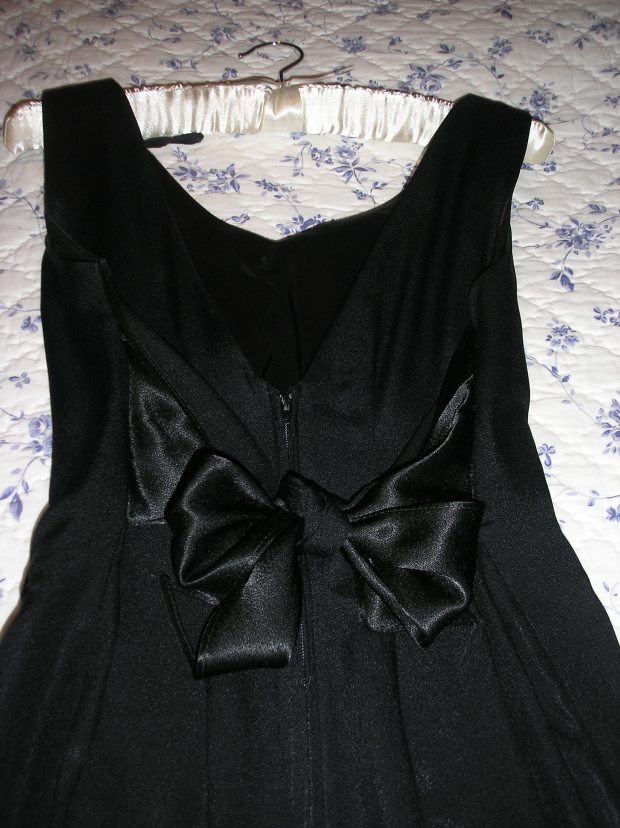
or we might have a future need for them some time and they won’t be there.  I still haven’t read those books I picked up at the book sale last winter, but we might be snowed in for a week and then I’ll have something to read.  Most bookworms have great difficulty getting rid of books.  It seems a shame to discard a book, unless it’s a really bad book, and even then someone put a lot of effort into writing it.  (I once read that books are one of the most often requested items in refugee camps).   While I won’t be appearing on any hoarder reality tv shows, I do have a problem with some categories (see blog on vintage clothes on the main menu), and I admit I am a paper pack-rat too.   With the clothes I am mourning the life I had, or aspired to (in the case of that chic little black cocktail dress with the bow in the back). OLYMPUS DIGITAL CAMERA My intention with The Vintage Corner was to sell some of the clothes and donate the money to charity, which can always make you feel better about throwing things out.   I lost track of how many trips I made to the local thrift shop, but one day when I took an old ghetto-blaster in, (music for the garage, but it was never used and covered with dust), there was an immigrant family looking for a radio, so it was perfect timing.   How happy they were, and how pleased I was to be able to help someone else.    

               Recently I came across a review for a new book from Sweden, “The Gentle Art of Swedish Death Cleaning” (Scribner Jan 2018) by Margareta Magnusson, which may be more suited to older generations. 

The Gentle Art of Swedish Death Cleaning: How to Make Your Loved Ones’ Lives Easier and Your Own Life More PleasantThe Gentle Art of Swedish Death Cleaning: How to Make Your Loved Ones’ Lives Easier and Your Own Life More Pleasant by Margareta Magnusson


This Swedish author recommends you streamline your belongings while you are still healthy enough to do the job, thus saving relatives the difficult task of sorting out after you are gone.  It sounds morbid but it is actually uplifting, finding the right homes for all your beloved possessions so they can bring joy to someone else, plus it can relieve the burden of looking after so many things when you might not have the health or energy to do so.   Still it does make me sad to walk into a thrift store and see all those lovely sets of good china which graced many a holiday table and which no one wants anymore.   I collect blue and white china (which does bring me joy),

OLYMPUS DIGITAL CAMERA

My grandmother’s turkey platter

 and thrift shops are excellent places for that, although I am now more selective in what I buy.         

          The final chapter in the Marie Kondo book deals with the life-changing part of the title – apparently “the lives of those who tidied thoroughly and completely in a single shot are without exception dramatically altered.”   Some of her clients discarded their excess weight, their jobs and even their husbands, and went on to live much happier lives.  The rationale for this is that detoxifying your house has a detoxifying effect on your body and mind as well.  It increases your happiness and good fortune to live in a natural state surrounded only by the things you love.  She says, “when you put your house in order, you put your affairs and your past too, and you can see quite clearly what you need in life and what you don’t, and what you should and shouldn’t do.”  The things we really like do not change much over time.  Putting your house in order is a great way to discover what they are.   I’m not sure if this is just so much psycho mumbo-jumbo, but you cannot deny it is a serene feeling to having a clean and tidy house.   She does not seem to acknowledge however that some people prefer and even feel more comfortable with a certain degree of clutter around them.  It makes a home look lived in as opposed to one staged for a real estate open house…you know the type, when you walk into a house and nothing is out of place and there’s not an open book in sight.   I can’t say my life was altered in any transformative way, (but then I broke the all in one shot rule), but I would have to say the book was successful in making me stop and think, do I really need to keep this, and while some clutter has crept back, the usual suspects in the usual places, (papers in the den and kitchen drawers you may plead guilty), over-all it was a worthwhile read.   The whole concept of sparking joy, while airy-fairy, did make me much more conscious of what I bought.  Not only did a new acquisition have to bring me joy, but did I even need it?  After spending three months decluttering I didn’t want to have to do it again.   But there was a good feeling of accomplishment and satisfaction when it was done and someday when I must downsize there will be less to pack and unpack.   As anyone who has ever moved can attest, moving can be a great motivator for decluttering. 

          The other day I saw a very large moving truck on my street, it almost stretched the whole block, which made me think about how much stuff people have today compared to the past.  My maternal grandmother came through Ellis Island in 1922 from Holland, on her honeymoon, with one large wicker trunk containing all her worldly possessions.   My dad’s ancestors arrived in Canada from Ireland in 1846 at the height of the potato famine with nothing but the clothes on their backs.  They abandoned what few supplies they brought with them, when they jumped ship in the St. Lawrence during a cholera epidemic.  They had to borrow one pound from the Canadian government (National Archive Records), for water transport from Toronto to where they settled, but by 1900 they had nice crystal,

OLYMPUS DIGITAL CAMERA

farm heirloom

 and monogrammed silverware, (I wish I still had some of those forks).   Things can bring you pleasure and joy and we can spend a lifetime buying but in the end, we have nothing – you can’t take it with you, as the saying goes.  There is a time to collect stuff and a time to get rid of it.  

       Incidentally, about a month after I returned the book to my yoga instructor, I saw a copy at a thrift shop for two dollars, so I bought it to keep as a reference book, which is a no-no according to the rules, but which I knew would come in handy some day.   The author also has a sequel, Spark Joy – An Illustrated Master Class in Organizing and Tidying Up, but when I picked it up and glanced through it, there was a whole section on camisole folding, and since I don’t own any camisoles, I closed it back up and left it there on the shelf to bring joy to someone else. 

Quote of the Day:   “Have nothing in your house that you do not know to be useful or believe to be beautiful.”   (William Morris)

Charles Dickens A Christmas Carol

       We have Charles Dickens to thank or blame, depending on your perspective, for the present Christmas madness.   The movie about The Man Who Invented Christmas is currently in theaters, and was based on a 2009 book by Les Standiford.   
The Man Who Invented Christmas: How Charles Dickens's A Christmas Carol Rescued His Career and Revived Our Holiday SpiritsThe Man Who Invented Christmas: How Charles Dickens’s A Christmas Carol Rescued His Career and Revived Our Holiday Spirits by Les Standiford

Maybe Santa will bring me this for Christmas…hint, hint.

      Although I have not seen or read either, I am currently in the process of re-reading A Christmas Carol, the illustrated version, an annual tradition I try to keep, although I don’t always succeed.    OLYMPUS DIGITAL CAMERA

A Christmas Carol is my favorite book of all time.  I love it for it’s perfect plot, it’s memorable characters and its simple message of hope and redemption.   While I like the movie (especially the 1951 version with Alistair Sim, although the 1938 version has a better Tiny Tim and Bob Cratchit and a much scarier ghost of Christmas past which would have me scurrying to bed when I was Tiny Tim’s age), the book itself is pure perfection.   You wouldn’t change a thing in it.  It’s so ingrained in our memory that we couldn’t imagine it any other way.  Desperate for money, with a mortgage overdue and six children to support, Dickens produced it in a mad six-week frenzy in October of 1843.   It was published on Dec 19, just in time for the Christmas trade, and immediately sold out, and has been in print ever since.

      If I am ever in New York at Christmas time, my first stop will be the Morgan Library, where every year Dickens original handwritten sixty-eight-page manuscript is on display over the holiday season.  Dickens chose the red leather binding himself and gifted and inscribed it to his friend, Thomas Mitton.   Here is an online link to the manuscript, and you can now buy a facsimile copy from the Morgan shop online.      

http://www.themorgan.org/exhibitions/charles-dickens-a-christmas-carol

      A few years ago, the library held a contest for Dickens fans and scholars to study the manuscript in search of the most noteworthy editorial changes.   While he may have written it in an outpouring of creative genius, he still did a lot of crossing out and revising.  Can you imagine Tiny Tim being called Fred?   It is a sad part of history lost that our present writing methods no longer permit this peek into the creative process.    

      Dickens was long-winded, (why use one word when ten will do), so for a short tale, it is wordy, but it’s not as bad as Oliver Twist (which I read at age twelve when the movie musical came and found a difficult read), or A Tale of Two Cities or any of his other works.   In A Christmas Carol the descriptive passages are pure bliss.   Some of my favorites include, the description of the damp piercing cold at the beginning of the story, (foggier yes and colder. Piercing, searching, biting cold), the entire passage about the Cratchit household and their Christmas dinner, (Mrs. Crachit dressed out poorly in a twice-turned gown but brave in ribbons and Belinda too, and Peter with his collar done up), the dancing and food at old Fezziwig’s party, (away they all went, twenty couples at once), the games (blind man’s bluff and charades) and music at his nephew Fred’s, and the town and the grocer’s all dressed for Christmas with the people sallying forth full of goodwill and good cheer.        

     And who can forget those classic lines, “Why, where’s our Martha?….not coming on Christmas Day?”  “for it is good to be children sometimes, and never better than at Christmas,”  “come and see me, will you come and see me,” and “there’s such a goose, Martha.”    The goose description alone is priceless. 

         ”Such a bustle ensued that you might have thought a goose the rarest of all birds; a feathered phenomenon, to which a black swan was a matter of course — and in truth it was something very like it in that house. Mrs Cratchit made the gravy (ready beforehand in a little saucepan) hissing hot; Master Peter mashed the potatoes with incredible vigour; Miss Belinda sweetened up the apple-sauce; Martha dusted the hot plates; Bob took Tiny Tim beside him in a tiny corner at the table; the two young Cratchits set chairs for everybody, not forgetting themselves, and mounting guard upon their posts, crammed spoons into their mouths, lest they should shriek for goose before their turn came to be helped. At last the dishes were set on, and grace was said. It was succeeded by a breathless pause, as Mrs Cratchit, looking slowly all along the carving-knife, prepared to plunge it in the breast; but when she did, and when the long expected gush of stuffing issued forth, one murmur of delight arose all round the board, and even Tiny Tim, excited by the two young Cratchits, beat on the table with the handle of his knife, and feebly cried Hurrah!

There never was such a goose. Bob said he didn’t believe there ever was such a goose cooked. Its tenderness and flavour, size and cheapness, were the themes of universal admiration. Eked out by apple-sauce and mashed potatoes, it was a sufficient dinner for the whole family; indeed, as Mrs Cratchit said with great delight (surveying one small atom of a bone upon the dish), they hadn’t ate it all at last. Yet every one had had enough, and the youngest Cratchits in particular, were steeped in sage and onion to the eyebrows.” 

img026           My ancestors always had a goose for Christmas, as was the custom back then as they were readily available on the farm.   This post card was given to me by a descendant of a great uncle who had moved to Seattle around 1920.   He must have been home for Christmas one year as he has written across the bottom in pencil, Xmas dinner on the farm.   I inherited the crystal bowl on the table, but not the goose tradition, only a turkey will do for Christmas. Even Scrooge preferred turkey, as he bought the prize turkey and sent it anonymously to the Cratchit family at the end.  (That delivery boy must have been Canadian as he said, “EH?….why, it’s Christmas Day.”)

The pudding description is spectacular too.     

“In half a minute Mrs Cratchit entered — flushed, but smiling proudly — with the pudding, like a speckled cannon-ball, so hard and firm, blazing in half of half-a-quartern of ignited brandy, and bedight with Christmas holly stuck into the top.

Oh, a wonderful pudding! Bob Cratchit said, and calmly too, that he regarded it as the greatest success achieved by Mrs Cratchit since their marriage. Mrs Cratchit said that now the weight was off her mind, she would confess she had had her doubts about the quantity of flour. Everybody had something to say about it, but nobody said or thought it was at all a small pudding for a large family. It would have been flat heresy to do so. Any Cratchit would have blushed to hint at such a thing.”


Unlike Mrs. Cratchit, I won’t be worrying about the quantity of flour,

OLYMPUS DIGITAL CAMERA

or like Tiny Tim, hearing the pudding singing in the copper.  I’ll just be listening for the ding of the microwave.   Although I bought the pudding at the British shop, the rum sauce will be homemade, and is equally good on vanilla ice cream for those who don’t care for Christmas pudding. 

      My standard rum sauce is just a mixture of butter, brown sugar, water and some rum added in the last five minutes, with most of the alcohol boiled away just leaving the flavor.   I tend not measure, so it’s never the same from year to year, including the rum which can vary depending on the stress level.  It can be made ahead, and stored in the fridge and microwaved later, along with the pudding.   You can also buy individual portions of plum pudding at the British shop, but it is more economical to buy the larger size.  

       If you have a moment of peace and quiet over the holidays, A Christmas Carol is a good read, and a simple reminder of what Christmas is all about.  And so, in the words of Tiny Tim,  God Bless us Every One! 

OLYMPUS DIGITAL CAMERA

A Tiny Caroler – Dec 2017

Song of The Day:   God Rest Ye Merry Gentleman (because it’s in the book) – click here for music link  –  The New York Philharmonic Orchestra

PS.  Edited Dec. 2018 to add that while I found the movie while interesting I could not get past the fact that Dan Stevens did not suit the role as he will always be Mathew in Downton Abbey.    I have not read the book yet but I know Santa will bring it this year, as I bought it myself while shopping for others!