Cabin Fever

By this time of year many of us are experiencing Cabin Fever – loosely defined as “irritability, listlessness, and boredom from long confinement or isolation indoors.” That feeling of being trapped is generally caused by snowstorms when you can’t go out even if you wanted to – those severe blizzards where they’re telling people to stay home, off the roads and wait for the snowplows to do their thing – but it’s been made even worse this year by the pandemic lockdowns. 

Although we may be stuck inside, we have all the comforts of home – a warm dwelling, good food and plenty of entertainment available.  It’s even possible to ignore things altogether if you don’t look outside, especially if you have a cozy fire to sit beside, a hot beverage and a good book or movie.  Winter can be very hygge.

While I would normally appreciate these quiet January days after the hustle and bustle of the Christmas season, lots of time to read and write and putter about pretending to reorganize, this year when we’ve been cooped up inside so much already, it seems downright claustrophobic.   So let’s call it pandemic fever instead.  In fact the term cabin fever had an early association with typhoid fever and quarantine.

As the term originated with the pioneers who spent long winters by themselves, when severe weather and long distances from neighbors were truly isolating, let’s take a look at how people coped with cabin fever way back when there were cabins.

The Log Cabin

I often wondered how my ancestors survived their first winter here.   They came from Ireland in 1846 during the potato famine, three brothers and their families, and after jumping ship in the St. Lawrence to evade the cholera epidemic, arrived in Toronto, starving and penniless.   They had to borrow one pound from the Immigrant Land Agent (National Archives Document Oct 16 1846) to pay for water transport to the area where they would settle.  The land was all wilderness then, and arriving so late in the year, they would never have survived the first winter were it not for the help of the Indians and a neighbor who helped them build a hut dwelling and showed them how to hunt for game.  (Most likely they ate a lot of venison stew).  They were unprepared for the cold and the snow as the posters advertising Upper Canada boasted about its abundant game (true) and tropical climate (well maybe in the summer).   Did they even have any warm clothing?   My great-grandfather, who had stayed behind to go to school, arrived later wearing a straw hat.  They would gladly have returned to the misery of Ireland in those early years. 
The First Winter

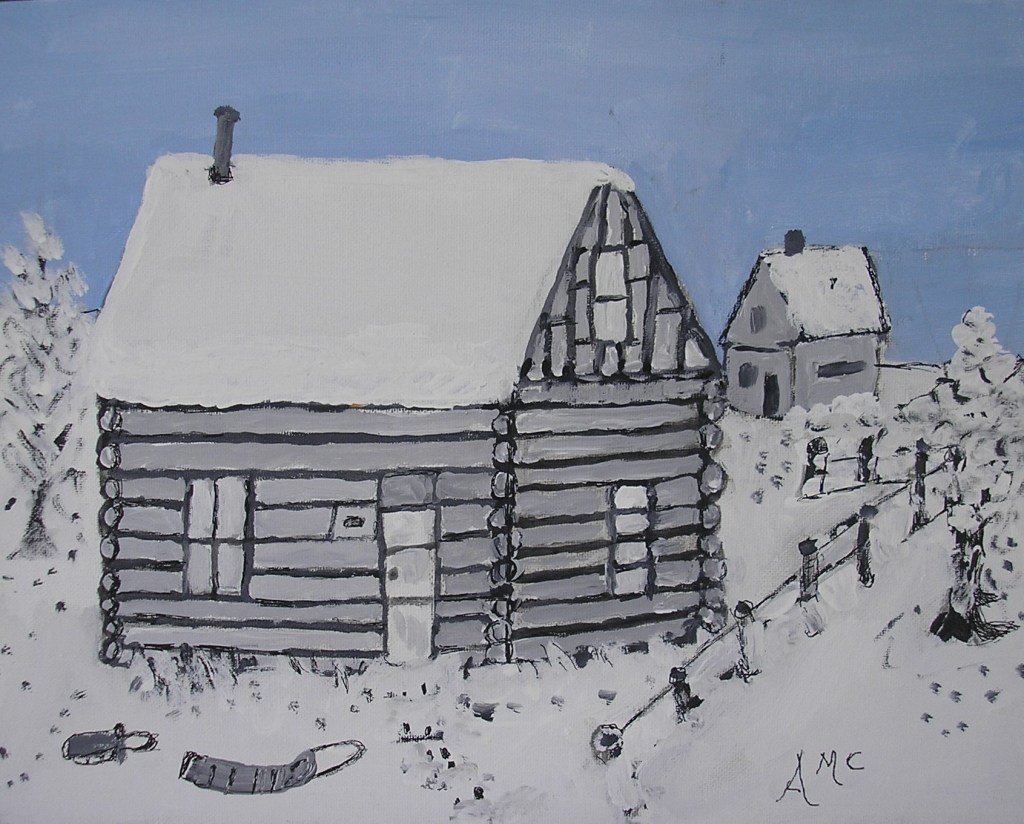
Their first homestead was on swampland and the water was bad, so eventually they moved to a different site a few miles down the road, where they build a log cabin, similar to this one I blogged about in my Pioneer Village post.   

The inspiration behind the painting….

This cabin dates from 1870, and is fairly large, with room for a farmhouse table and a sleeping loft above.    

A warm stove…

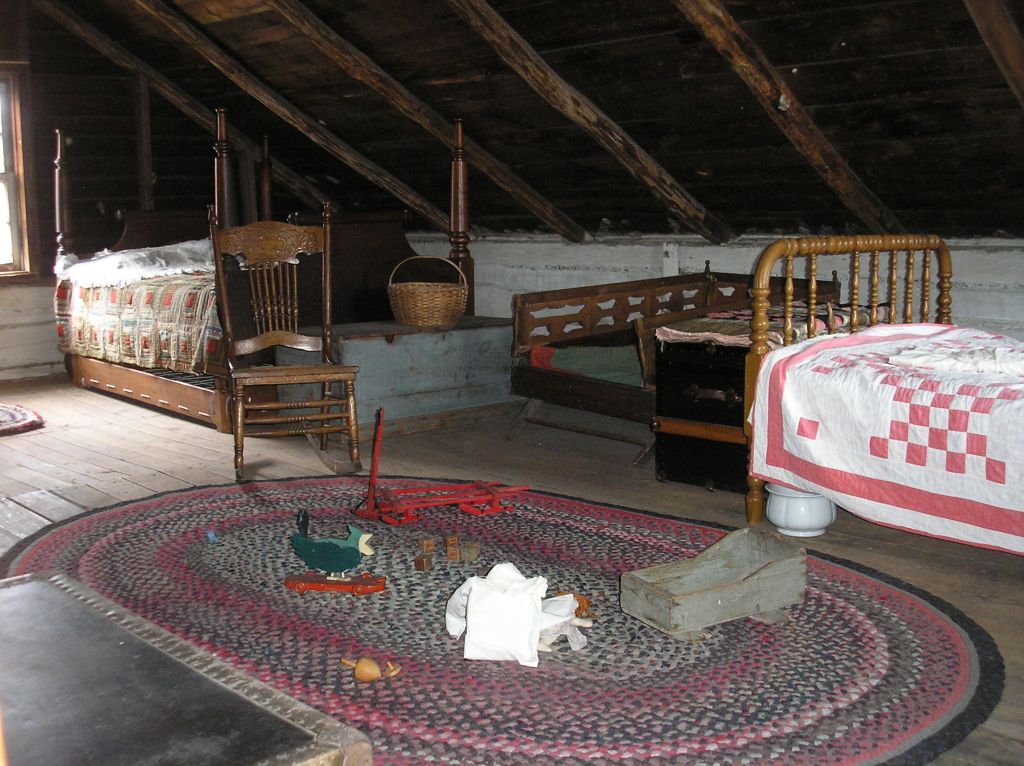
Another cabin on the site of the local Heritage Museum is much smaller, and housed just two people, a widow and her young son.  

The original Tiny House…

It was constructed in 1857 of lumber rather than logs, as there was a sawmill nearby – the interior is pine. With only two rooms, this typical first home was built quickly, as more effort went to clearing the land and planting crops.

While small in size, it was snug and warm with the long stove pipe circulating the heat across the house.  There was an additional sleeping space in the attic over the kitchen.

The rope bed was covered with a straw or feather mattress.

While the quilt is nice, it does make me grateful for my comfy bed, with its deep mattress, soft sheets and down comforter, and there’s certainly not much counter space in that kitchen!   

Now the local heritage museum is fund-raising to restore another log cabin.  

This one has an interesting and well-traveled history.   Originally built in 1840 in the Goderich area, it was disassembled in the 1930’s and floated down Lake Huron to a lakefront property where it was used as a summer cottage. In the 1970’s it was donated and moved to it’s current site in a local park where it was used for community events such as Christmas in the Park, until it fell into such a state of disrepair that it was deemed unsafe and they decided to tear it down and build a replica.   A great hue and cry ensued from the public and the local historical society, so they relented and at a cost of $50,000 are paying to have it relocated to the museum site for future restoration.  I know, it seems a lot of money to spend on a derelict old building but they waste money on other things, and how many 180 year old log cabins are left?  This will be it’s third move, but just look at that solid construction.    

No chilly drafts would come through those thick walls, but they do need to do something about the broken windows.      

I’ve been feeling bad about my house lately. My renos remain undone, dust bunnies abound and I don’t seem to have the energy to give it a good cleaning. My cleanliness standards have slipped considerably since no one is seeing it but me. Hopefully in March I’ll be motivated to give it a good spring cleaning.

But after a look at these humble abodes, I’m appreciating my own home and hearth more, and feeling better about cabin fever. We have so many more creature comforts today and all the modern conveniences. Maybe it really is all about perspective.

With no internet or Netflix to occupy themselves with what did they do for entertainment back then?   Being Irish, I’m sure there was music – the fiddle – and story telling often took the place of books, and I hope there was comfort food too – warm bread and  apple pies and taffy treats.  

So perhaps some things haven’t changed – after today’s dose of wintry weather it’s time for some beef stew. 

Supper by candlelight…

PS.  While researching this, I came across two books, The Lost Diaries of Susanna Moodie by Cecily Ross, a fictionalized historical novel based on the life of Susanna Moodie, a genteel English writer who immigrated to Canada in 1832. Moodie wrote about her experiences in the Canadian wilderness and subsequently published her memoirs as Roughing It In The Bush and Life in the Backwoods. I enjoyed the fictionalized book more, as it was rich in historical detail, although the first half in England was not as interesting. Both books depict a harsh life with many hardships and little in the way of fun or luxuries, a sobering look at the reality of pioneer life for many women.    

(1128 words)       

The Tall Ships

        The Tall Ships have come and gone, sailing away on a south wind and lots of good cheer, as the Gordon Lightfoot song goes.   They have spent the summer visiting ports along the Great Lakes and were in my vicinity for the weekend, attracting 100,000 visitors in the process.   You could purchase general admission day and weekend passes, as well as boarding passes that included deck tours, but as I am not a fan of big crowds or standing in long line ups in the sweltering heat, I viewed them from afar on Friday afternoon – along with thousands of other people lining the shore with the same idea!   

The Tall Ships

Among the six ships in dock, was The Bluenose II, a famous Nova Scotia ship,  and my favorite, the Nao Santa Maria, the flagship from the 1492 voyage Christopher Columbus made when he discovered North America.

The Tall Ships

Photo courtesy of Nao Santa Maria Facebook page

This replica was built in Spain to celebrate the 525th anniversary of the discovery of the new world and has spent the past two years touring various ports of call on this side of the Atlantic.   (The Nao Santa Maria has it’s own Facebook page if you wish to check if it will be in your area).    

The Tall Ships

We probably all remember the grade school rhyme, “In 1492, Columbus sailed the ocean blue,” and we may remember the three ships on that famous voyage, the Santa Maria, the Nina and the Pinta, but I was unaware that the Santa Maria did not make the return journey home as it had run aground on a sandbar in Hispaniola/Haiti on Christmas Day 1492. 

Shipwreck AMc

Shipwreck!

Here’s a link with more description about the three ships, and also a Wikipedia link with some information about the design, cargo, and the voyage.   As the largest of the three, the Santa Maria was the main cargo ship, carried the most men, 52 of the 90, and was considered an old tub too unwieldy to navigate river mouths and shallow bays, which was left to the smaller faster Pinta.   Columbus had struggled for years to obtain financing for his project (searching for a sea route to the far east and the treasures of Cathay), until the Queen of Spain reluctantly granted approval for the journey.    How overjoyed they must have been to have sighted land and being proven right, even though they were unaware at the time that it was a whole other unexplored continent.   

The Tall Ships

Ahoy mates! Land ahead! (Photo from Nao Santa Maria Facebook page)

Can you imagine travelling across the ocean in that for two months?    

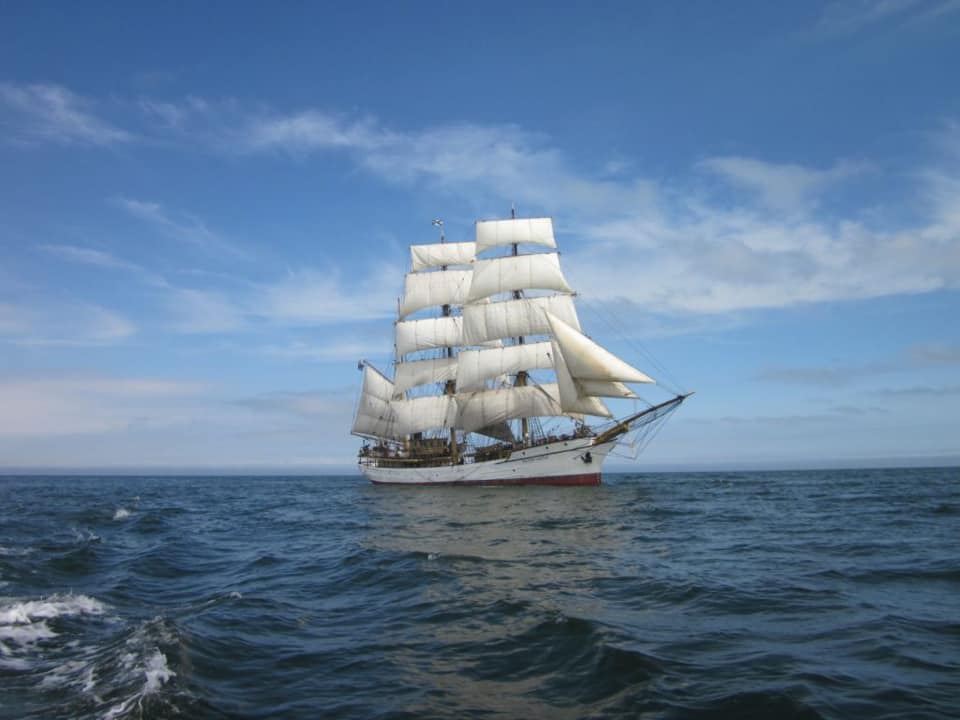
I had anticipated the opening Parade of Ships to be a glorious sight to behold – a beautiful sunny day, blue sky and water, white sails billowing in the breeze.  While the weather was okay (coolish, sunny but lots of clouds), there was such a brisk north breeze, it wasn’t really a Parade of Sails, it was a Parade of Masts! 

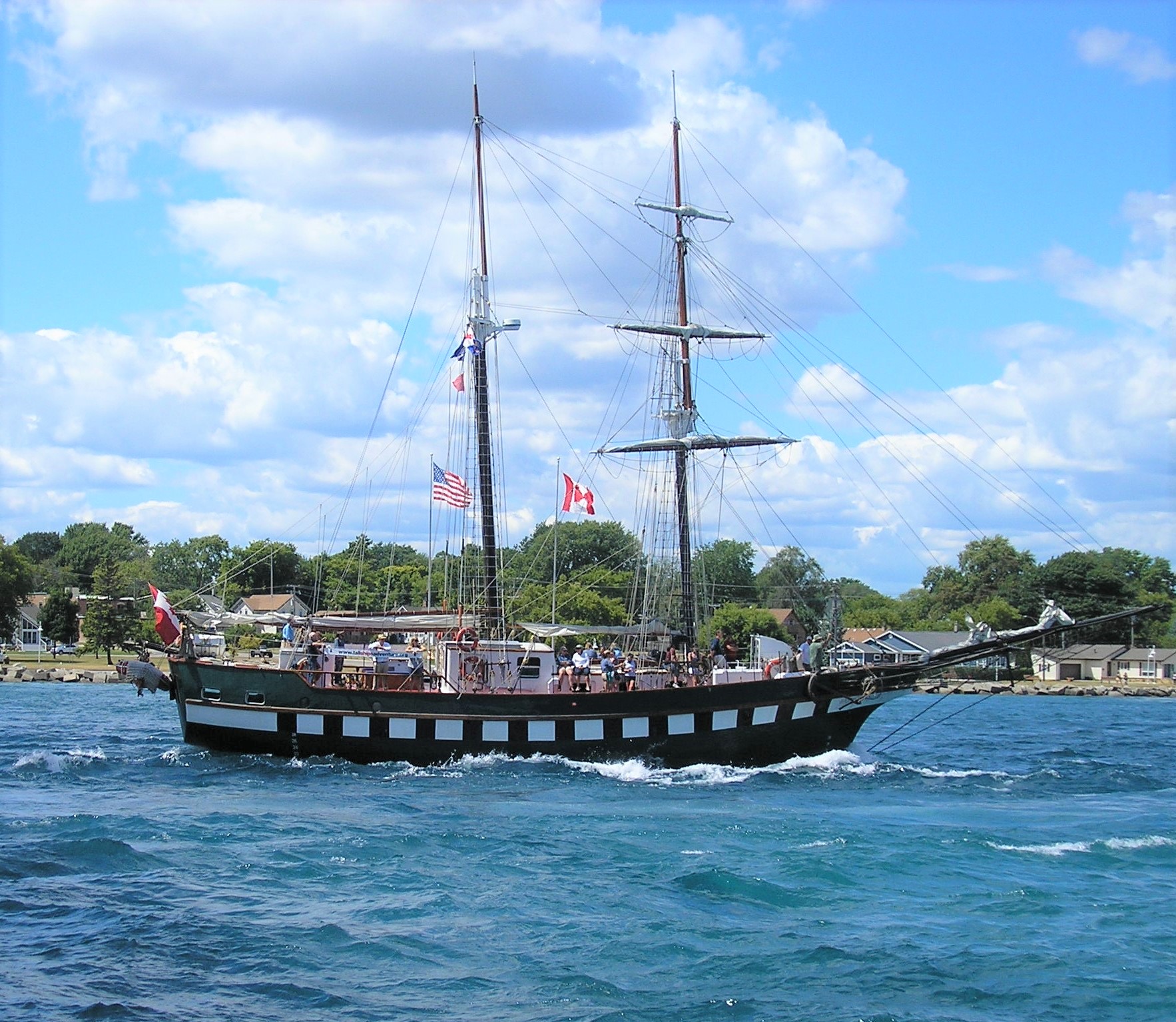
The water was so dark and choppy, I had to lighten my pictures to be able to see anything, plus a cloud managed to obscure the sun every time a ship went by.    One of the crew was quoted as saying the sails were not up for safety reasons, as the river channel was too deep and narrow to allow much maneuverability, and it was too windy and rough once they got out on the lake.   Plus, it wasn’t really a parade, as there were long gaps between the appearance of one ship and the next.   We chatted and visited with fellow sightseers, many of whom had driven great distances, and ate french fries from chip trucks under the bridge, which is one of the touristy things to do in this town.   This is the first ship which came along, although I don’t know the name, as I was too far away to see.  

The Tall Ships

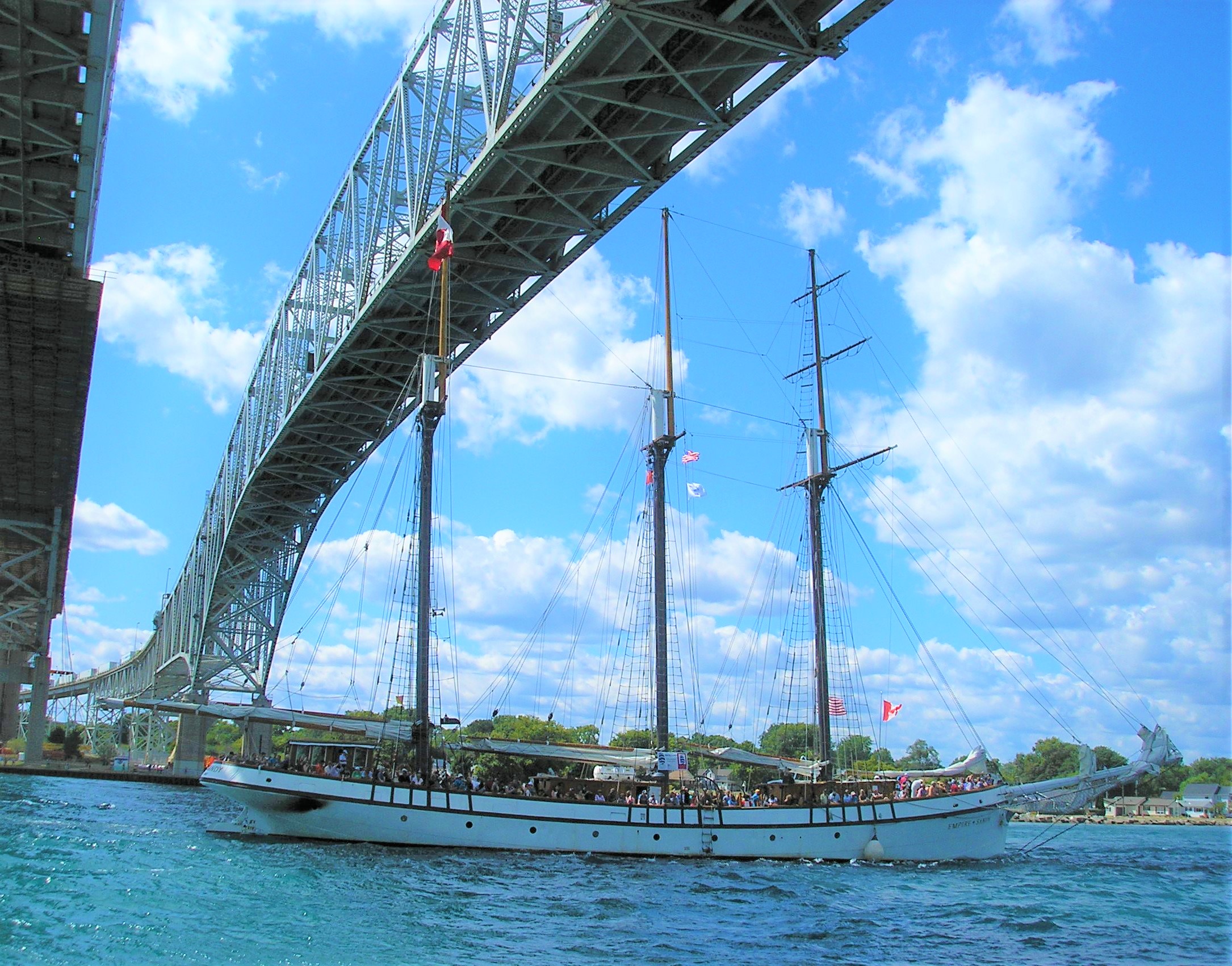
Several were so tall, we watched in awe as they barely cleared the bridge. 

The Tall Ships

The Tall Ships

For $120 you could go on board for a two hour cruise during the Parade of Sails, which was sold out, as were all the more reasonably priced ($85 and $60) morning and evening cruises where the proceeds went to charity.    I suspect the lack of sails was a liability issue also, as they wouldn’t want to risk anything with all those VIP’s and tourists aboard, especially if they were puking all over the nicely polished wooden decks.

The Tall Ships

I had a moment of regret, when the Empire Sandy went past.  It looked like such fun, and I don’t usually get seasick on boats, having been on cruise ships, ferries and even a small motorboat.         

The Tall Ships

But then I remembered the five days I spend on a Windjammer cruise in the Caribbean, back in my younger years, when I could more easily be talked into such things.   I’ve learned my lesson, while something might sound romantic and adventurous, the reality often doesn’t match up.   (Plus I require much more luxury in my vacations now).    I distinctly remember arriving in St. Marten’s and gazing at the small vessel in the harbor and thinking – no that could not possibly be it.   Nothing so small could hold 160 passengers and crew.   It did, except for the two who got off at the first stop and flew home, thus saving themselves four more days of misery.     Everyone on the boat was sea-sick the first 24 hours – the captain explained that was normal because the stretch from St. Martens to St. Kitt’s was notoriously rough.   (Well if that was the case, then why didn’t they depart from a port with calmer waters?)    He said most people were okay after the first day.   Many were not.   He said, stare at the horizon.   It didn’t help.   Better to be above deck, than below.   It wasn’t.   Have some more booze.   I don’t drink.   While the cabins were so small as to be claustrophobic, the rocking of the ship was somewhat comforting when you were tucked up in your bunk bed at night.   I tried not to think about the fact that only a foot of timber separated me from the watery depths.   The food was okay, if you could eat it.  (The dry crackers were highly recommended).    We visited St. Bart’s and a private island for a picnic and scuba diving which was a welcome break.    On Day 3, I applied one of those anti-nausea patches behind my ear – upon awakening on Day 4, I removed it, after walking into a wall and being told my pupils looked strangely dilated.  (Most fixed-dose drugs are not for me, as I am a featherweight).   Night 5 was particularly rough again, the rocking cradle turned into a see-saw, invoking a few prayers.   I was never so glad to see dry land again, and practically kissed the ground at the hotel.    The only good thing about the whole trip was the two days of shopping and restaurants in St. Marten’s capital city.  The only good thing about the ship was there was plenty of hot water in the showers, and they played Amazing Grace on deck in the evening when they unfurled the sails, a nice romantic ritual.   (Funny, I don’t remember the sails being raised during the day, probably too many drunken tourists about who might fall overboard).    Thank God a wretch like me was saved – but I swore never to set foot on a sailing ship again!

It may be exhilarating to be on board when the wind grabs the sails, but sailing is only for more adventurous souls, with strong stomachs.   For the rest of us, the Tall Ships are a pretty sight, best viewed from the safety of the shore.   

The Tall Ships

(photo courtesy of the Tall Ships Festival Facebook site)

Postscript:   Like the best of all plans, Columbus started small, with old ships.   News of his new world discovery spread quickly throughout Europe, so on his second voyage, he was given a fleet of 17 ships, with 1,200 men and the supplies needed to establish permanent colonies in the New World.  Which just goes to show how any new venture can start with one small step, which with a bit of luck and a favorable south wind, can turn into something much larger.