The Betrayal of Anne Frank – A Cold Case Investigation

     Imagine being stuck inside, in a small space, for two years, where going out meant risking your life.  No, it’s not the pandemic – it’s WW2, and the people in hiding are Jewish. 

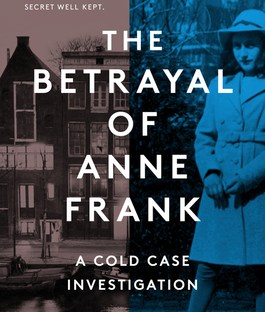
   Like many teenage girls of my generation, I read The Diary of Anne Frank, written by a fifteen-year-old Jewish girl in Amsterdam, when I was in grade school.   So when I saw The Betrayal of Anne Frank – a Cold Case Investigation by Rosemary Sullivan – on the new releases list, I knew I had to read it, and having read it, I knew I needed to blog about it.  The book is a captivating read, and a cautionary one.  It’s a timely topic, as with so much political turmoil in the world today, and so much divisiveness and hatred, it seems like history is repeating itself.          

Goodreads Publishers Blurb:

Using new technology, recently discovered documents and sophisticated investigative techniques, an international team—led by an obsessed former FBI agent—has finally solved the mystery that has haunted generations since World War II: Who betrayed Anne Frank and her family? And why?

Over thirty million people have read The Diary of a Young Girl, the journal teen-aged Anne Frank kept while living in an attic with her family in Amsterdam during World War II, until the Nazis arrested them and sent Anne to her death in a concentration camp. But despite the many works—journalism, books, plays and novels—devoted to Anne’s story, none has ever conclusively explained how the Franks and four other people managed to live in hiding undetected for over two years—and who or what finally brought the Nazis to their door.

With painstaking care, former FBI agent Vincent Pankoke and a team of indefatigable investigators pored over tens of thousands of pages of documents—some never-before-seen—and interviewed scores of descendants of people involved, both Nazi sympathizers and resisters, familiar with the Franks. Utilizing methods developed by the FBI, the Cold Case Team painstakingly pieced together the months leading to the  Franks’ arrest—and came to a shocking conclusion. 

The Betrayal of Anne Frank is their riveting story. Rosemary Sullivan introduces us to the investigators, explains the behavior of both the captives and their captors and profiles a group of suspects. All the while, she vividly brings to life wartime Amsterdam: a place where no matter how wealthy, educated, or careful you were, you never knew whom you could trust.

The Author: Rosemary Sullivan is the author of fifteen books, many of which are biographies, and the recipient of many international awards. She is a professor emeritus at the University of Toronto and has lectured worldwide.

Discussion:

     I found this book to be a fascinating but disturbing read. Cold cases are always interesting, but a famous cold case which is part of history, even more so, and trying to solve one seventy-five years later when all of the suspects are dead, almost impossible.

     Part One, the first hundred or so pages, deals with the background story.  For those unfamiliar, Anne Frank and her parents and older sister, along with another Jewish couple and their teenage son, and a local dentist – eight people in total – were hidden for two years in the upper annex of her father’s spice business, with the assistance of four of Otto Frank’s employees who brought them food and supplies.  The annex was at the back of the building facing a courtyard with a tree, Anne’s only glimpse of the outdoors for two years.  Based on an anonymous tip, the address was raided a few weeks before the liberation of Amsterdam, by a German Gestapo agent and three Dutch policemen.  They were all sent to concentration camps, and only her father Otto Frank survived, and later went on to publish Anne’s diary.    

     Part one introduces us to Anne’s world, and the complex politics of Amsterdam at the time, including the collaborators and the resistance movement.  It’s a fascinating look at just how quickly a normal life can deteriorate into one of treachery and survival.  It describes the political environment and the raid in detail, and the background and history of the people involved, including the policemen.         

        Part Two deals with the investigation of who had betrayed them.  The investigative team of thirty people, led by the retired FBI detective, narrowed thirty possibilities down to twelve scenarios, and then a further four, until they reached their final theory, based on a random note found in the archives, (no spoilers here) and note it is a theory, as there is no absolute proof which they made clear.

     Like any cold case, they looked at three factors – Knowledge, Motive and Opportunity.  Knowledge could come from rumors, observations, or resistance people being tortured. Motive could have been for money (there was a bounty of $7.50 guilders or $47 US for each Jew turned in), hatred or self-preservation, trying to stay on the good side of evil.  (Which begs the ethical question, could you turn someone else in to save yourself or your own family?)  Opportunity was having knowledge and access to the Germans or SD police.     

     Some suspects could be eliminated as they weren’t in the area at the time.  The team systemically went over lists of known collaborators and addresses from extensive war archives, reconstructing a  detailed map of the area.  They also designed a computer program to handle the masses of data.  There was so many archives to wade through that solving the case took several years.     

     Vince Pankoke, the lead detective said “there was no aha moment to end the investigation – the emergence of the betrayer was a slow coming together of evidence and motive, a jigsaw piece that suddenly undeniably fit.  He remarked that there was a weight of great sadness after the case was solved which has stayed with him since.” 

Additional Points of Interest:

     Originally born in Germany, Otto Frank had served in WW1 but had fled Germany in 1933 and set up a business in Amsterdam, a city known for its tolerance.  Yet the Netherlands transported more Jews to their deaths in concentration camps than any other country in Western Europe.  Of the 140,000 Jews living there, 107,00 were deported and only 5500 returned. There were an estimated 25,000 in hiding, one third of whom would eventually be betrayed.  

    We have the greed of the Gestapo agent to thank for the survival of Anne’s diary.  During the raid, Anne picked up her father’s briefcase which contained the diary to take with them.  The German police officer threw her diary with it’s checkered cover on the floor and filled the briefcase with the valuables and money that Otto and the others had managed to hold onto.  Had she taken it with her to the camp, it would have been destroyed.  After the raid, the two female employees rescued it and tucked it away for Anne’s return.  

      It was interesting to note how some of the interviewee’s memories (and their descendants), changed over the years.  Sometimes how people remembered things, did not jive with the documented reality, particularly after Anne’s fame grew.    

      In a particularly poignant section, Otto Frank describes Anne drinking in the natural world that had been denied her for so long, on the last train to Auschwitz.  It was summertime and she reveled in the fresh air and sunshine.   

     In one of the last pages of her diary, Anne writes, “It’s a wonder I haven’t abandoned all my ideals, they seem so absurd and impossible.  Yet I keep clinging to them, because I still believe, in spite of everything, that people are truly good at heart.” 

     It’s something to remember, that feeling of hope, especially at a time when the world seems to be tilting towards intolerance, that things can always be made right again.

     One final thought, you don’t have to like someone to help them.  My grandmother grew up in a southern rural area of Holland, and I remember her saying that her family had helped refugees during WW1.  (The Netherlands remained neutral during WW1 and attracted a flood of refugees.) They were from Turkey, and I also remember her saying that they were not nice people, but they helped them anyway.   My grandmother would have been 16 and it is debatable what would constitute not being nice at that age – being made to give up her bed, possibly being leered at, or the fact that they were gypsies, I believe was the word used.  Her parents were gone by WW2, although she had many brothers and sisters back home, but I never asked her, to my great regret, for any stories of those years.

PS.   You can visit the Anne Frank House and Museum in Amsterdam, (see online website for a one hour history and virtual tour of the annex) but anyone I know who has gone there has not been able to see it because of the long lineups. The Annex was accessed via a secret bookcase, (link to a 2 minute tour) and was fairly small to have housed eight people.  Here’s a youtube link to the only known video of Anne Frank on a balcony watching a wedding party. 

PS. One of my readers has mentioned that there has since been dissension about the research and conclusion of the book, to the extent that the Dutch and German publishers have suspended publication until they do a further review. Considering their end theory was a shocking revelation, and that Otto Frank (and his secretary) knew who had betrayed them for years and kept silent, and that the Switzerland foundation he set up in her name refused to cooperate in the research, it is not entirely unexpected for the book to be controversial. Readers wishing further information may google for more details.

Review of Books – Winter 2022

          Last July I did a review of the most memorable books I had read over the previous year – see A Reading Sabbatical.   I intended to do a quarterly review going forward, but other blog topics beckoned.  Since we’ve nothing much to do this time of year when we’re shut by the weather, here’s a summary of the (mostly) wonderful books I’ve read since.   Hopefully there will be something to tempt you to escape to another world for awhile….

Golden Girl – Elin Hilderbrand.    The protagonist, author of 13 beach novels and mother of three almost grown children is killed in a hit and run car accident while jogging near her home on Nantucket.  She ascends to the afterlife where she meets her guardian angel who allows her to watch what happens for one last summer.  She is granted three nudges to change the outcomes of events on earth but with her kids lives full of turmoil must decide when to use them.  

I can’t recall any other book where the protagonist was killed in the first chapter, so this was a unique twist on her usual drama-filled beach read.  This was intended to the author’s last novel, and seems somewhat semi-autobiographical, considering her bout with breast cancer five years ago.  For a swan song, it was a surprisingly good read, although being Elin Hilderbrand not without its annoying immature characters.   I wonder what she’ll do next?

Hostage – Clare MacIntosh –   You can save hundreds of lives – or the one that matters most.  A claustrophobic thriller set on a twenty hour plane flight from London to Australia.  The protagonist, a flight attendant with a five-year old daughter and a fracturing marriage back home, is handed a note by a hijacker, who knows exactly how to make her comply.  The anonymous skyjacker is part of a radical climate change group, and there is more than one of them seated among the passengers.   

If you can get past the premise that post 911, any flight attendant would ever allow anyone into the pilot’s cabin, then this was a very suspenseful read, and well done.  Clare MacIntosh at her best.  It seems like all my favorite suspense writers had excellent books out last year.  Perhaps one blessing of the pandemic was more time to write.

The Rose Code – Kate Quinn   A tale about the intertwined lives of three women codebreakers during WW2 and what destroyed their friendship. 

I honestly don’t remember much about this book, other than it was a good read.  There seem to be so many of these historical fiction books about WW2 lately that it’s hard to keep them all straight.

The Maidens – Alex Michaelides    A therapist becomes fixated on The Maidens, a secret society of female students at Cambridge associated with a handsome and charismatic professor of Greek Tragedy, after one of the members, a friend of her niece, is found murdered. 

The author’s first psychological thriller, The Silent Patient, was so successful (number one on the 2019 Goodreads mystery and thriller list), that it would be a hard act to follow, which he acknowledges in the notes.  This one also involves a therapist, and the author himself went to Cambridge, so perhaps he was writing about what he knows, but while I found it suspenseful, I didn’t find it nearly as good.  The whole idea of a secret sorority with slavish devotion to a professor seems like a throwback to the fifties, but then I’ve never been to Cambridge. 

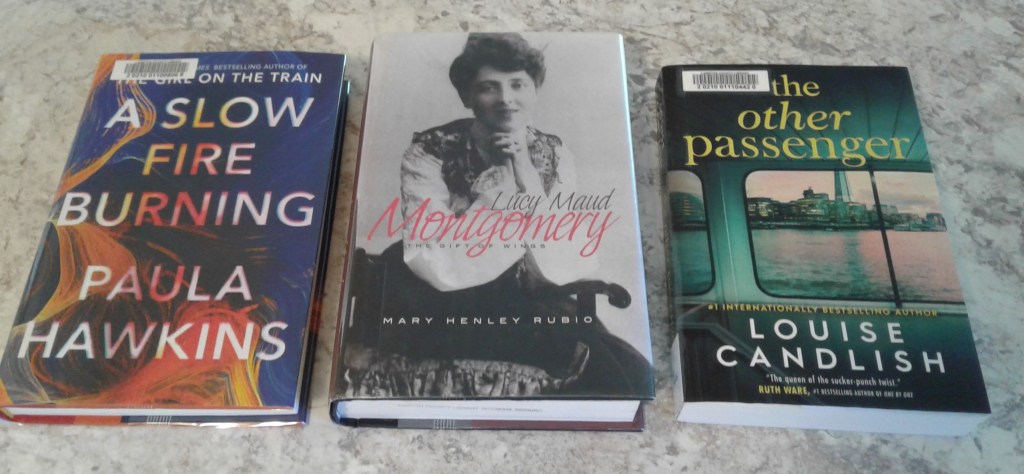
A Slow Fire Burning – Paula Hawkins.    Psychological thriller about a young man found murdered on a London houseboat, and the three women who knew and resented him. Laura, the troubled one-night stand last seen on his boat, Carla his grief-stricken aunt, already mourning the death of another family member, and Miriam the nosy eccentric neighbour who lives on an adjacent houseboat. 

Paula Hawkins wrote The Girl on the Train, and seems to specialize in damaged characters or misfits, but the character of Laura was so well done, you found yourself cheering for her.  It was interesting to read the point of view of someone normally shunned by society.  An excellent read with a satisfying ending, this was rated number one in the Goodreads Mystery category for 2021.  

L.M. Montgomery – The Gift of Wings – Mary Henley Rubio    The definite biography of L.M. Montgomery, by the esteemed author who edited her five published journals and had extensive access to papers and interviews never published before, including with LM Montgomery’s son.

I blogged about the life of L.M. Montgomery back in May (see link), and having read several biographies over the years thought I knew a lot about her, but I found this book absolutely fascinating, especially from a psychological point of view, as Maud was a very complex woman.  The depth of research in it was amazing, but then she knew her subject well from decades of study.  It’s a 2008 publication, so I had to order it from the library, but it was one of the best non-fiction books I’ve read this year.

The Other Passenger – Louise Candlish   Jaime, an older well-off male protagonist meets a group of fellow (“river rats”) passengers during his daily commute on a Thames riverboat in downtown London, including Kit a young hip debt-ridden twenty something, and they go for Christmas drinks.  The next time he takes the ferry the police meet him when he disembarks – Kit has been reported missing by his wife Melia and he was the last person to be seen with him…arguing.

Wow, this certainly had a lot of twists and turns.  So well done, which just goes to show you can tell a riveting story about the most dislikeable and unrelatable of characters.  The dedication at the front of the book said “For all those who think they want more” or words to that effect.  This was my first read with this award-winning British mystery author, and I was impressed.

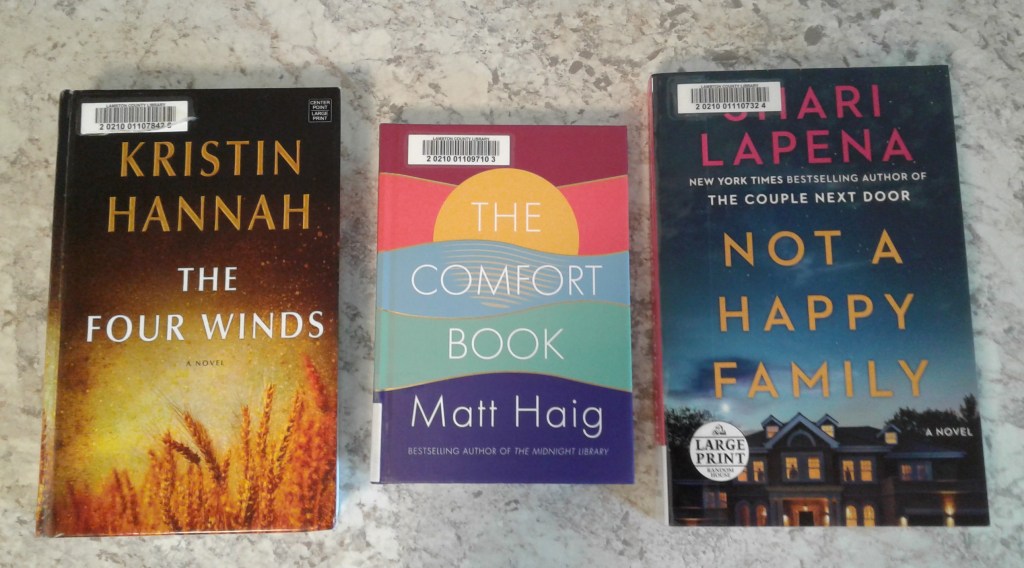
The Four Winds – Kristen Hannah    Historical fiction novel set in the Dust Bowl and the Great Depression, with a strong female protagonist who after being abandoned by her husband, goes west with her children in search of a better life.  

This was interesting read, but although it’s been compared to The Grapes of Wrath, it’s not Steinbeck.  Kristen Hannah wrote The Nightingale (2000), a novel about fleeing Paris during WW2, but I didn’t find this one quite as good, although she is excellent at describing the plight of refugees, and it is a forgotten historical period, one I knew little about.  I absolutely hated the ending, although I concede it was probably necessary.

The Comfort Book – Matt Haig    A slim collection of one-per-page notes, quotes and observations that serve as gentle reminders that life is not all gloom and doom.

I sometimes enjoy a Philosophy-Lite book, and while I liked his novel, The Midnight Library, I was never able to get into any of his other non-fiction essay type books, most of which deal with depression.  Some of the quotes were memorable, and I thought I might write them down, but now I’ve forgotten them.   

Not a Happy Family – Shari Lapena    When a wealthy couple is murdered the day after a contentious Easter dinner with their three estranged children, they stand to inherit the family fortune, unless one of them is responsible for the murder.

Well, the title says it all.  Shari Lapena is one of my favorite murder mystery writers, and I look forward to her annual offering.  This was good and certainly well done, but we’ve become so accustomed  to unexpected twists at the end, that when there isn’t one, it’s feels somewhat disappointing.

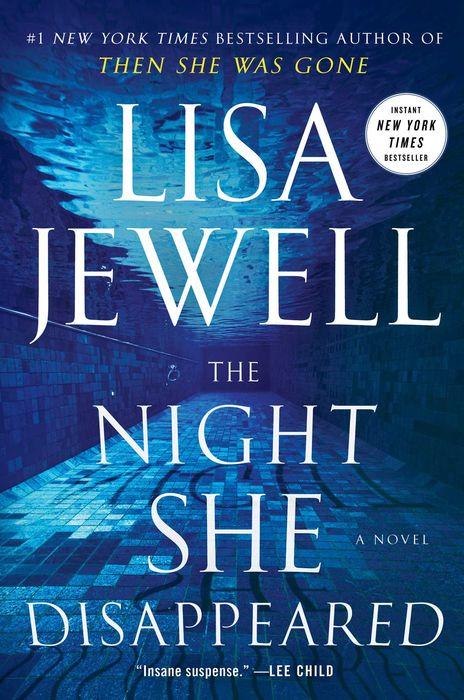
The Night She Disappeared – Lisa Jewell    A teenage mother leaves her baby with her mother while she goes out for the evening with friends, and never returns.  She was last seen going to a party at a mansion in the woods.  A cold case, an abandoned mansion and the kind of dysfunctional family Lisa Jewell does so well. 

Lisa Jewell is another of my favorite mystery authors and she’s really outdone herself in this latest one.

World War C – Sanjay Gupta     Lessons from the COVID Pandemic.

I debated not reading this, as aren’t we all sick of hearing about the pandemic, but it was quite interesting, but then I like a good science book.  His style is immensely readable, and I picked up some facts about the coronavirus I was unaware of.   25% of all mammals in the world are bats, and they tend to have immunity to coronaviruses.   Since the book went to press in the summer, it’s already out of date, but still a worthwhile read.

The First Survivors of Alzheimer’s – edited by Dale E. Bredesen MD   Seven patients talk about how they recovered life and hope in their own words.

I saw this on the shelf at the library and was curious, especially since I had read Sanjay Gupta’s book about building a better brain and the preventative changes we can make in middle age.  It’s edited by a physician who has developed a certain treatment regimen.  The patients were in the self-reported early stages of mild cognitive decline. While the patient’s stories were interesting, they never really explained what the regimen involved. I guess you have to buy his first two books for that. After I got to patient seven who was gulping down 40 pills a day, I lost interest. Not recommended at all.   

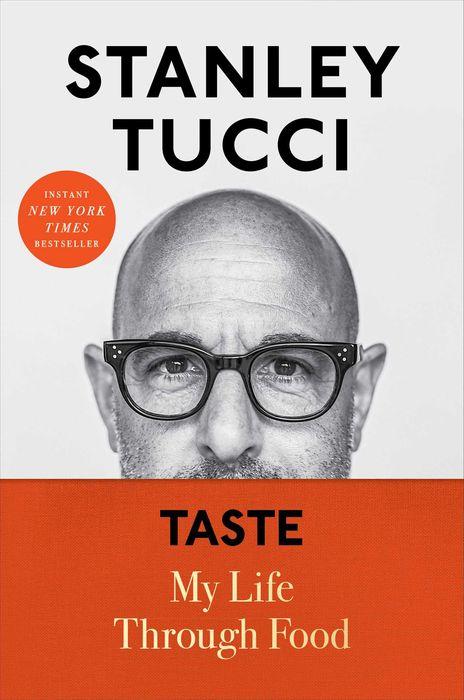
Taste – My Life Through Food – Stanley Tucci    Food memoir by the actor Stanley Tucci.

I loved this book and blogged about it in November. (see link)  This was my favorite non-fiction read of the year, and you feel like you’ve found a new friend when you’re done. 

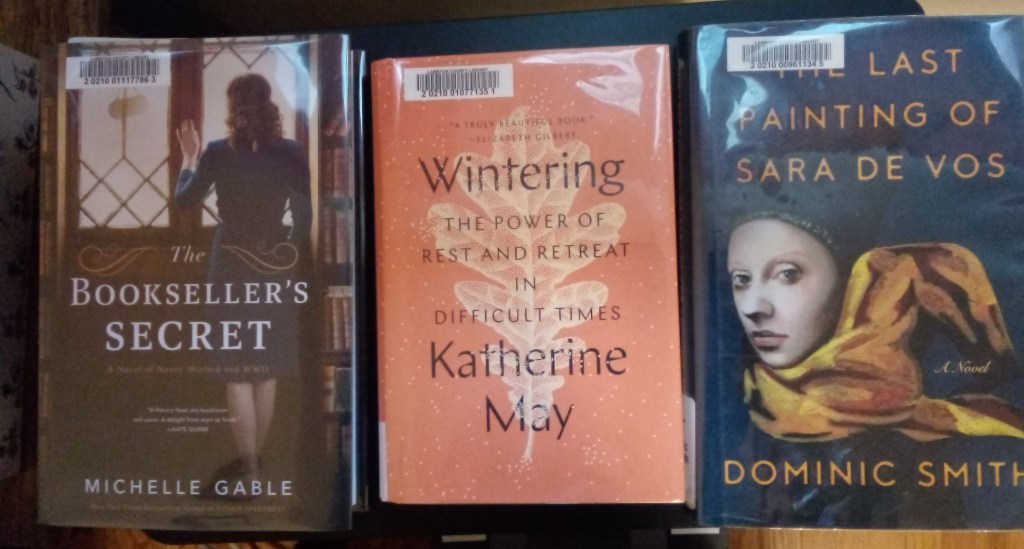
The Bookseller’s Secret – Michelle Gable –  A Novel of WW2 and the Mitford sisters

I’m a sucker for any title with a bookstore in it.  Another historical WW2 novel involving a modern-day journalist and a forgotten manuscript but as I don’t care about the Mitford sisters I never got past the first few pages. 

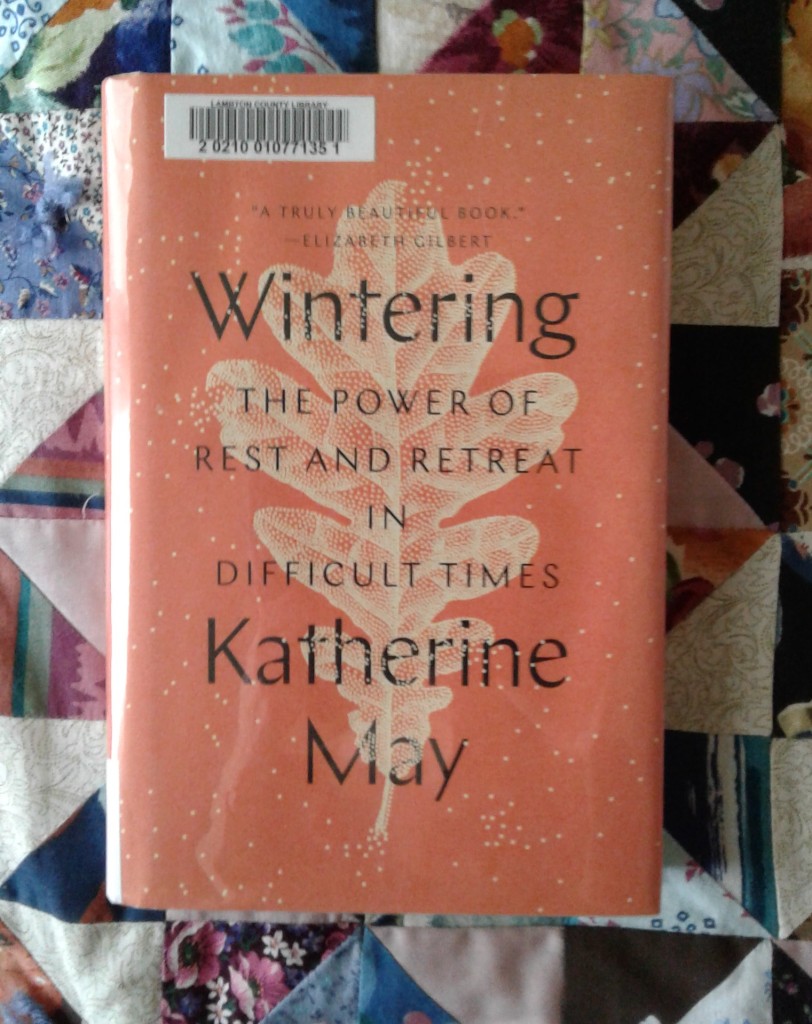
Wintering – Katherine May  –  a book of personnel essays about wintering the difficult periods of our lives.  

Blogged about it – (see link) – loved it – such wonderful writing.   Hope we hear more from this British author. 

The Last Painting of Sara De Vos – Dominic Smith   A novel about art and forgery, spanning three continents and three time periods.  A rare landscape by a female Dutch painter of the golden age, is on a collision course between the inheritor of the work in 1950’s Manhattan and the celebrated art historian in Sydney who painted a forgery of it in her youth.

I would like to know more about the art world and thought this was a good premise for a novel.  A good read, nice writing.  A prize-winning author, but it’s the first book of his I’ve read.     

The Last Thing He Told Me – Laura Dave   Wife is handed a note – Protect Her.  Mystery about a man living a lie and his new wife and 16-year-old daughter who band together to discover what happened after he suddenly disappears. 

This was a selection of my book club and a Reese Witherspoon pick as well.  Very well done for one of those how well do you really know your spouse genre mysteries.  A satisfying ending.   

Wish You Were Here – Jodi Picoult     Thirty something art specialist who has her life all mapped out, travels to the Galapagos Islands alone when her surgical resident boyfriend must stay behind in New York to deal with the early days of the COVID crisis (2020), and then starts to re-evaluate her life, job and relationships.

She’s one of my favorite authors, but I’ve barely recovered from her previous disaster The Book of Two Ways – that 400-page tome about death doulas/Egyptian mythology/archeology digs/AI/old boyfriends/parallel universe with the totally ambiguous ending.

First of all, I hate a dumb protagonist. If an island is closed and they tell you to go home, don’t act like a rich entitled tourist and stay and then gripe about it.  I was so irritated by the main character and the whole premise that I was going to abandon it, because of course she meets someone on the island, and there are some truly laughable love scenes……but then……around page 190…..it all changes.  What a brilliant piece of trickery! So, my advice would be to stick it out, although after the “sudden revelation,” I did guess the ending. I wouldn’t go so far as to say she’s gotten her groove back, but it’s close.  I just hope she doesn’t start writing romance novels because love scenes are not her forte.  

One word of caution though – do not, repeat, do not read this in the ER dept as I did, (for a non-COVID issue), and also if you have lost someone to COVID or are paranoid of catching it then best to skip it altogether.  Her boyfriend’s texts/emails contain way too much ICU detail, and aren’t we all sick of the pandemic anyway – do we really want to read about it, even in a novel?   

So curl up with a cat and a cup of tea, and a good book! I hope this wasn’t too long, but for book lovers can there ever be too many books to check out?

Wintering

If wintering is a verb then we all need to learn to winter – to rest and recharge, especially in difficult times.  Wintering can be a season to survive, a respite from the busyness of the rest of the year, or a state of mind such as a feeling sad or depressed. 

Winter is often a time for retreat – never more so than this year.  Usually I don’t mind the month of January, and enjoy the excuse to stay home when the weather turns nasty, but this year it just seems like more of the same.  So it was with interest that I saw a review on someone’s blog of a non-fiction book called Wintering, by Katherine May.   As I sometimes enjoy a light philosophical read, I ordered it from the library, but found it so interesting and well written that it might go on my purchase list.  (I usually only buy books I intend to re-read.)

The crazy quilt behind the book is perfect for winter slumbering

Here’s the Publishers Blurb:  Sometimes you slip through the cracks: unforeseen circumstances like an abrupt illness, the death of a loved one, a break-up, or a job loss can derail a life. These periods of dislocation can be lonely and unexpected. For May, her husband fell ill, her son stopped attending school, and her own medical issues led her to leave a demanding job. Wintering explores how she not only endured this painful time, but embraced the singular opportunities it offered.

A moving personal narrative shot through with lessons from literature, mythology, and the natural world, May’s story offers instruction on the transformative power of rest and retreat. Illumination emerges from many sources: solstice celebrations and dormice hibernation, C.S. Lewis and Sylvia Plath, swimming in icy waters and sailing arctic seas.

Ultimately Wintering invites us to change how we relate to our own fallow times. May models an active acceptance of sadness and finds nourishment in deep retreat, joy in the hushed beauty of winter, and encouragement in understanding life as cyclical, not linear. A secular mystic, May forms a guiding philosophy for transforming the hardships that arise before the ushering in of a new season.

About the Author:

Katherine May is a freelance writer of both fiction and nonfiction, and previous creative writing teacher.  Her journalism and essays have appeared in a number of publications, including The Times, Good Housekeeping and Cosmopolitan.  In the book she reveals she has Asperger’s Syndrome.  “I learned to winter young. As one of the many girls of my age whose autism went undiagnosed, I spent a childhood permanently out in the cold.” (page 11)

Discussion: 

As we’ve just passed the winter solstice, this is a book to curl up with and enjoy in the deep dark depths of January.

The book is a series of personal essays, divided into chapters, from September to March, with further sub-titles such as Slumber, Light, Midwinter, Snow, Cold Water, and Thaw.

I especially enjoyed the chapters on hibernation, (who knew dormice and bees could be so interesting), slumber (isn’t it always easier to sleep in the winter), and light (seeking out the northern lights in Norway).  As the author lives by the sea in England, and has not experienced the full force of a brutal snow-filled winter, she journeyed north to seek the cold and snow and to view the Northern Lights.         

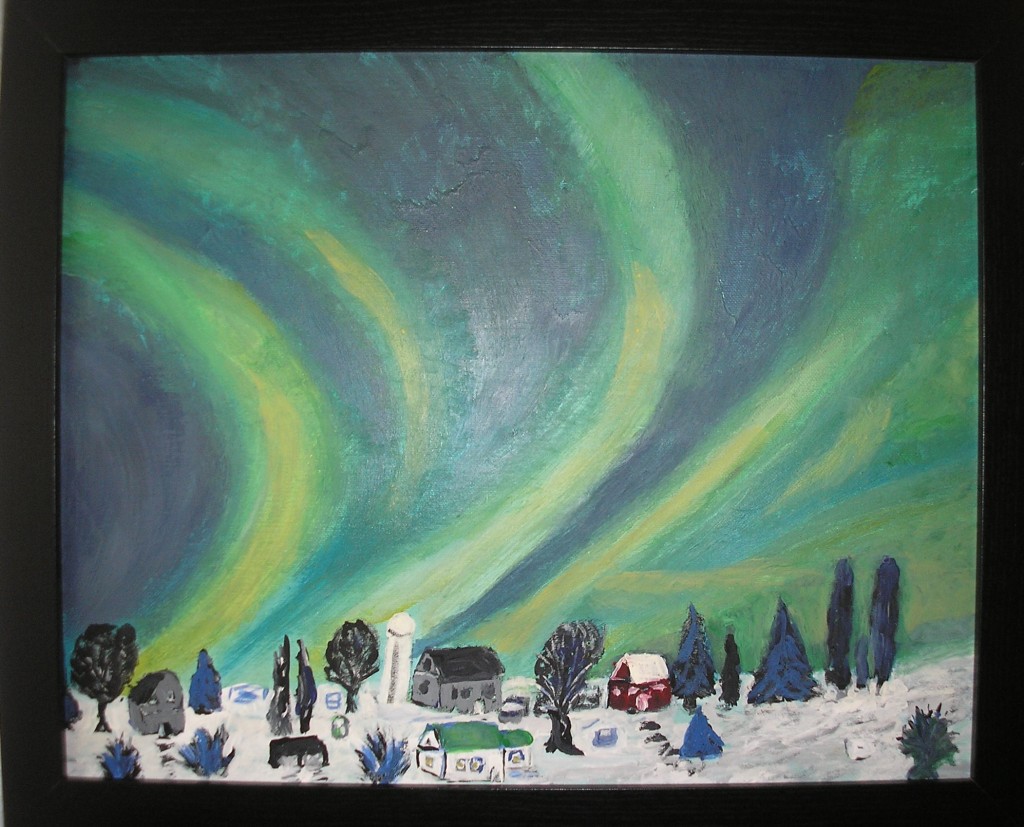
Northern Lights over the Farm

She also visited Stonehenge during the Winter Solstice. There’s a chapter on light (the festival of St. Lucia), on cold water (taking the polar bear plunge) and snow (winter walks in nature are much easier on a British beach than trudging through snowdrifts).

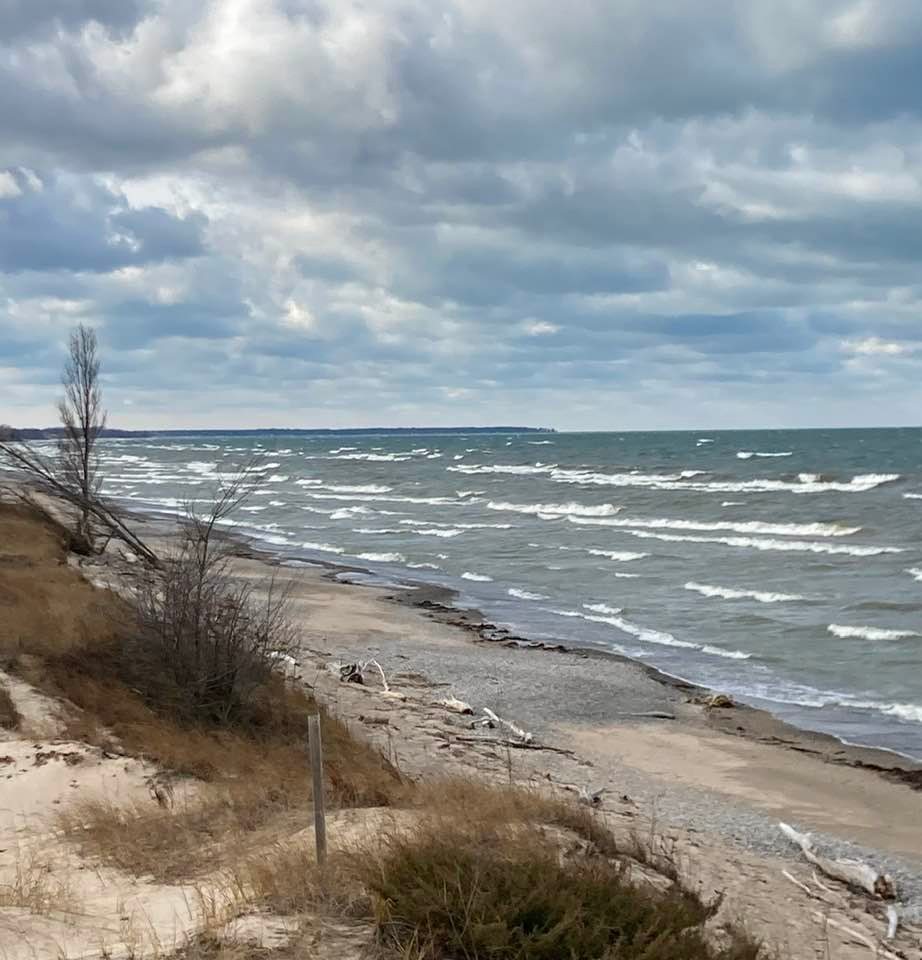
Our beach in winter (December) before the snow.

Here’s a Goodreads link to some quotes from the book for a sample of her writing. The prose is so lovely, I would recommend it for that reason alone, even if you weren’t interested in the topic.   No wonder Elizabeth Gilbert praised it as “a truly beautiful book.”

She also mentions a poem by Syliva Path titled “Wintering” which I was not familiar with, but I imagine inspired the title of the book.   

It’s difficult to sum up what this book is actually about, it’s not advice, or self-help, but more meditative reflections on a season we all must go through. 

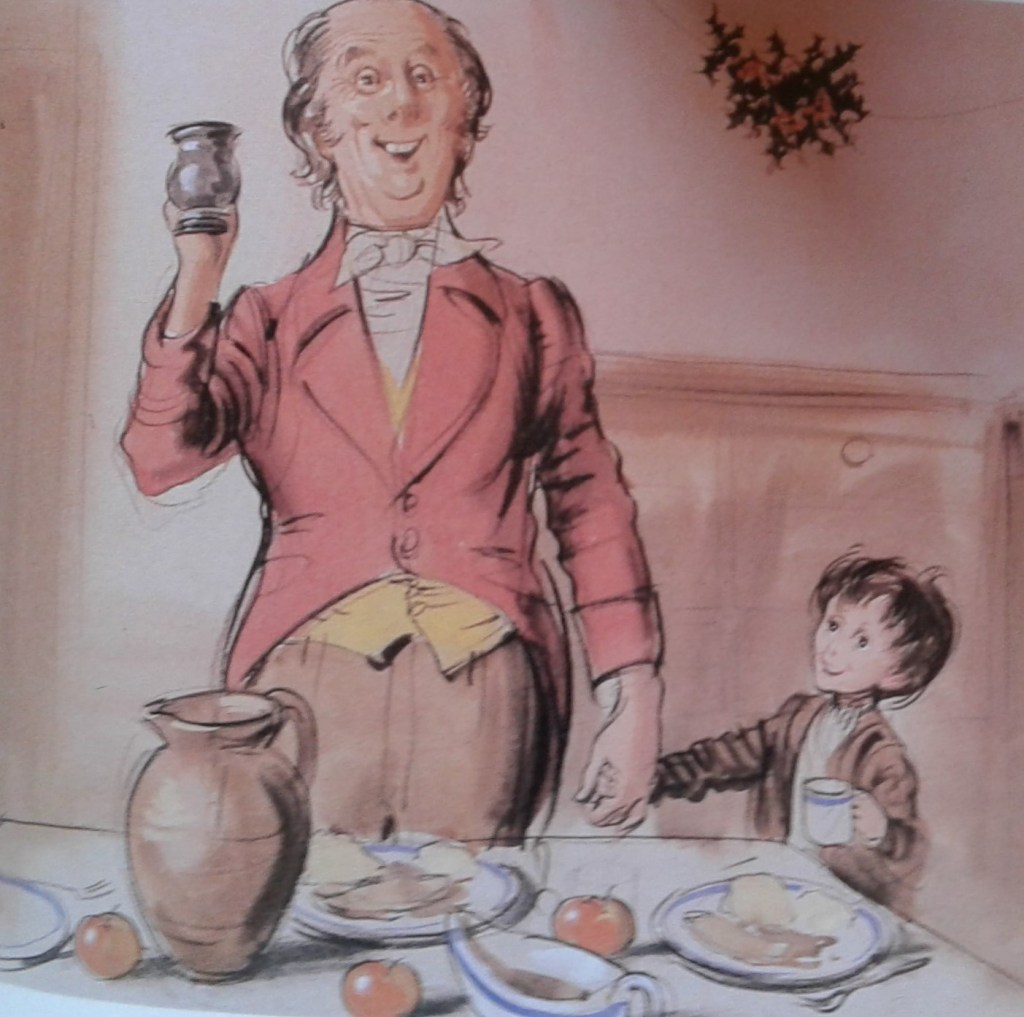
Winter! Bah Humbug!

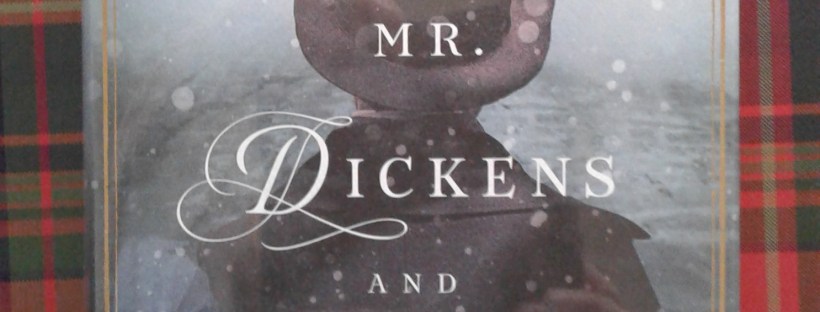
Mr. Dickens and His Carol – The Literary Salon

It’s that time of year again – time for me to blog about one of my favorite books, A Christmas Carol by Charles Dickens. Recently, my library book-club chose Mr. Dickens and His Carol by Samantha Silva – a fictionalized account of how this famous book came to be written.

Publishers Blurb: Charles Dickens is not feeling the Christmas spirit. His newest book is an utter flop, the critics have turned against him, relatives near and far hound him for money. While his wife plans a lavish holiday party for their ever-expanding family and circle of friends, Dickens has visions of the poor house. But when his publishers try to blackmail him into writing a Christmas book to save them all from financial ruin, he refuses. And a serious bout of writer’s block sets in.

Frazzled and filled with self-doubt, Dickens seeks solace in his great palace of thinking, the city of London itself. On one of his long night walks, in a once-beloved square, he meets the mysterious Eleanor Lovejoy, who might be just the muse he needs. As Dickens’ deadlines close in, Eleanor propels him on a Scrooge-like journey that tests everything he believes about generosity, friendship, ambition, and love. The story he writes will change Christmas forever.

Discussion: I’ve blogged before (see link) about The Man Who Invented Christmas, by Les Standiford, a non-fiction book which delved into the history of Dickens classic tale, and the inspiration for the plot and characters. Ms. Silva’s book is historical fiction, and common to the genre, she has taken great liberties, first in imagining his muse – a lady he met on the streets of London during his customary night-time wanderings while plotting out his books. Having read several biographies of Dickens life I’m fairly certain no such woman existed, but as he is reputed to have left his wife and ten children for a much younger actress towards the end of his life, perhaps that is where she got the idea? In this book his wife and children depart for Scotland, angry over Dickens decision to pay an impromptu visit to his first love, and he is left alone to ponder his problems. (Serves him right – maybe he was a bit of a player?) Second, we’re a hundred pages in before the woman-of-mystery-muse is introduced, and not one word has yet been written, but as I recall Dickens wrote his novella over the course of six weeks, not two as she says. I guess I like my historical fiction to be somewhat factual. Third, was the inspiration for Scrooge, Dickens himself? The idea is intriguing, and she has a plausible explanation for the age difference, but somehow it just doesn’t translate.

The book jacket describes the author as a writer and screenwriter from Idaho, and she mentions several near misses in selling the script to Hollywood. As this and the Standiford book (a much better book, if a mediocre movie) came out the same year (2017), she decided to adapt it into a novel instead. That must be frustrating for an author – to find out someone else has a similar idea, especially after you’ve poured your heart into it. For a debut novel, it is well-written, in a style somewhat reminiscent of Dickens.

As I’m only half way through, it wouldn’t be fair to critique it too harshly, but it’s light fluffy fare – but then sometimes that’s exactly what you need, especially at Christmas. Save the heavy stuff for the fruitcake. I’m not sure why the book-club chose this, but it’s no fault of the librarians, as they’re limited to the book club kits purchased by someone else. Perhaps it was just a seasonal selection which sounded promising. The chapters are short, the plot thin, and I’m not sure what there would have been to discuss but as the book-club is now virtual, perhaps they just toasted with some hot rum punch and wished everyone a Merry Christmas.

Merry Christmas and God Bless Us Everyone!

(Edited to add – I stayed up late last night and finished it, and the last fifty pages and ending were surprisingly good! – so I would give it a 3 out of 5)

A Food Memoir and Some Music

My regular readers may have noticed my lack of baking blogs lately. That’s because I had my cholesterol tested last June and it was borderline. Borderline is worse than bad, as borderline means you should watch it, whereas bad means you absolutely must, but either way you feel guilty when you don’t.

But there’s nothing to say that you can’t read about food. I absolutely devoured this month’s Literary Salon selection – Stanley Tucci’s bestseller, Taste: My Life Through Food. (goodreads link) This is a book for both foodies and non-foodies alike.

I must admit, I didn’t even know who Stanley Tucci was, other than that guy who ate his way through Italy last spring on those CNN TV specials – Searching For Italy, where he would visit a different city each week and explore their food culture, of which I only caught the episodes on Florence and Milan. (It’s been renewed for season two next year) He was sort of a replacement for the late Anthony Bourdain, but they must have known he had the book coming out. (His wife is a literary agent in London.) So when I saw the reviews were unanimously positive, I put it on reserve. As well as being an author, he has starred in 70 movies, although the only ones I can recall are Julie and Julia (where he played Paul Child) and The Devil Wears Prada, and also The Hunger Games. He’s the kind of nondescript actor you can easily overlook, but his book is one of those interesting reads you can’t put down.

Growing up Italian, food was always important to him, especially pasta. There are a few recipes scattered throughout the chapters, but maybe you have to be a pasta-lover to fully appreciate them. It may be blasphemous, but to me all pasta tastes the same. Yes, I know, the different textures help pick up the various sauces and fillings, but to me it’s all just pasta. But I do have a mild allergy to garlic, so I might not be the best judge.

I had many Italian friends growing up as I attended a Catholic high school. Their food was different than the meat-potato-veg fare we ate at home. Their desserts were different too – I remember in particular a cake so liquor-soaked you could get drunk on it. While Stanley Tucci came from Italian roots, he grew up in the suburbs of New York. I had to laugh when he wrote about his class-mates wanting to trade their peanut butter or baloney sandwiches for whatever tasty leftovers his mother had put in his lunchbox, scoring some extra Twinkies in the process. (My favorite was always those chocolate Hostess cupcakes with the cream filling in the centre, which we did not get very often.)

As Stanley Tucci has just turned sixty, the first few chapters are about growing up in the 60’s and 70’s. When he was thirteen his father took the family to Florence for a sabbatical year, (in the TV episode he took his parents, now in their eighties back to revisit the city), so the first time he ever ate in a restaurant was in Rome. They did not eat out very often in Florence, as a high school art teacher’s salary did not extend to dining in restaurants, but his mother cooked wonderful meals at home.

It’s hard to imagine not eating out in restaurants, but if you grew up in that era, most people didn’t, other than MacDonalds or a diner or burger joint. I was 19 before I ate Chinese food, let alone experience any other culture. My mother’s nod to pasta was spaghetti with Campbell’s tomato soup as the sauce. Ragu was a big improvement. By high school my Italian had stretched to pizza.

There’s a chapter about the food and catering on movie sets (I haven’t quite forgiven him for eating puffin in Iceland, even if there are 8 million of them), and a chapter on cooking during the pandemic while at home with his wife and children – he has two young kids and four over 18. He lost his first wife to breast cancer in 2009. He met his second wife at her sister’s (Emily Blunt) wedding (they bonded over their shared love of food) at “a venue that could be George Clooney’s villa” – there’s some name dropping, but in a fun jesting way. “A man who resembles Colin Firth” was very helpful in taking him to ER when he was nauseated after his chemo treatments. And Ryan Reynolds, what a kind soul to lend him his New York apartment while he was undergoing radiation treatment.

On the tv episodes I often wondered how he stayed so slim? He says he has always had a fast metabolism, but the last chapter of the book deals with his 2017 bout with tongue cancer. For a person so devoted to food, to have such a diagnosis must have been devastating, especially having been through cancer with his first wife, and now having a young family with a two year old and a baby on the way. After surgery, chemo and radiation, he endured 6 months of tube feeding, and then two years of not being able to taste food, and a heightened sensitivity to hot and cold. But he came through it, being all the more appreciative of surviving, and being able to taste once more.

This is an entertaining read, as well as a revealing personal memoir. The descriptions are witty and funny and it’s just lovely writing. One small complaint, which spoiled it for me a bit, was the number of swear words. It seems to be a fad these days, but to me it’s just not literary, and if that is the only adjective you can come up with to describe a dish or restaurant, then you must be channeling Anthony Bourdain. So for that I subtract one star….and maybe another half-star for the lack of any reference to gelato.

And now for the music part – I saw Billy Joel sing this in concert when I was a poor student in the 70’s – back when Italian food was a plate of homemade lasagna and a bottle of Mateus.

“A bottle of white, a bottle of red
Perhaps a bottle of rose instead
We’ll get a table near the street
In our old familiar place
You and I -face to face

A bottle of red, a bottle of white
It all depends upon your appetite
I’ll meet you any time you want
In our Italian Restaurant”

A Reading Sabbatical

I once read about a woman who took a reading sabbatical.   She packed up a whole load of books and escaped to an isolated cottage in another country and read….and read….and read.   Sounds like the ideal vacation to me, and having a whole year to do nothing but read would be like heaven…..and so it has been during the pandemic. Not that there haven’t been other things to do while stuck at home, but there’s certainly been plenty of time for my favorite activity.

quote by Jane Austen

When I was younger and in the habit of escaping the Canadian winter for a week down south, I would always tote a pile of books in my suitcase (this was in the days before e-Readers) and spend at least half of the time poolside with a good book, the other days being devoted to exploring whatever tropical destination we happened to be in.  One vacation sticks out in my mind, a week on Turks and Caicos, long before it was developed, with five boring books and no way to buy more. The only shopping centre was a strip mall of offshore companies and one souvenir shop devoid of even a rack of paperbacks. For a reader, there’s nothing worse than being stuck on a tropical island with a bad selection of books. I don’t scuba dive/snorkel/can’t even swim, so after my daily walk on the lovely and pristine beach I was bored to tears.

I find other people’s bookshelves fascinating. When they’re interviewing some expert on TV about some matter of vital importance, I’m usually studying the bookshelves behind them and wondering what’s on them, and being envious if they are the nice floor-to-ceiling ones, preferably in white, which I can not install as I have hot water heat rads.

I average about one book a week, and start to feel antsy if I don’t have several in reserve, but this past year my intake has increased dramatically. I spent the first few months of the first lockdown working my way through my stash (18) of mostly non-fiction volumes from bookoutlet, but when the library reopened last summer for curbside pickup it was like Christmas in July!

I keep a book journal where I sporadically list the books I’ve read, usually just tossing the library slips in for later recording. I had intended to do a quarterly review here on the blog, but other topics got in the way, so while I’m not going to list or link to all the books I’ve read during the past year, or even make a best of the best list, here’s a sampling of some of them, with some (honest) observations.  

I should note that when I used to do book reviews on Goodreads, before I started blogging, I rated everything a 4, with an occasional 3 or 5, because I only reviewed books I liked. If the book was boring or not to my taste I would not finish it and so left the skewering to other folks. This was partly in an effort to be kind, keeping in mind that the author had poured much time and effort into something which after all did get published, and partly because reading is so subjective. Just because I didn’t like it, didn’t mean someone else wouldn’t enjoy it. But every once in awhile a book, usually a much-hyped bestseller, would annoy me so much that I would pen a fairly blunt review…..so expect things to be a bit more judgmental here. I haven’t had the best selection this past year, not being able to browse the shelves of my local library or bookstore so I was more reliant on the publishers PR, which sometimes can be disappointing.

I love vintage fashion so I thought The Grace Kelly Dress would be an interesting read.  Years ago, I read a historical fiction book about the designers behind Jackie Kennedy’s iconic pink boucle suit so I thought this would be something similar, but more of a three generational saga.   It was not – it was a whole lot of drama about saying yes to the dress, and the lavender-haired multi-tattooed tech CEO millennial granddaughter eventually said no to her grandmother’s historic couture gown and had it cut down into a pair of trousers.  (There I just saved you from a painful read).  I don’t think the author intended to make a statement about the difference between the generations but that’s what came across.  The 50’s were a much classier era, people had manners.

Separation Anxiety was a DNF (Did Not Finish) – it was on a recommended list but I found the plot so stupid (middle-aged woman facing empty nest “wears” her dog by carrying it around in a sling? – see cover photo) that I never even got past the first ten pages, other than to skim the ending and see she if she stayed with her lazy weed smoking husband. It was supposed to be hilarious and heart-breaking – it was neither. Sad, when the author hadn’t written anything in over a decade, that this is the best she could come up with.    

Sophie Hannah had been recommended to me as a good mystery writer and as she has been appointed the heir apparent to carry on Agatha Christie’s Hercules Poirot series (I read the Killings at Kingfisher Hall) but not being a big AG or HP fan, I decided to try one of her own books.  Perfect Little Children was a long disappointing read – you simply cannot have a murder mystery with only one suspect.   I kept waiting for the twist at the end but there wasn’t one.

I enjoyed the two non-fiction books so much I blogged about them – see The Library Book post and Secondhand – Travel in the new Global Garage Sale.

Every year I swear I’m done with Elin Hilderbrand and yet I find myself ordering her latest.  Her characters are now middle-aged and they need to grow up and stop drinking, and driving, and she needs to stop killing them off in the last chapter.  Troubles in Paradise was was the last of her winter Caribbean trilogy, but I’m long past the age where living in a tropical paradise would have any appeal to me.

In A Time for Mercy – John Grisham revisits the small southern town of his first book (which I’ve never read), 25 years later.  This was a captivating read, but I find sometimes his endings just dwindle away – it’s like he’s done with it, reached his word count, and that’s that. I also read his Camino Winds – a murder mystery set on an island off the coast of Florida during a hurricane. Good descriptions of the hurricane, but again the ending kind of trailed off. The last scene was the middle aged protagonist celebrating in a bar with his buddies. (Female version of Elin Hilderbrand)

I’m a big fan of Lisa Jewell, but her novels can sometimes be disturbing.  Invisible Girl was a good read, more like a murder mystery.   She really knows how to pull you into the story. 

The Talented Miss Farwell – about a small town bookkeeper who collects big time art – was an interesting book, unique in topic and plot line. It was certainly readable, but I’m not quite sure what the point was, and I expected a better ending. I enjoyed it for the view into the elite New York art world.

Elin Hilderbrand – 28 Summers – her annual Nantucket beach read.  (see above) Corny premise – star crossed Lovers meet on Nantucket the same weekend every year for three decades? But they can’t be together the other 51 weeks because he’s married and his wife is running for President. It was such an unrealistic plot it was funny, and not in a good way. If it wasn’t for Nantucket I wouldn’t bother with her, but I’ve always wanted to go there.

The Guest List – murder at a fancy resort wedding on an island off the coast of Ireland – good characterization and suspense.   A Reese Witherspoonl bookclub selection. I enjoyed this one so much I read her previous book The Hunting Party – set in Scotland.

Stranger in the Lake – murder mystery – Kimberly Belle was a new author to me, but I tried her other books and could not get into them.  (see Pretty Little Wife comment) 

I used to love Joanna Trollope, but she’s been more miss than hit the past decade – Mum and Dad was not one of her best.  Drama about a British couple who are vineyard owners in Spain and their millennial aged children. Poor character development, stilted and repetitive dialogue (Are you okay Mum?) and really the parents were only in their early 70’s, not even old enough to really worry about yet.   A lot of stuff about sibling rivalry and not much of a plot.

Hidden Valley Road – non-fiction book about a family of twelve children in the 60/70’s and six of the ten boys were diagnosed with schizophrenia.  Decades later, the two youngest, both girls, collaborate with a journalist investigating a genetic link to the disease.  An Oprah Book club selection, which I normally avoid like the plague, but this was totally fascinating. But then I like a good medical book and have had some exposure to schizophrenics through my work. Be grateful for a sound mind. The research was interesting, particularly the preventative angle. Not sure why they kept having kids when advised not to, but it must have been a nightmare living in that house. Both parents had died, so we do not get their POV.  

Dear Edward was a library bookclub selection which I skimmed but decided I did not want to read, as it was about a 12 year old boy who is the sole survivor of a plane crash which killed 183 people, including his parents.  The world is depressing enough….

Mary Higgins Clark was the Queen of Suspense, and I blogged about her passing last year at the age of 93. (link) Piece of My Heart is the last in the series she co-wrote with Alafair Burke.  It’s clear that even at her advanced age MHClark was the mastermind of the duo. This was so unlike the previous works that Ms. Burke must have finished this one mostly on her own, as it was as dull as toast, with little to no suspense.

The Midnight Library – by Matt Haig was good, but got off to a slow start, and I did not find the writing as a female protagonist quite believable. (In an author interview he remarked that he had made an earlier attempt from a male POV. He also said he was striving for something hopeful like It’s A Wonderful Life).  Writing about parallel universes seems to be a popular theme these days, (who knows how many other dimensions are out there we might be currently living in. Some of them might even contain aliens!) I was close to abandoning it, but LA (fellow book lover and blogger of Waking up on the Wrong Side of 50), convinced me to stick it out and I was glad I did as the ending was worth it.  Besides I love anything with a library in it.

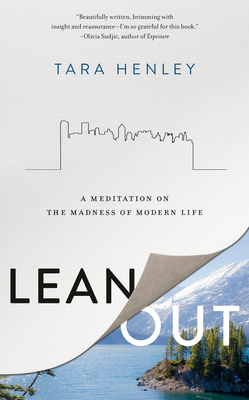
Lean Out – by Tara Henley – I enjoyed this non-fiction ode to time-out so much that I blogged about in My Literary Salon. I seem to have had better luck with non-fiction this year.

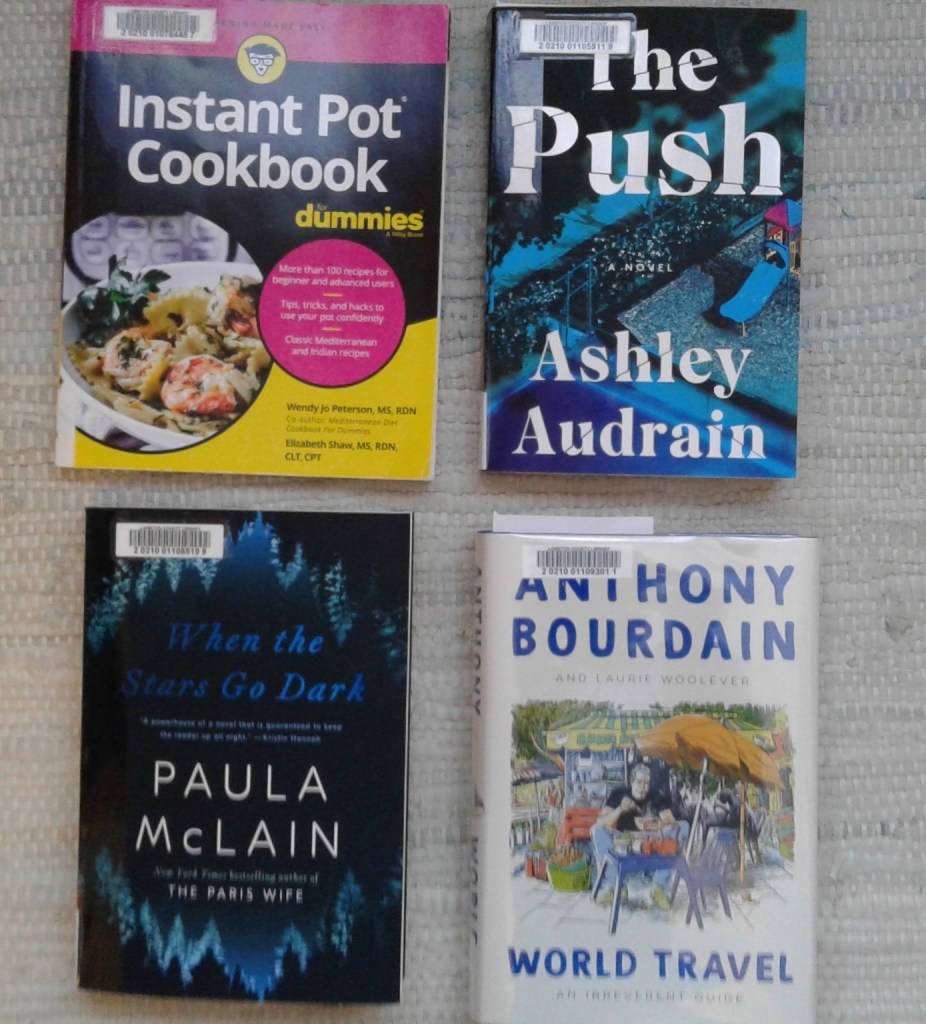
Two of these were DNR or did not get even started.   The weather turned too warm for Insta-Pot soup, and World Travel – the Anthony Bourdain book, written by his collaborator after his death but full of his own quotes, had so much swearing in it I found it offensive and merely skimmed a few chapters. I used to watch his tv show occasionally but have never read his first, Kitchen Confidential or any of his other books so I have nothing to compare it to.

When the Stars Go Dark – by Paula McLain of The Paris Wife fame – about a CA detective searching for missing girls, was good for her first attempt at a non-historical/murder mystery.

The Push was a riveting read – motherhood isn’t all it’s cracked up to be, especially when you have a deeply disturbed sociopath child.   I’m still trying to figure out what I think about this book, so it would make excellent bookclub fare.   As a first-time novelist, I wonder where she got the idea, but then we have only to look at the news and wonder what it would be like to be the parent of a child who commits a violent crime, even if she is only seven.

Pretty Little Wife – DNF – reminder – do not order anything with the wife/exwife/trophy wife as the murder victim/suspect/crime solver etc.

Anxious People – Sorry LA – I know you said to give it a chance, and I may someday but it was overdue and I had to take it back.   By the same author as A Man Called Ove – which I loved and which Tom Hanks is re-making as a movie….I enjoyed the Swedish version.

The Listening Path – by Julia Cameron – a big disappointment which I blogged about anyway.

Keep Sharp – by Dr. Sanjay Gupta.   I loved this book, it’s an easy read for non-medical folks, full of common sense advice but it’s scary to think the decisions we make in middle-age determine how well we live in old age.  I may blog on this later.  He has another book coming out later in the year – World War C – Lessons from the Covid Pandemic.

The Last Garden in England – library bookclub selection, a multi-generational story about an English garden.   A good tale, but nothing much to discuss, character driven with the garden merely a background.

A Promised Land – presidential memoir by Barrack Obama – although it’s not pictured here.  I read his two earlier books but they were slim volumes. I’m sure his time in the White House was interesting but 700 pages was just way too much detail for me.  I got to page 200 and it was still the primaries, and I had to return it and besides, Michelle said it better and more concisely in Becoming.  I’ve not heard too much about this book after the initial buzz, but there is to be a volume two.  I like to read in bed with the book propped up on my lap and it was just way too heavy…..literally, it weighed a ton.

The Last Bookshop in London – this was a surprisingly good read for light historical fiction, but then I love anything with a bookshop.  Set in WW2 England during the Blitz….you can imagine the rest.

The Windsor Knot – cute premise and title with Queen Elizabeth playing sleuth. It was a slow, not very suspenseful read but somehow I do not think the Queen would be amused. Not everyone’s cup of tea.

The Lost Apothecary – also a good historical fiction murder mystery, but then I’m biased towards anything with an apothecary, especially a female one, even if it was a place you went to obtain poison for your intended (male) victim. The 1800 London past woven into a present day story, with a surprisingly hopeful ending. 

Biggest disappointing read of the year which I had been so looking forward to was Jodi Picoult’s – The Book of Two Ways. Book opens with married female protagonist surviving a plane crash. Does she go home to her husband and child or fly off someplace else? Waded through 400 pages on death doulas, AI, Egyptian hieroglyphics and archaeology, much of which was standard university lecture material and had little to do with the plot, only to arrive at a totally ambiguous ending. I guess if you live in a parallel universe you don’t have to chose between your responsible-but-no-longer-in-love-with husband and your sexy grad-school Indiana-Jones type boyfriend because you can have both? Or maybe you the reader gets to decide? The ending was just plain annoying. In the author notes she thanks her editor for making her change it as it was so much better, which only left me wondering what the original ending might have been. I’ve never known Jodi Picoult to write a bad book before so it was doubly disappointing. I found her last one, Small Great Things, (how someone becomes a white supremacist) a timely and outstanding read.

There were many other books I didn’t take photos of…..some the kind you can’t put down.

I particularly enjoyed The Pull of the Stars – by Emma Donoghue about an obstetrical hospital in Ireland during the 1918 Spanish flu, which I found riveting, both for it’s historical obstetrical detail (not advised for anyone pregnant but many of my friends were OB nurses) and for it’s depiction of the pandemic (much the same as today, masks, distancing, fresh air, but thank god no carbolic acid disinfectant). I was surprised by the ending, but after I researched the author it make sense. Only a well respected writer (the Room) could get away with no quotation marks around the dialogue, an odd feature which didn’t seem to distract from the story.

I love murder mysteries and psychological thrillers, if they’re not too gory and I have my favorite authors – One by One by Ruth Ware was excellent, the setting a snowy ski chalet in the French alps with eight co-workers. The End of Her – by Canadian author Shari Lapena who is consistently good also, and Grace is Gone – by Clare McIntosh. Woman on the Edge – by Samantha Bailey, about a woman who hands her baby to another woman on the subway platform before she jumps, was also an interesting read.

For historical fiction, The Book of Lost Names – Kristen Harmel – a WW2 saga about a female forger helping Jewish children escape, and The Paris Library -Janet Skeslien Charles about librarians working at the American Library in Paris during the Nazi occupation, – were both good reads.

I hope you have found something interesting here for your summer reading.  I also have a link to My Literary Salon reviews on the front pages of my website on the main menu under Books.

It’s either feast or famine, and I have little out from the library at the moment, which has been the recent victim of a “cyber security incident” thus disabling the online reservation process. I hope they get it fixed soon, or we Readers will all soon be in withdrawal. I’m always up for a recommendation, so please leave any favorite reads or authors you’ve discovered in comments.

PS. 3000 words – and I was criticizing Obama? Maybe I’ll stick to a quarterly review in the future…

Anne of Green Gables – The Original Manuscript

This time of year when the trees are blossoming always reminds me of Anne of Green Gables. Anne declared Prince Edward Island “the bloomiest place ever,”

and there are numerous references to them in the book, from the Snow Queen and the cherry orchard right outside Anne’s bedroom window to the White Way of Delight, where the overarching trees created an avenue of bloom on the buggy ride home from the train station, to a simple arrangement of apple blossoms in a chipped blue jug on the table. Anne Shirley was a fan of nature, and so was her famous creator, Lucy Maud Montgomery.

Last summer I had the delight of re-reading this favorite children’s class, and I enjoyed it just as much as when I first read it as an eleven year old girl, the exact same age as Anne.

My 1965 childhood edition had several illustrations.

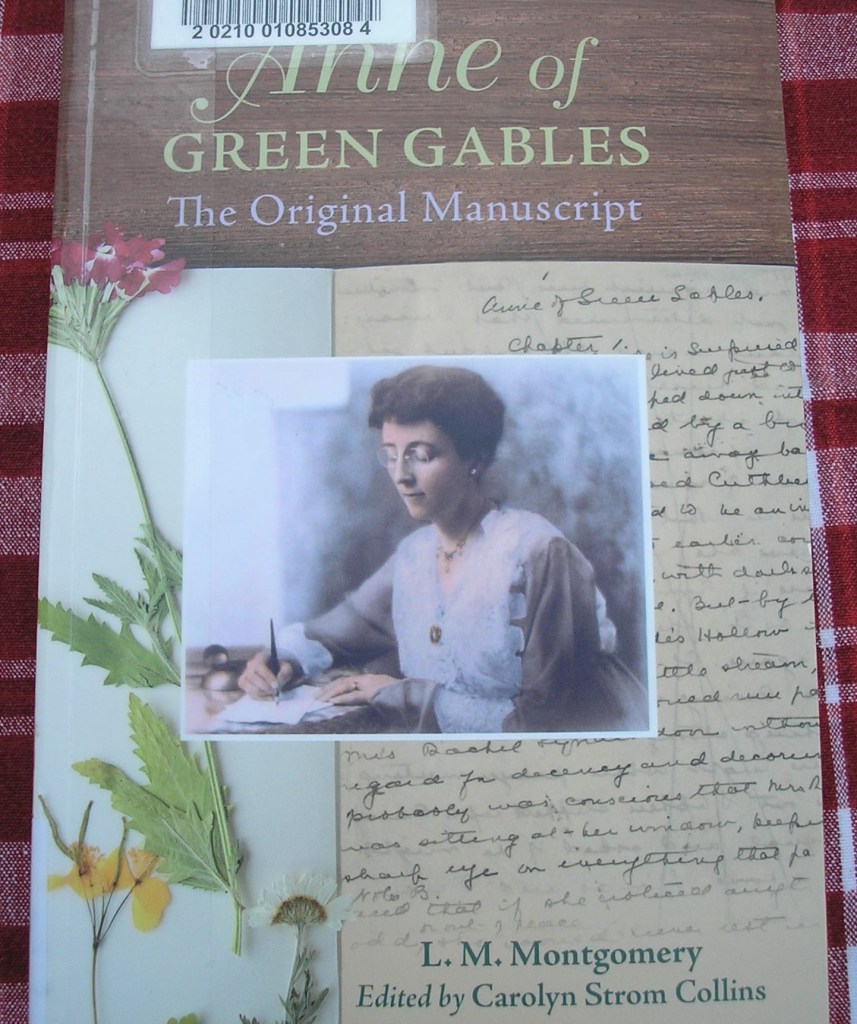
This month’s Literary Salon pick – Anne of Green Gables – the Original Manuscript was released by Nimbus Publishing in Halifax in July of 2019.

The Publishers Blurb:

This fascinating book presents the original text of Montgomery’s most famous manuscript, including where the author scribbled notes, made additions and deletions, and other editorial details. For example: Diana was originally called Laura, and then Gertrude, before the author settled on Diana. L.M. Montgomery scholar Carolyn Strom Collins offers a rare look into Montgomery’s creative process, providing a never-before-published version of the worldwide phenomenon.
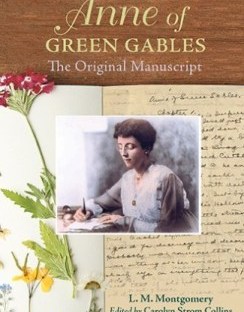
Differing from previous versions of Anne, this book provides a transcription of the text and notes from Montgomery’s original manuscript, and shows how they were integrated to form the full novel.

Discussion:

As a life long fan of Lucy Maud Montgomery, our most famous of Canadian authors, being given permission to scan all 844 pages of the original handwritten manuscript must have been a labor of love for editor, Carolyn Strom Collins.

The manuscript is kept in the archives at the Confederation Centre for the Arts, in Charlottetown PEI, in a dark room with no photography allowed as befitting an object of such literary reverence. It is 116 years old now, and Maud kept it all her life, (in her journal she proudly proclaimed it “mine,mine,mine” the day the first copy arrived in the mail), although the typed copy she submitted to the Page Publishing company in Boston in 1907 has since been lost.

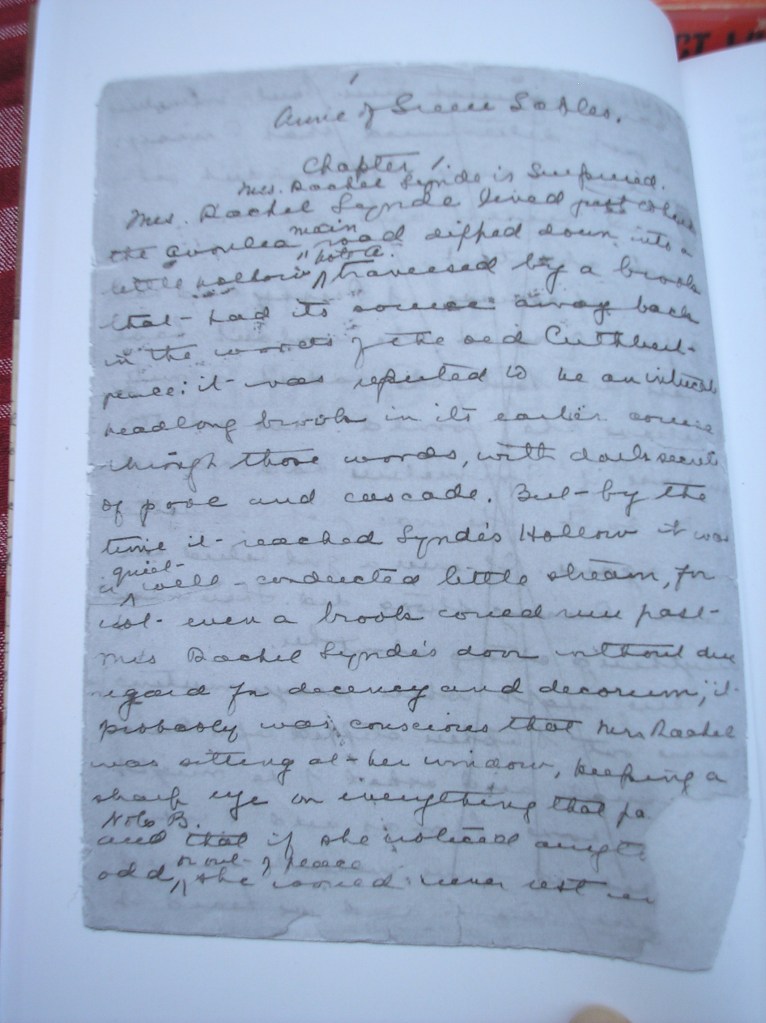
The manuscript is in two parts, the main body of 709 pages and 135 pages of notes, some of them misnumbered.   Maud wrote quickly and sometimes overlooked punctuation, especially in the notes section.  The pages measure 8.5 X 6.5 inches, considerably smaller than the average typed page, and are about 3 inches thick in total.

In this newly released edition, there is a scanned copy of the first handwritten page at the beginning of each chapter.

Maud was a schoolteacher so her handwriting was fairly easy to read. Paper was scarce so she wrote on both sides, and sometimes on the backs of bills and other stories.

The editor decided to place the changes and additions Maud made in the notes beside the corresponding pages for easy viewing.

I was amazed at how few changes Maud made to the handwritten copy. Likely her stint working as a copy editor and columnist for a Halifax newspaper came in handy. As the typewritten copy she submitted has not survived, it’s unclear whether final changes in the book were made by Maud or the editors, or both. Mostly they had to do with punctuation. Although this was her first book, Maud was an experienced author by then, having published well over 300 short stories and poems in the previous decade, enough to provide a source of income, but I suspect she was also one of the lucky ones whose words just flowed out of her head.

Although she records in her journals “brooding” up her heroine and and blocking out chapters and incidents, if there are any written copies of this prep work they are long gone.

The story behind the book and it’s publication is an interesting one, and lucky for us it didn’t stay in a hatbox.

Anne of Green Gables began as an idea jotted down in a notebook many years earlier, “Elderly couple apply to orphan asylum for a boy.  By mistake a girl is sent them.”  In the spring of 1905 Maud was searching through the notebook for suitable ideas for a seven-part serial for a Sunday School paper, but as the story progressed Anne took possession of her, and casting morals and lessons aside she decided to write a whole book about her instead.  Many of Maud’s own childhood experiences and dreams were worked into it’s chapters. Didn’t we all sigh over Gilbert Blythe who was based on one of her school-chums? Many of the scenes of Avonlea in the book – the Lake of Shining Waters, Lover’s Lane – were based on locales in the small farming community of Cavendish where she lived.

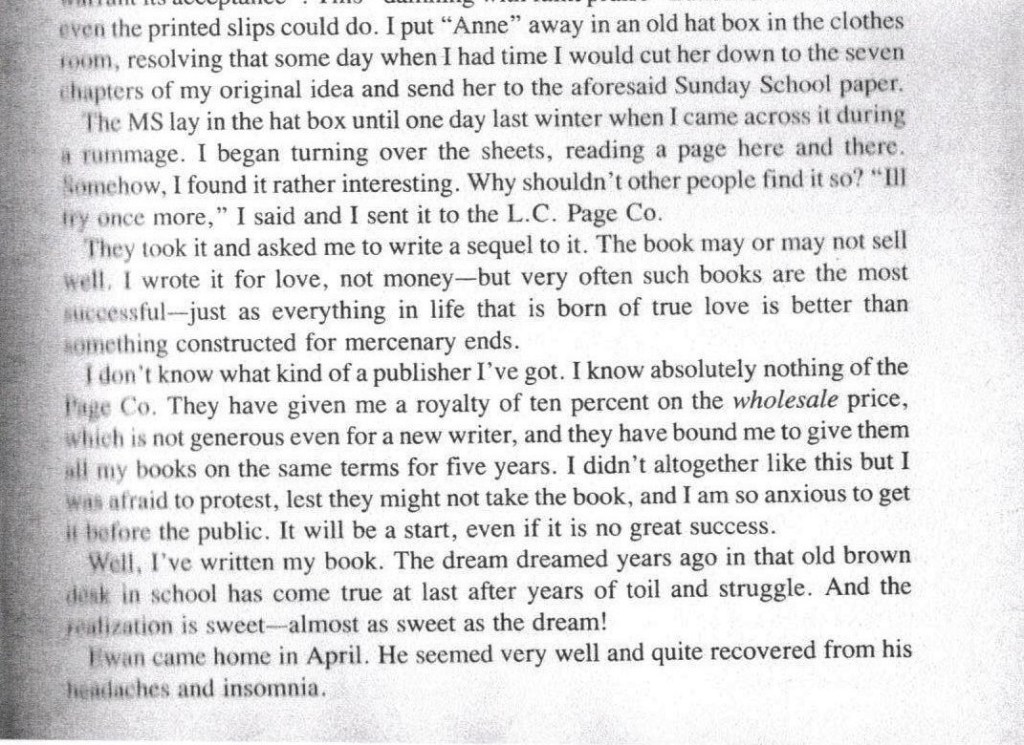
Journal entry – Aug 16 1907

After sketching out the plot outline, she began to write in May 1905, finishing it eight months later, in January 1906. She wrote for a few hours a day, mostly in the evenings after the rest of her work was done, and in longhand with a pen that had to be dipped in ink.   “It was a labor of love and nothing I have ever written gave me so much pleasure to write.”   She then typed it up on her second-hand typewriter, which didn’t print w at all.  (I saw the typewriter, set up on the kitchen table, when I visited the Anne of Green Gables museum many years ago.)  

She mailed the typed manuscript out to four American publishers (one new firm, one “betwixt and between” firm, and two old established firms, MacMillan and Henry Holt “some merit but not enough to warrant acceptance”) over the course of 1906, with universal rejection, so she gave up and stored it in a hatbox, where it remained until the winter when she decided to try again, this time with the Boston publisher L.C. Page and Co, a company she admitted she knew nothing about.   It was close to rejection again, but a staff member who was from Prince Edward Island, advocated for Anne. 

Journal Entry Aug 16 1907

Maud signed a contract for a paltry royalty and five years of any future work, which she agreed to reluctantly, thrilled to have the book accepted, and promptly began work on the sequel – Anne of Avonlea – which was published a year later in 1909.   I remember her journals being full of legal disputes with Page & Co. in later years when she had switched to McLelland and Stewart in Toronto.

She was pleased with the final appearance of the book, “lovely cover design, well bound, well printed. Anne will not fail for lack of suitable garbing at all events.”

The  book sold well right from the beginning,  went through seven printings and 20,000 copies by the end of the first year 1908, and has never been out of print since, with 50 million copies worldwide and over forty translations. 

She recorded in her journal, “I can’t believe that such a simple little tale, written in and of a simple P.E.I. farming settlement, with a juvenile audience in view, can really have scored out in the busy world.”

She produced seven more Anne books, ten other novels, two collections of short stories, a book of poetry and many stories, essays and articles before her death in 1942, but it is her first novel that remains the most famous.  “It was born of true love and often such books are most successful.”

I enjoyed reading the story again and taking a peak into the author’s creative process. It was interesting to see how a book goes from an idea jotted down to a few chapters to a completed manuscript to a printed copy….with all it’s many sequels. She never seemed to run out of ideas. I can’t imagine having to dip your pen in ink every few lines – we have it so much easier today. But I also wonder when things are so quickly deleted if we will lose this recording of how a book comes about….for it did not spring fully formed, even though her words may have flowed easily.

What lessons can aspiring novelists learn from this?

The best writing is a labor of love.

If you should be so lucky as to be published, don’t be too eager to sign everything away.  Research a bit first.

Just to begin, for that is often the hardest part, even for Maud. 

“Of late years I have been thinking of it seriously but somehow it seemed such a big task I hadn’t the courage to begin it. I have always hated beginning a story. When I get the first paragraph written I feel as though it were half done. To begin a book therefore seemed a quite enormous undertaking. Besides, I did not see just how I could get time for it. I could not afford to take time from my regular work to write it.”

And most importantly perseverance – many books have been written in just a few hours a day. I hope you have found this tale of how Anne came to be inspiring.

PS.  The manuscript will be online in 2022, as part of a digital exhibition entitled Exploring a National Treasure: LMM’s Anne of Green Gables Manuscript, curated by the Confederation Centre Art Gallery and the L.M. Montgomery Institute at the University of PEI. It’s nice they gave the editor of this book, Carolyn Strom Collins, a few years to profit from her efforts.

PS.  Next week in Part Two I will blog about The Journals of L.M. Montgomery, published fifty years after her death, which provide a fascinating insight into her successful but often tormented life.   Plus a bit about my trip to Cavendish, Prince Edward Island – holy ground for Anne fans – if I can find the photos.

The Literary Salon – The Listening Path – by Julia Cameron

When was the last time you had a really good sit-down soul-satisfying conversation with somebody? Notwithstanding the pandemic, it’s surely a given in today’s society that we have become a nation of non-listeners. We have a tendency to interrupt with our own opinion, or maybe we’re not really listening at all but thinking about what our reply will be. I blame this general lack of attention on the instantaneous nature of the internet. We have become so accustomed to conducting everything at high speed, that we’ve lost the fine art of conversation….in person….not by text or tweet. It takes time to have a conversation, and two people who are willing to truly listen to each other’s words. Someone may say they are fine, but you can tell from the tone of their voice or facial expressions that they’re not, and so you ask questions, and then listen carefully. Listening better was one my goals this year, so it was with great anticipation that I ordered Julia Cameron’s latest release, The Listening Path – The Creative Art of Attention.

Publisher’s Blurb from Goodreads:

The newest book from beloved author Julia Cameron, The Listening Path is a transformational journey to deeper, more profound listening and creativity. Over six weeks, readers will be given the tools to become better listeners—to their environment, the people around them, and themselves. The reward for learning to truly listen is immense. As we learn to listen, our attention is heightened and we gain healing, insight, clarity. But above all, listening creates connections and ignites a creativity that will resonate through every aspect of our lives.

Julia Cameron is the author of the explosively successful book The Artist’s Way, which has transformed the creative lives of millions of readers since it was first published. Incorporating tools from The Artist’s Way, The Listening Path offers a new method of creative and personal transformation.

Each week, readers will be challenged to expand their ability to listen in a new way, beginning by listening to their environment and culminating in learning to listen to silence. These weekly practices open up a new world of connection and fulfillment. In a culture of bustle and constant sound, The Listening Path is a deeply necessary reminder of the power of truly hearing. 

Why I Liked It: I didn’t. I don’t even know how it got published. Normally I wouldn’t review a bad book, because I would have quit reading it, but I finished this one out of respect for the author, the creativity expert and author of 40 books most of them truly inspiring, including her first, The Artist’s Way.

I read The Artist’s Way back when it was first published in 1992, and enjoyed it, although I’d have to say I found the Morning Pages a bit OCD. I even tried them once during a week’s vacation, but who has a spare hour in the morning to write out three long hand pages of stream of consciousness stuff. (This was in the days before computers, but she still requires they be hand written, and never in the evening!) Unless you were seeking clarity or trying to solve a problem, and even then wouldn’t you get sick of whining about it day after day, I just couldn’t see the point. For many people those early morning hours are often the most productive of the day, and for some, the only time they get any writing done at all. The Artist’s Dates and Meditative Walks were fun and helpful suggestions though. It was a twelve week program for discovering your creative self, which grew out of a writer’s workshop she taught, although the art can be any genre – writing, painting, music, etc. A best-seller at the time, the book has never been out of print and a few years ago they re-issued a 25th anniversary edition, but it can be found at book discount places, as can many of her other popular books on creativity. I own several of her earlier works and found them uplifting, especially for people who may not have anyone who encourages their writing, or even understands it. She’s revered as the Cheerleader of Creativity.

But back to The Listening Path:

The Publisher’s blurb sounded good, but this book was a disappointing read on so many levels.  It’s a slim 180 page volume, with a long 40 page introduction, which is basically a recap of The Artist’s Way, and six chapters, Listening to the Environment, Others, Our Higher Self, Beyond the Veil, Silence and Our Heroes, with the chapters getting progressively shorter, so that towards the end they were only 4 or 5 pages. The pages themselves had a weird format of very narrow columns (4 inches), designed to make the book appear longer.

The Beyond the Veil chapter (where she connects with the world beyond and her spirit friend Jane tells her not to second-guess herself, the book is going well), reminded me of a seance.  (Jane, if you’re listening, it was bad advice).  The listening to others chapter, which should have been the gist of the book, consisted of interviews with her artist friends and acquaintances, who may be perfectly nice people but are not experts in the field and had nothing interesting to offer other than their personal opinions. (I could just as well interview my friends about listening but then medical people like jargon and brevity. I inadvertently offended a newly minted colleague once when I said cut to the chase.)

There were lots of walks with her dog Lily (a cute but yappy little Westie terrier) in the Santa Fe area where she lives, constant weather reports on storms and hail, feeding the dog salmon, and something called gravlax to stop her from barking and annoying the neighbors.  “Lily! Salmon! Treat!” was repeated so many times, (pages 44, 45, 47, 56, 97 and whenever there was a thunderstorm), it got to be annoying.  She has a bad connection on her landline, (several pages on that including dialogue), feels “bludgeoned” by a friend’s dietary advice that she eat more protein, (ditto….sister you don’t know what a bad day is), worries about whether she can afford a house (yes her accountant says she can, and a maid too)….basically it was a whole lot of repetitive personal trivia, zero research and nothing much at all to do with the topic of listening. Unless you’re writing a personal blog, sharing anecdotes for a reason, and/or lead an interesting life, this kind of stream of consciousness stuff might better be left to Morning Pages, not published in a hardcover format for $50 Cdn ($36.99 US).

Her one and only novel, Mozart’s Ghost was like that too – I swear the protagonist lived in the laundry room, but after 43 rejections (page 19) what would you expect? Not that you can’t branch out and try something new, but sometimes an author can be good at one genre, but not others.  (I loved Frances Mayes series of Under The Tuscan Sun travel books, but her attempt at a chick-lit novel was painful).   If you like an author, you expect only good things from them, and are doubly disappointed when they don’t deliver.     

The Listening Path was written pre-pandemic, and while many people have been lonely during this past year, with no company and their only social outlet walking the dog, if you read between the lines this book spoke volumes about how solitary a writer’s life can be.  She needs to ditch the desert, move back to New York and re-read her own books for inspiration.

I didn’t sense too much joy in the creation- more of a pounding out the pages to meet a deadline. There was a lot of self-doubt which I don’t remember from her earlier works.   Was her stuff out of date (yes, Morning Pages)? There was much angst about teaching a course in London she has taught for decades – how can someone with 40 books be so lacking in self-confidence and so insecure.  I perked up at the mention of London though, it sounded much more interesting than walking in Santa Fe.

I even wondered if she was well, maybe even depressed? I read her 2006 memoir, Floor Sample, many years ago, and what struck me was what an unhappy life she had lead, because the memoir was such a direct contrast to her positive encouraging books.  She was married at one time to director Martin Scorsese (a man she declares she still loves – page 114), has a daughter and a grandchild and is a decades long recovered alcoholic.  I suspect AA inspired her writer’s workshops, hence the 12 week programs.   

Normally if I’m struggling with a book, I’ll hop on Goodreads and if enough people share my opinion, then I quit. (Too many DNF’s mean it’s not me, it’s you dear author, keeping in mind of course that some of those glowing reviewers may be receiving free copies).  But I soldiered on….it was readable, but barely, in a train wreck sort of way.

All in all, it was a timely topic which just didn’t translate, and I was left with a sense of disappointment, but you’ll be relieved to know there was a happy ending, as Lily got one of those anti-bark “citronella spray” dog collars. I didn’t even know such a thing existed, but apparently dogs hate the smell of citronella. Yes, that was how the book ended, with a short section entitled, “The Neighbors Rejoice.” I may pass that tip along to my neighbors.

This brings up the question – what does a publisher do when a best-selling author turns in a sub-standard manuscript? A good editor will hand it back to be fixed, or they may just publish it, take the money and run. It might be better to abandon it though and save the author’s reputation. Julia Cameron is 73 now, aren’t writers allowed to retire? (Another recent example of this is Jodi Picout’s latest, The Book of Two Ways, a four hundred page disaster which defies description, although I’ll try in a future blog). Same with the author – it’s hard to be objective especially when you’ve put so much work into something, and it’s also hard to admit when something just isn’t working. Books are subjective, but if the general consensus/feedback isn’t good, then you know there’s a problem.

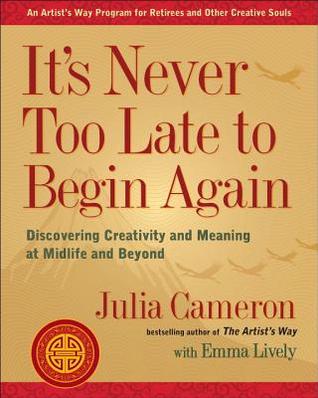
If you want to read a good book by Julia Cameron, I would highly recommend this one.

Publishers Blurb:
 
Julia Cameron has inspired millions with her bestseller on creativity, The Artist’s Way. In It’s Never Too Late To Begin Again, she turns her eye to a segment of the population that, ironically, while they have more time to be creative, are often reluctant or intimidated by the creative process. Cameron shows readers that retirement can, in fact, be the most rich, fulfilling, and creative time of their lives.

When someone retires, the newfound freedom can be quite exciting, but also daunting. The life that someone had has changed, and the life to come is yet to be defined. In this book, Cameron shows readers how cultivating their creative selves can help them navigate this new terrain. She tells the inspiring stories of retirees who discovered new artistic pursuits and passions that more than filled their days—they nurtured their souls.  
A twelve-week course aimed at defining—and creating—the life you want to have as you redefine—and re-create—yourself, this book includes simple tools that will guide and inspire you to make the most of this time in your life:

–  Memoir writing offers an opportunity to reflect on—and honor—past experience. This book guides you through the daunting task of writing an entire memoir, breaking it down into manageable pieces. 
–  Morning Pages—private, stream-of-consciousness writing done daily—allow you to express wishes, fears, delights, resentments, and joys, which in turn, provide focus and clarity for the day at hand.
–  Artist Dates encourage fun and spontaneity.
–  Solo Walks quell anxiety and clear the mind.

This fun, gentle, step-by-step process will help you explore your creative dreams, wishes, and desires—and help you quickly find that it’s never too late to begin again. 

This book is geared more for middle-aged folks like me facing their second acts…..those reluctant souls who maybe always wanted to do something creative but lacked the courage to try. I read it back in 2016 and it was a big factor in starting my blog, although it was a whole year before I actually wrote anything on it, and another three months before I made it public. (My creative soul was a bit rusty). This book was an inspiring read, which truly delivered.

PS. Two out of three isn’t bad, and goes to show that even the best of writers have their duds. Do you think it is better to abandon a book which just isn’t working and move on to something else, or stick with it and carry on?

PS. I’ll be exploring more on the dichotomy between a writer’s books and their life, in a future blog about L.M. Montgomery, of the Anne of Green Gables series.

The Literary Salon: Lean Out – A Meditation on the Madness of Modern Life

One potential benefit of the pandemic is that many people are finding their lives are less busy and less stressed.  Without the daily commute to work and the rush of getting the kids to their various after-school activities, there is suddenly more time to make supper, relax, or binge-watch your favorite TV shows.   For some this new work-life balance might become a permanent way of life, although I’ve heard some complaints that working remotely means even longer hours as there is no longer any distinction between office and home.

If the key to happiness is the perfect work-life balance, then what happens when that balance is way out of whack and how do we realign it? This month’s Literary Salon pick, Lean Out – A Meditation on the Madness of Modern Life by Tara Henley, addresses that issue.

Here’s the Publishers Blurb from Goodreads:

“In 2016, journalist Tara Henley was at the top of her game working in Canadian media. She had traveled the world, from Soweto to Bangkok and Borneo to Brooklyn, interviewing authors and community leaders, politicians and Hollywood celebrities. But when she started getting chest pains at her desk in the newsroom, none of that seemed to matter.

The health crisis–not cardiac, it turned out, but anxiety–forced her to step off the media treadmill and examine her life and the stressful twenty-first century world around her. Henley was not alone; North America was facing an epidemic of lifestyle-related health problems. And yet, the culture was continually celebrating the elite few who thrived in the always-on work world, those who perpetually leaned in. Henley realized that if we wanted innovative solutions to the wave of burnout and stress-related illness, it was time to talk to those who had leaned out.

Part memoir, part travelogue, and part investigation, Lean Out tracks Henley’s journey from the heart of the connected city to the fringe communities that surround it. From early retirement enthusiasts in urban British Columbia to moneyless men in rural Ireland, Henley uncovers a parallel track in which everyday citizens are quietly dropping out of the mainstream and reclaiming their lives from overwork. Underlying these disparate movements is a rejection of consumerism, a growing appetite for social contribution, and a quest for meaningful connection in this era of extreme isolation and loneliness.

As she connects the dots between anxiety and overwork, Henley confronts the biggest issues of our time.” 

Discussion: (or why I liked it)

When I first started working in the early 1980’s, 9-5 actually meant 9-5, with lunch and coffee breaks too.  At my first job the majority of the work was done in the morning and afternoons were devoted to staff meetings etc. We would often have cake at these meetings, (it was always somebody’s birthday) and after a small pre-closing rush, be out the door at 5pm.   (Does it say something about me that what I remember most about my first job is the cake? It was chocolate with the most divine icing, from a bakery in town and someone would run down on their lunch hour and pick it up.)  Nobody stayed late, although someone was on (paid) call for the rare emergency.

When I ended my career forty years later, long hours and unpaid overtime were the norm and the expectation. We were so chronically understaffed that many nights I would arrive home still in overdrive and not be able to decompress for hours.  There were no meal breaks, except a scarfed down sandwich when your blood sugar got too low to function, lots of cold coffee, and few washroom breaks. (The dilemma in health care is if you don’t get the work done, it’s the patient who suffers.)

The sad thing about the workplace, is that my experience has become the new normal, no matter what your job.  If you’re caught up in the work/eat/sleep cycle, doing more with less, and with impossible quotas or targets to meet, you may feel you’re lucky enough to have a job, especially in these perilous economic times, and not be in a position to complain.   

While I enjoyed my work and was never bored, it was the working conditions which were the problem, and eventually I was just too burnt-out to continue. After a bout of stress-related chest pain, I opted for early retirement. Although retirement was an adjustment, living on less, I’m a happier person now and more relaxed.  My former colleagues tell me I look better, younger – I get more sleep.

 So I could really relate to Tara Henley’s story – right down to the chest pain.   (Tara did eventually go back to work in media as she is the CBC producer who contacted me about the radio interview for my mother’s art exhibit. I discovered this book when I googled her name).   Several years ago at the age of 40, she started having chest pains at her desk and decided to take a time-out to seek a better life-work balance, a journey she researched and documented in her book, Lean Out.

She wrote the book partially in response to the book Lean In, by Sheryl Sandberg, the COO of Facebook. I did not read Lean In when it was published a few years ago as I was no longer working and not interested in any book about how to achieve success in the workplace, but I recall hearing lots of backlash about it – mainly that the author, a white woman of privilege, had a tendency to unfairly blame women for not achieving more success in the workplace. Women were advised to lean in…..as opposed to opt-out of their careers.  Easy to say if you can afford child-care and domestic help as you climb the corporate ladder – the majority of working women I know are just plain exhausted.

I suppose it depends on what stage in your career you are at, but even if you absolutely love your job, it can become like a blood-sucking vampire, draining the life out of you if you don’t take sufficient time away from it. Time away renews your soul and gives you a fresh perspective. I grew up in the baby-boomer age of dedicated employees with work ethic, but companies today can’t expect loyal employees if they treat them poorly or don’t value them at all. How many young people today have full time jobs with benefits and guaranteed pensions?

Being older also gives you a different perspective on work. No one ever said on their deathbed that they wished they has worked more – in fact, most people say the exact opposite. They wish they had worked less and lived more. Mostly I’m mad at myself for putting up with such bad working conditions.

Lean Out was released in the spring of 2020, just before the pandemic hit, but in a premonition of what was to come, it has much to say about our current situation.   In many ways COVID has forced people to reassess their work-life balances.  Can we live on less?  Cook at home more?  Will we ever go back to the old ways – working in office buildings and rushing here and there.  Do we want to?  

I really wish I had read this book when I was still working, as I could relate to so much of the material, (except for the hip-hop – I’m way too old for that. Tara got her start in journalism by writing music reviews). It’s so profound and full of common-sense wisdom, and so well written.  Here’s an excerpt from page 152.

“What gave me joy, it turned out, was pretty simple.  Waking up every day without an alarm.  Reading all the books on my nightstand.  Eating when I was hungry, resting when I was tired, staying at home when I was under the weather.  Moving my body every day.  Being outside.  Cooking for people I cared about. 

The key to contentment, I realized, was time.  And the more time I had, the less money I needed.  I didn’t need treats to boost my spirits during a rough week, because my week was never particularly rough.  I didn’t need lavish vacations, as Your Money or Your Life put it, my daily life was not something I needed to vacate.  When my true needs were met, I did not need to compensate with stuff.”

There are chapters on unplugging from the internet, seeking solace in nature, loneliness and finding your tribe (40% of young people living in big cities are single dwellers who often don’t have a social support network and can’t afford the rent let alone save for the future), the meaning of home, and living on less – well documented with research, interviews and personal anecdotes.

This book is not a simplistic how to manual, but a beautifully written blueprint for a realistic way to live a happier and saner life.   I wish I had “leaned out” sooner.

Extra Time

Many of us have extra time on our hands these days, especially if you’re currently in lock-down and no longer have that daily commute to work – extra time to read, start a hobby, or attack that long list of things you always wanted to do. For some people staying home more has been a difficult adjustment, for others it’s a prelude to what retirement might be like someday and an opportunity to think about how you might like to spend your golden years.

This month’s Literary Salon pick, is Extra Time – Ten Lessons for An Aging World, a non-fiction book by Camilla Cavendish.

Publishers Blurb: (from Goodreads)

“From award-winning British journalist, Camilla Cavendish, comes a profound analysis of one of the biggest challenges facing the human population today.

The world is undergoing a dramatic demographic shift. By 2020, for the first time in history, the number of people aged 65 and over will outnumber children aged five and under. But our systems are lagging woefully behind this new reality. In Extra Time, Camilla Cavendish embarks on a journey to understand how different countries are responding to these unprecedented challenges.

Travelling across the world in a carefully researched and deeply human investigation, Cavendish contests many of the taboos around ageing. Interviewing leading scientists about breakthroughs that could soon transform the quality and extent of life, she sparks a debate about how governments, businesses, doctors, the media and each one of us should handle the second half of life. She argues that if we take a more positive approach, we should be able to reap the benefits of a prolonged life. But that will mean changing our attitudes and using technology, community, even anti-ageing pills, to bring about a revolution.”

Discussion:

With average life expectancy reaching into the mid-80’s now and people retiring early, we may have another 20 or 30 years of extra time. This thought-provoking book takes a look at the culture surrounding ageing in our society, and changes to the way we view ageing now. While not everyone agrees that 60 is the new 40, it’s true that many more of the “young-old” are enjoying active healthy lifestyles much longer than before. I remember thinking my parents were middle-aged at 40, and now people that age are going back to school, having babies, taking up sky-diving.

It’s no secret I like a good non-fiction book, especially one with a well-researched basis. This book delves into how different countries are handling the ageing epidemic without producing a strain on their economies or health-care systems, by exploring different ways of caring for the elderly or “very old.” Certainly the number of COVID deaths in nursing and retirement homes is telling us our current system is not working, and calls for government reform are ineffective if standards are never enforced. Many homes are understaffed and underfunded, as we have found out during the pandemic. Here in Canada they had to call in the military reserves to help feed and care for patients in particularly hard hit homes in Quebec and Ontario, a national disgrace, especially as many of them were privately-owned-for-profit places. I wonder how much cognitive decline ensues when residents are locked in their rooms every day without the stimulation of activities or even company at mealtimes.

There is a chapter on research into anti-aging strategies and one on implementing programs to give seniors a purpose in life and a meaningful way to give back. Think of how many healthy seniors there are whose talents are wasted as they are considered too old to work or contribute. Certainly it helps to have a purpose in life or a passionate pursuit of some kind, like my mother with her art – taking up painting at the age of 87 when she stopped driving. Of course my mother is fortunate to have her health and with all her relatives living well into their 90’s, a good dose of genetic luck. In a recent interview about her late-in-life art career, the radio host remarked, in her introductory comments, “Many people have second acts in their lives, but few well into their 90’s…..”

What would you like your second act to be? For those who dread old age, I found this book to be a positive, hopeful and uplifting read.

PS. Of course, the most tragic disease of old-age is Alzheimer’s. Just as I was posting this, I received an email about a new book by neurosurgeon Dr. Sanjay Gupta. As I find his COVID advice to be both realistic and scientific, I’ll add this one to my future-to-read list. Keep Sharp – Build a Better Brain at any Age – by Sanjay Gupta.

(762 words)