A lighthouse is a tower or building emitting a beacon of light on a dark and stormy night. Originally designed as navigational aids for warning of dangerous coastlines, reefs and rocks, or for marking safe harbors, they are largely ornamental now. Expensive to operate and maintain they have been mostly replaced by other electronic navigational devices and any remaining ones have been automated and no longer require a lighthouse keeper. Still, they have a certain romance about them – who doesn’t love a picture of a lighthouse?
As an important part of marine history, they make great tourist attractions. Canada’s most famous lighthouse at Peggy’s Cove attracts thousands of tourists a year. (link) You can explore on the boulders around the structure but despite the warning signs, a few people are swept into the dangerous surf every year.
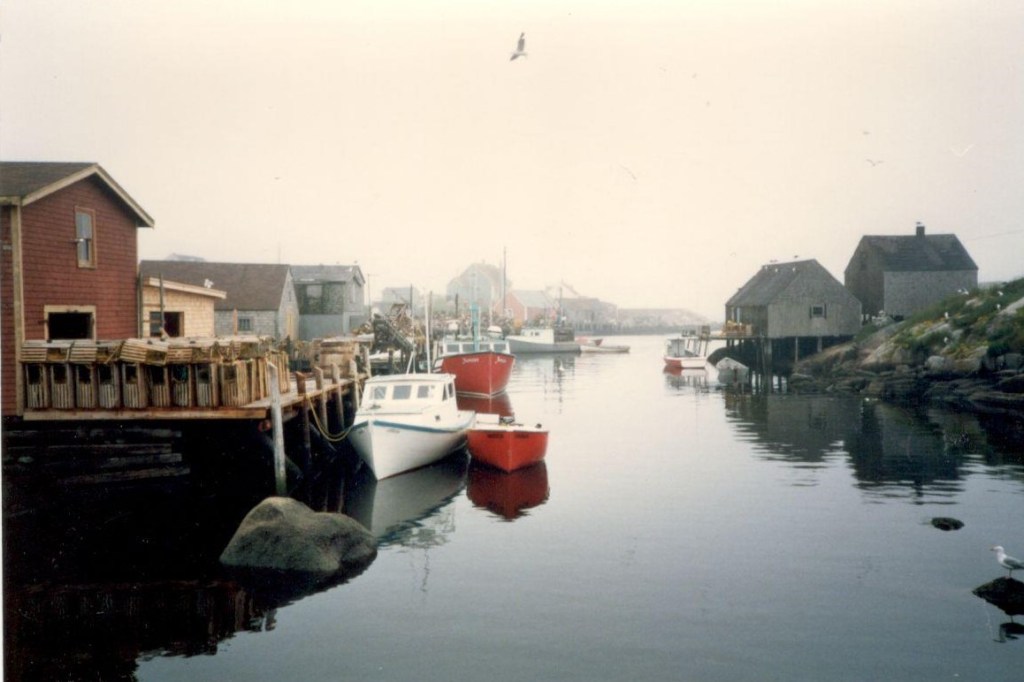
A misty morning at Peggy’s Cove
Peggy’s Cove is an idyllic fishing village in Nova Scotia – it’s like stepping back in time.
Old vacation photos
Here’s another lighthouse from Prince Edward Island, as you can note from the red soil.
Although I live in the Great Lakes region, there aren’t many lighthouses around here anymore. There’s this one at the entrance to the lake on the American side.
Lake lighthouse
And this smaller one along the river.
River Lighthouse
The odd shaped structure above, was moved to a local pioneer village/museum after it was decommissioned. While researching its history I was surprised to discover that my great Uncle Leo, was at one time (1948) the light-keeper there. I only knew Uncle Leo as an old man, bald and as deaf as a door-knob. When he came for a visit, the conversation would be a shouting match, music to a seven year old eavesdropping on adult conversation. He was also a house painter, and the official ringer of the church bell, so a bit of a jack of all trades. The maternal side of my dad’s family were known as river rats. Uncle Leo’s brother owned a cargo boat which made regular runs to Detroit, although not rum-running during Prohibition as they were strict religious folks. Another brother went down on one of the freighters in the Great Lakes Storm of 1913, which I’ve blogged about before in The Witch of November, a gale so furious that even the lighthouses were not of much help to the many ships which floundered and sank.
Maintaining the light and the log books was a meticulous business and the light-keeper sometimes lived adjacent to or on site in the larger lighthouses, with snug kitchen and sleeping accommodations on the bottom floor.
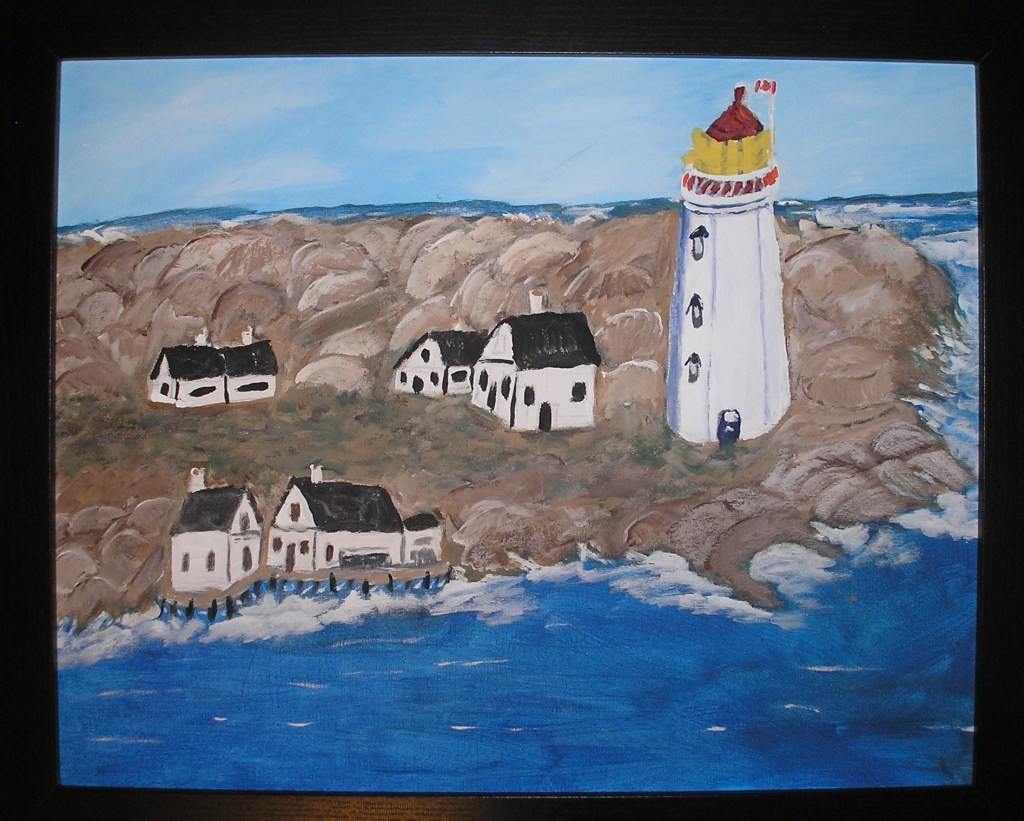
Here are a few more of my mother’s folk-art paintings, with variations in color scheme.
I’ve borrowed the title to this blog from the famous novel by Virginia Wolfe, (link) although I have not read it, or any of her other works, but I suppose I should some day, as it was rated one of the top classic novels of all time.
A more modern novel referencing light-houses is the best-seller The Light Between Oceans by M.L. Stedman. This was an interesting read if you missed it when it was first published in 2012. The setting is 1926 post WW1 Australia where a returning soldier takes a job as a lighthouse keeper on a small island off the coast, and later brings his new bride there. They are the sole inhabitants, with no visitors other than a supply boat which comes once a season to replenish their stores. After several years of isolation the grieving wife has suffered two miscarriages and a stillbirth. One day, a small rowboat washes up on shore with a dead man inside and a crying baby. Instead of reporting it to the authorities, the lighthouse keeper buries the dead man and is persuaded by his wife to keep the baby and pass it off as their own. Two years later when they visit the mainland on shore leave, and see the posters for the missing child, the morale dilemma ensues. The plot made for perfect book club discussion material. The author is an Australian lawyer, and this was her first published book. The 2016 movie did not do it justice due to miscasting and despite being filmed in Australia/New Zealand it failed to capture the descriptions and desolation of the windswept island so vivid in the book.
I can’t imagine being stuck in a lighthouse on an island for two years with no other souls around. Oh wait, after a rather solitary 17 months, maybe I can….but a safe harbor is now in sight!
I am finally fully vaccinated……but not without some drama.
I last wrote The Corona Diaries at the end of The Winter of Our Discontent, but you might call this installment The Promise of Spring which didn’t quite materialize, and hopefully not the start of The Summer Which Never Came?
It’s been a depressing several months, the weird and wacky weather, the long frustrating wait for vaccines to get us out of this mess, the hope for better days ahead, when they all seemed more of the same, and all the while the world was blooming with loveliness.
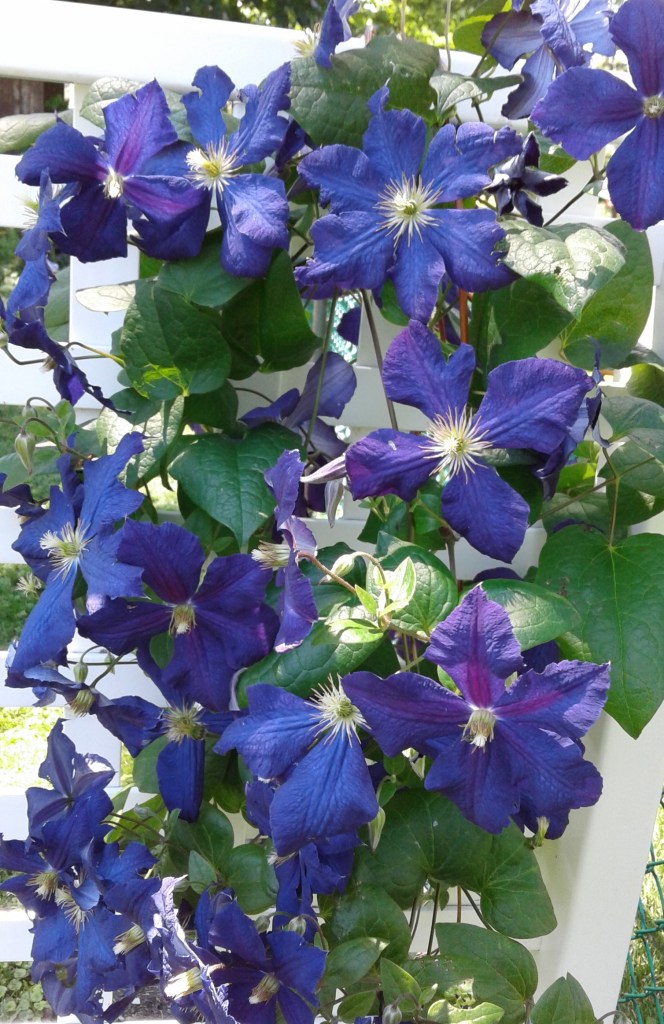
Purple Jackmanii clematis Hydrangea bush enjoying the morning sun.
May and June are my favorite months, but somehow this year they got cluttered up with much delayed appointments – doctors, dentists, lab work, vision, both for myself and my mother. Then there were the maintenance things like car, A/C, computer and spring cleaning maid service. (I still can’t believe the earliest appointment is mid-August – guess we’ll have to live with the dust for awhile longer). Having received one dose of the Pfizer vaccine on April 20 I felt it was safe(r) to re-book some of this now and get it over with, but it seemed like every day when the weather was perfect for sitting outside there was something on. The rest of the time it was either too hot and humid, too cold or too rainy. So much for spring. Now after two weeks of drought, we’ve had two weeks of rain – so much rain that the backyard is a tropical resort for giant mosquitoes, one of which bit me on the leg resulting in several days of itchiness so intense I couldn’t sleep, so I’ve retreated inside again….like a hermit going back into it’s shell.
Hermit crab
As there were um…..comments about the last post (A Reading Sabbatical) being too long, I shall spare you the drama (and accompanying word count) of the vaccine process, other than to say that I long for the days when they just lined us up for a jab with the needle.
Archives photo 1956 – high school students receiving polio vaccine
Actually when I was in grade two in 1963 we were lined up for the oral polio vaccine, which was even better, as they dispensed it on a sugar cube. We never had sugar cubes at home so the sensation of that dry granular square in my mouth was such a strange thing that the memory has stayed with me.
After five months of lock-down, even I, the most contented of homebodies, have been enveloped in a cloud of gloom and doom lately. Now that I’m fully vaccinated and can go out, there’s nothing much to do – every outdoor summer event was cancelled months ago, including the fall fairs. We are now entering stage two of reopening, with the stages spaced at cautious three week intervals, assuming case counts remain low and vaccination rates continue to increase.
I’m tired of cooking, but with no indoor dining until August, I’d rather wait until my birthday when I can visit my favorite steakhouse, a place with tablecloths and candles and frigid air-conditioning, and be served a meal someone else has prepared and will clean up after.
Non-essential stores have reopened too, at 25% capacity and after the initial crowds disperse, I’m looking forward to some retail therapy, if only to browse and buy socks. I have a whole list of things which need replacing – things you have to look at in person not pictures on a website.
And I’m sure once I get a haircut next week I’ll feel better and be ready to face the world again with more optimism. My bangs have achieved Cousin-It status and it will be nice to be able to see through my new glasses. I haven’t had my hair this long since I was a teenager, and while I kind of like the hippy look, the darker graying roots simply must go.
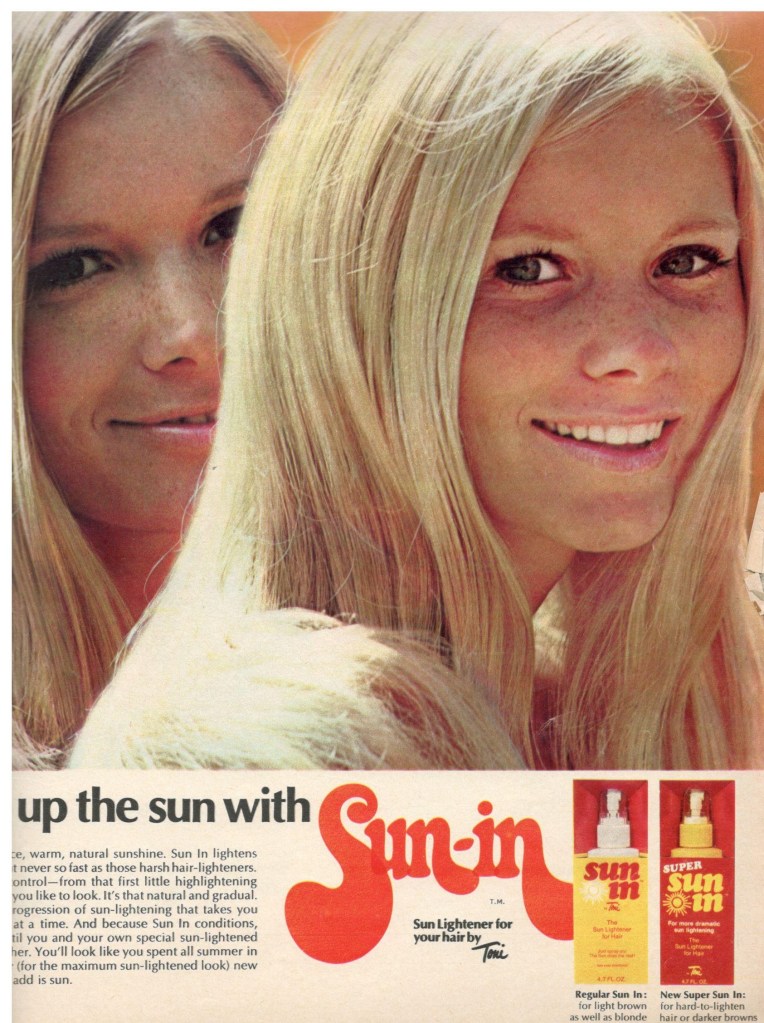
Sun-In and sunlight – and you’ll be blonder tonight!
I once read about a woman who took a reading sabbatical. She packed up a whole load of books and escaped to an isolated cottage in another country and read….and read….and read. Sounds like the ideal vacation to me, and having a whole year to do nothing but read would be like heaven…..and so it has been during the pandemic. Not that there haven’t been other things to do while stuck at home, but there’s certainly been plenty of time for my favorite activity.
quote by Jane Austen
When I was younger and in the habit of escaping the Canadian winter for a week down south, I would always tote a pile of books in my suitcase (this was in the days before e-Readers) and spend at least half of the time poolside with a good book, the other days being devoted to exploring whatever tropical destination we happened to be in. One vacation sticks out in my mind, a week on Turks and Caicos, long before it was developed, with five boring books and no way to buy more. The only shopping centre was a strip mall of offshore companies and one souvenir shop devoid of even a rack of paperbacks. For a reader, there’s nothing worse than being stuck on a tropical island with a bad selection of books. I don’t scuba dive/snorkel/can’t even swim, so after my daily walk on the lovely and pristine beach I was bored to tears.
I find other people’s bookshelves fascinating. When they’re interviewing some expert on TV about some matter of vital importance, I’m usually studying the bookshelves behind them and wondering what’s on them, and being envious if they are the nice floor-to-ceiling ones, preferably in white, which I can not install as I have hot water heat rads.
I average about one book a week, and start to feel antsy if I don’t have several in reserve, but this past year my intake has increased dramatically. I spent the first few months of the first lockdown working my way through my stash (18) of mostly non-fiction volumes from bookoutlet, but when the library reopened last summer for curbside pickup it was like Christmas in July!
I keep a book journal where I sporadically list the books I’ve read, usually just tossing the library slips in for later recording. I had intended to do a quarterly review here on the blog, but other topics got in the way, so while I’m not going to list or link to all the books I’ve read during the past year, or even make a best of the best list, here’s a sampling of some of them, with some (honest) observations.
I should note that when I used to do book reviews on Goodreads, before I started blogging, I rated everything a 4, with an occasional 3 or 5, because I only reviewed books I liked. If the book was boring or not to my taste I would not finish it and so left the skewering to other folks. This was partly in an effort to be kind, keeping in mind that the author had poured much time and effort into something which after all did get published, and partly because reading is so subjective. Just because I didn’t like it, didn’t mean someone else wouldn’t enjoy it. But every once in awhile a book, usually a much-hyped bestseller, would annoy me so much that I would pen a fairly blunt review…..so expect things to be a bit more judgmental here. I haven’t had the best selection this past year, not being able to browse the shelves of my local library or bookstore so I was more reliant on the publishers PR, which sometimes can be disappointing.
I love vintage fashion so I thought The Grace Kelly Dress would be an interesting read. Years ago, I read a historical fiction book about the designers behind Jackie Kennedy’s iconic pink boucle suit so I thought this would be something similar, but more of a three generational saga. It was not – it was a whole lot of drama about saying yes to the dress, and the lavender-haired multi-tattooed tech CEO millennial granddaughter eventually said no to her grandmother’s historic couture gown and had it cut down into a pair of trousers. (There I just saved you from a painful read). I don’t think the author intended to make a statement about the difference between the generations but that’s what came across. The 50’s were a much classier era, people had manners.
Separation Anxiety was a DNF (Did Not Finish) – it was on a recommended list but I found the plot so stupid (middle-aged woman facing empty nest “wears” her dog by carrying it around in a sling? – see cover photo) that I never even got past the first ten pages, other than to skim the ending and see she if she stayed with her lazy weed smoking husband. It was supposed to be hilarious and heart-breaking – it was neither. Sad, when the author hadn’t written anything in over a decade, that this is the best she could come up with.
Sophie Hannah had been recommended to me as a good mystery writer and as she has been appointed the heir apparent to carry on Agatha Christie’s Hercules Poirot series (I read the Killings at Kingfisher Hall) but not being a big AG or HP fan, I decided to try one of her own books. Perfect Little Children was a long disappointing read – you simply cannot have a murder mystery with only one suspect. I kept waiting for the twist at the end but there wasn’t one.
Every year I swear I’m done with Elin Hilderbrand and yet I find myself ordering her latest. Her characters are now middle-aged and they need to grow up and stop drinking, and driving, and she needs to stop killing them off in the last chapter. Troubles in Paradise was was the last of her winter Caribbean trilogy, but I’m long past the age where living in a tropical paradise would have any appeal to me.
In A Time for Mercy – John Grisham revisits the small southern town of his first book (which I’ve never read), 25 years later. This was a captivating read, but I find sometimes his endings just dwindle away – it’s like he’s done with it, reached his word count, and that’s that. I also read his Camino Winds – a murder mystery set on an island off the coast of Florida during a hurricane. Good descriptions of the hurricane, but again the ending kind of trailed off. The last scene was the middle aged protagonist celebrating in a bar with his buddies. (Female version of Elin Hilderbrand)
I’m a big fan of Lisa Jewell, but her novels can sometimes be disturbing. Invisible Girl was a good read, more like a murder mystery. She really knows how to pull you into the story.
The Talented Miss Farwell – about a small town bookkeeper who collects big time art – was an interesting book, unique in topic and plot line. It was certainly readable, but I’m not quite sure what the point was, and I expected a better ending. I enjoyed it for the view into the elite New York art world.
Elin Hilderbrand – 28 Summers – her annual Nantucket beach read. (see above) Corny premise – star crossed Lovers meet on Nantucket the same weekend every year for three decades? But they can’t be together the other 51 weeks because he’s married and his wife is running for President. It was such an unrealistic plot it was funny, and not in a good way. If it wasn’t for Nantucket I wouldn’t bother with her, but I’ve always wanted to go there.
The Guest List – murder at a fancy resort wedding on an island off the coast of Ireland – good characterization and suspense. A Reese Witherspoonl bookclub selection. I enjoyed this one so much I read her previous book The Hunting Party – set in Scotland.
Stranger in the Lake – murder mystery – Kimberly Belle was a new author to me, but I tried her other books and could not get into them. (see Pretty Little Wife comment)
I used to love Joanna Trollope, but she’s been more miss than hit the past decade – Mum and Dad was not one of her best. Drama about a British couple who are vineyard owners in Spain and their millennial aged children. Poor character development, stilted and repetitive dialogue (Are you okay Mum?) and really the parents were only in their early 70’s, not even old enough to really worry about yet. A lot of stuff about sibling rivalry and not much of a plot.
Hidden Valley Road – non-fiction book about a family of twelve children in the 60/70’s and six of the ten boys were diagnosed with schizophrenia. Decades later, the two youngest, both girls, collaborate with a journalist investigating a genetic link to the disease. An Oprah Book club selection, which I normally avoid like the plague, but this was totally fascinating. But then I like a good medical book and have had some exposure to schizophrenics through my work. Be grateful for a sound mind. The research was interesting, particularly the preventative angle. Not sure why they kept having kids when advised not to, but it must have been a nightmare living in that house. Both parents had died, so we do not get their POV.
Dear Edward was a library bookclub selection which I skimmed but decided I did not want to read, as it was about a 12 year old boy who is the sole survivor of a plane crash which killed 183 people, including his parents. The world is depressing enough….
Mary Higgins Clark was the Queen of Suspense, and I blogged about her passing last year at the age of 93. (link) Piece of My Heart is the last in the series she co-wrote with Alafair Burke. It’s clear that even at her advanced age MHClark was the mastermind of the duo. This was so unlike the previous works that Ms. Burke must have finished this one mostly on her own, as it was as dull as toast, with little to no suspense.
The Midnight Library – by Matt Haig was good, but got off to a slow start, and I did not find the writing as a female protagonist quite believable. (In an author interview he remarked that he had made an earlier attempt from a male POV. He also said he was striving for something hopeful like It’s A Wonderful Life). Writing about parallel universes seems to be a popular theme these days, (who knows how many other dimensions are out there we might be currently living in. Some of them might even contain aliens!) I was close to abandoning it, but LA (fellow book lover and blogger of Waking up on the Wrong Side of 50), convinced me to stick it out and I was glad I did as the ending was worth it. Besides I love anything with a library in it.
Lean Out– by Tara Henley – I enjoyed this non-fiction ode to time-out so much that I blogged about in My Literary Salon. I seem to have had better luck with non-fiction this year.
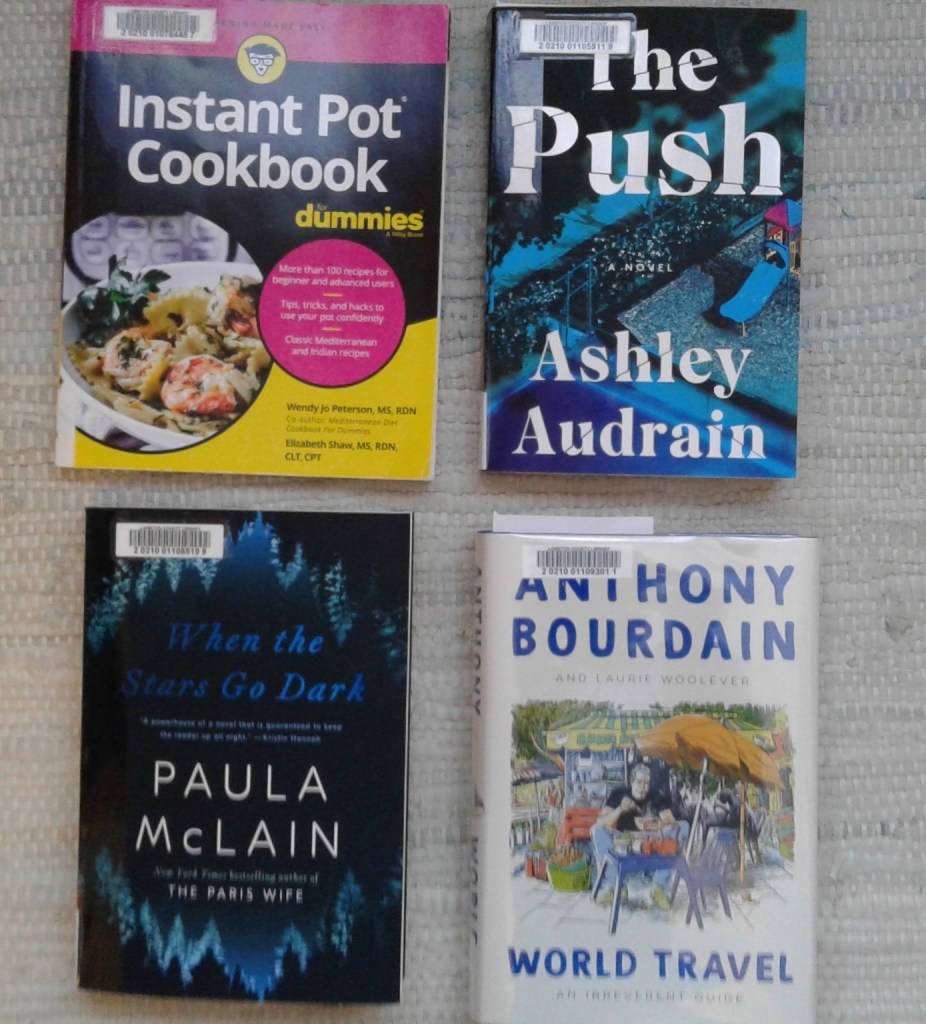
Two of these were DNR or did not get even started. The weather turned too warm for Insta-Pot soup, and World Travel – the Anthony Bourdain book, written by his collaborator after his death but full of his own quotes, had so much swearing in it I found it offensive and merely skimmed a few chapters. I used to watch his tv show occasionally but have never read his first, Kitchen Confidential or any of his other books so I have nothing to compare it to.
When the Stars Go Dark – by Paula McLain of The Paris Wife fame – about a CA detective searching for missing girls, was good for her first attempt at a non-historical/murder mystery.
The Push was a riveting read – motherhood isn’t all it’s cracked up to be, especially when you have a deeply disturbed sociopath child. I’m still trying to figure out what I think about this book, so it would make excellent bookclub fare. As a first-time novelist, I wonder where she got the idea, but then we have only to look at the news and wonder what it would be like to be the parent of a child who commits a violent crime, even if she is only seven.
Pretty Little Wife – DNF – reminder – do not order anything with the wife/exwife/trophy wife as the murder victim/suspect/crime solver etc.
Anxious People – Sorry LA – I know you said to give it a chance, and I may someday but it was overdue and I had to take it back. By the same author as A Man Called Ove – which I loved and which Tom Hanks is re-making as a movie….I enjoyed the Swedish version.
The Listening Path – by Julia Cameron – a big disappointment which I blogged about anyway.
Keep Sharp – by Dr. Sanjay Gupta. I loved this book, it’s an easy read for non-medical folks, full of common sense advice but it’s scary to think the decisions we make in middle-age determine how well we live in old age. I may blog on this later. He has another book coming out later in the year – World War C – Lessons from the Covid Pandemic.
The Last Garden in England – library bookclub selection, a multi-generational story about an English garden. A good tale, but nothing much to discuss, character driven with the garden merely a background.
A Promised Land – presidential memoir by Barrack Obama – although it’s not pictured here. I read his two earlier books but they were slim volumes. I’m sure his time in the White House was interesting but 700 pages was just way too much detail for me. I got to page 200 and it was still the primaries, and I had to return it and besides, Michelle said it better and more concisely in Becoming. I’ve not heard too much about this book after the initial buzz, but there is to be a volume two. I like to read in bed with the book propped up on my lap and it was just way too heavy…..literally, it weighed a ton.
The Last Bookshop in London – this was a surprisingly good read for light historical fiction, but then I love anything with a bookshop. Set in WW2 England during the Blitz….you can imagine the rest.
The Windsor Knot – cute premise and title with Queen Elizabeth playing sleuth. It was a slow, not very suspenseful read but somehow I do not think the Queen would be amused. Not everyone’s cup of tea.
The Lost Apothecary – also a good historical fiction murder mystery, but then I’m biased towards anything with an apothecary, especially a female one, even if it was a place you went to obtain poison for your intended (male) victim. The 1800 London past woven into a present day story, with a surprisingly hopeful ending.
Biggest disappointing read of the year which I had been so looking forward to was Jodi Picoult’s – The Book of Two Ways. Book opens with married female protagonist surviving a plane crash. Does she go home to her husband and child or fly off someplace else? Waded through 400 pages on death doulas, AI, Egyptian hieroglyphics and archaeology, much of which was standard university lecture material and had little to do with the plot, only to arrive at a totally ambiguous ending. I guess if you live in a parallel universe you don’t have to chose between your responsible-but-no-longer-in-love-with husband and your sexy grad-school Indiana-Jones type boyfriend because you can have both? Or maybe you the reader gets to decide? The ending was just plain annoying. In the author notes she thanks her editor for making her change it as it was so much better, which only left me wondering what the original ending might have been. I’ve never known Jodi Picoult to write a bad book before so it was doubly disappointing. I found her last one, Small Great Things, (how someone becomes a white supremacist) a timely and outstanding read.
There were many other books I didn’t take photos of…..some the kind you can’t put down.
I particularly enjoyed The Pull of the Stars – by Emma Donoghue about an obstetrical hospital in Ireland during the 1918 Spanish flu, which I found riveting, both for it’s historical obstetrical detail (not advised for anyone pregnant but many of my friends were OB nurses) and for it’s depiction of the pandemic (much the same as today, masks, distancing, fresh air, but thank god no carbolic acid disinfectant). I was surprised by the ending, but after I researched the author it make sense. Only a well respected writer (the Room) could get away with no quotation marks around the dialogue, an odd feature which didn’t seem to distract from the story.
I love murder mysteries and psychological thrillers, if they’re not too gory and I have my favorite authors – One by One by Ruth Ware was excellent, the setting a snowy ski chalet in the French alps with eight co-workers. The End of Her – by Canadian author Shari Lapena who is consistently good also, and Grace is Gone – by Clare McIntosh. Woman on the Edge – by Samantha Bailey, about a woman who hands her baby to another woman on the subway platform before she jumps, was also an interesting read.
For historical fiction, The Book of Lost Names – Kristen Harmel – a WW2 saga about a female forger helping Jewish children escape, and The Paris Library -Janet Skeslien Charles about librarians working at the American Library in Paris during the Nazi occupation, – were both good reads.
I hope you have found something interesting here for your summer reading. I also have a link to My Literary Salon reviews on the front pages of my website on the main menu under Books.
It’s either feast or famine, and I have little out from the library at the moment, which has been the recent victim of a “cyber security incident” thus disabling the online reservation process. I hope they get it fixed soon, or we Readers will all soon be in withdrawal. I’m always up for a recommendation, so please leave any favorite reads or authors you’ve discovered in comments.
PS. 3000 words – and I was criticizing Obama? Maybe I’ll stick to a quarterly review in the future…
The Secret Garden (goodreads link) is a children’s book by Frances Hodgson Burnett about an orphaned girl who discovers a locked abandoned garden on her uncle’s British estate. First published in 1911, it has been made into a movie numerous times, most recently in 2020 with Colin Firth in a cameo role as the uncle. As I enjoyed re-reading Anne of Green Gablesso much I’m adding this one to my To Read list, and the movie also, as I’ve heard the cinematography is stunning, especially as there won’t be any garden tours again this summer.
After five months in lock-down we are slowly and cautiously reopening, with ten people allowed for an outdoor gathering in stage one, and the rest of the stages contingent on receiving second doses earlier than our scheduled 16 weeks apart. Although they are trying to speed things up, only 17% of the population have received two doses so far, and with the shot being only 30% effective against the Delta variant after one dose, I think my garden will be remaining secret for awhile longer. It’s a shame not to be able to share all the loveliness, so please join me for a tour of what’s new and what grew.
The weather has been weird and wacky all spring, an unseasonable hot spell the first of April, followed by a cold month, then hot and humid again in May, then cold with frost warnings at night, then hot and humid again and despite thunderclouds no rain for two weeks….and all this by mid-June! Most things in the garden bloomed earlier than usual and have already come and gone, (see Wordless Wednesday Peonies) or are past their peak. The roses (see Wordless Wednesday Roses blog) have become blowzy and even with succession planting I’m wondering what there will be left to look now that summer has officially arrived. Wilted hydrangeas perhaps?
Lots of flower buds on the ones which didn’t get tinged by frost.
Morning glories and zinnias if they survive the heat and the weed-wacker?
I liked the pink centres and they’re already up an inch along the back fence.
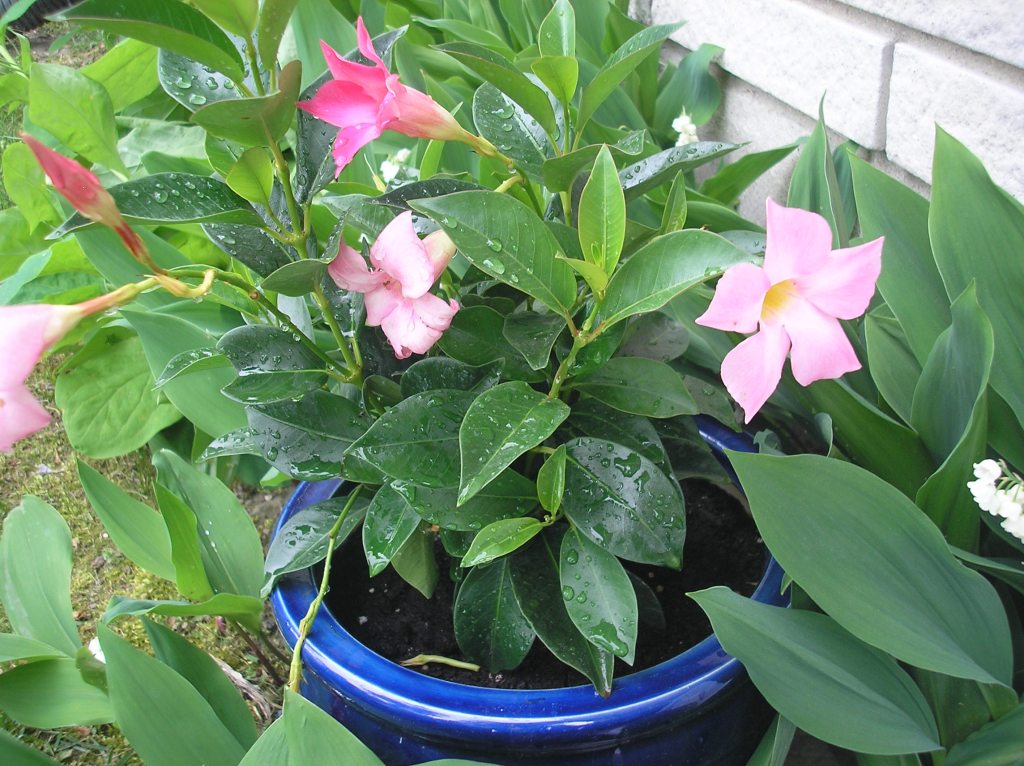
My lily of the valley, seen here peeking out from around the Dipladenia plant, was just starting to bloom but after being hit by frost the delicate little flowers turned brown overnight.
The daisies were particularly abundant this year and early as they are usually July flowers.
My regular Common Lilac bushes were duds flower-wise again this year, although they have lots of foliage. I was disappointed in these Bloom Again Lilacs too which I bought two years ago. The flowers are small and the bush spindly, without much greenery. They smell nice but I would not plant these again, as I do not like wimpy bushes. I like things which make a statement!
Prep Work: For me the fun is in the planning and buying, not the watering (I try) and weeding (I don’t). Whereas last year my entire garden expenditure was $8 (two tomato plants and some lettuce), this year I shopped, even if the selection was poor due to the yo-yo spring and the rationing by suppliers, the result of a lack of seasonal migrant workers due to COVID so one nursery owner informed me. I bought (but wisely) as I figured if I’m stuck at home I want pretty…….preferably in pink!
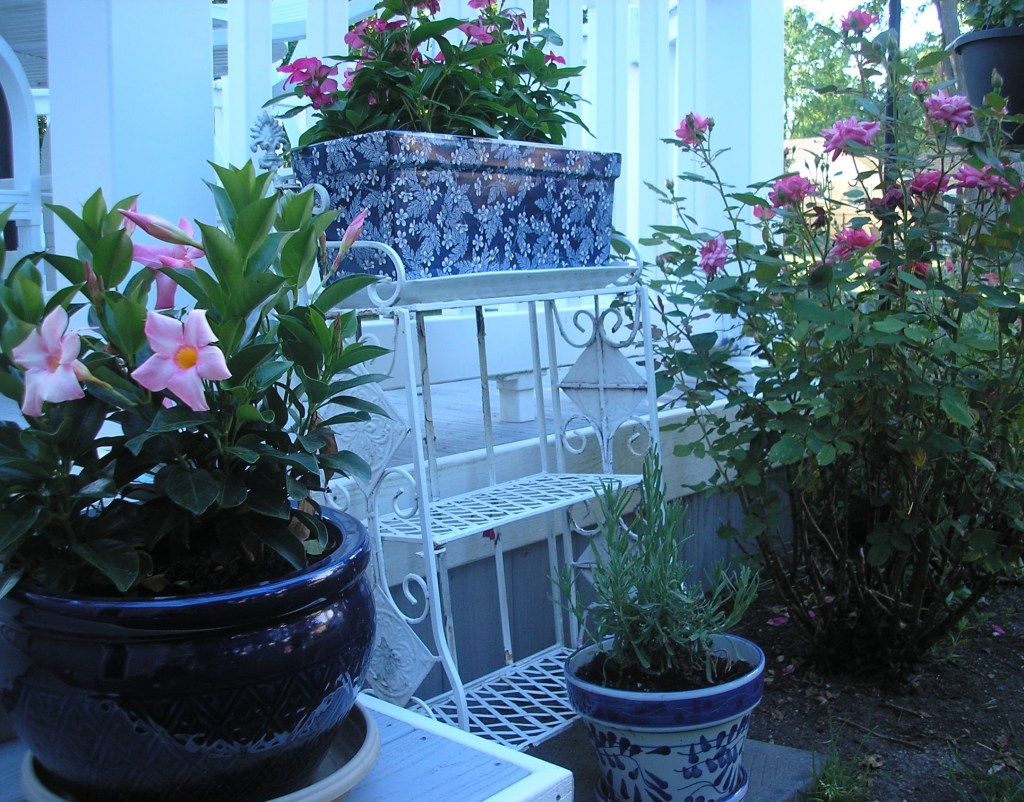
Vinca and begonias waiting to be planted. The planter box is painted in Molokai Blue.
Nice hanging baskets were scarce and expensive so I did my own pots using vinca instead of my usual geraniums and petunias. I’ve never bought vinca before but it’s heat tolerant and looked bright and cheerful. Plus at $4 a pot and two per basket, it’s a cheap alternative if you don’t mind getting your hands dirty. (I’ve found those vinyl pandemic gloves very useful for gardening – just throw them away.)
I put some in my ceramic planter, where I would normally have wave petunias, also in short supply this year.
They’ve already spread out so much I probably could have just planted one per container.
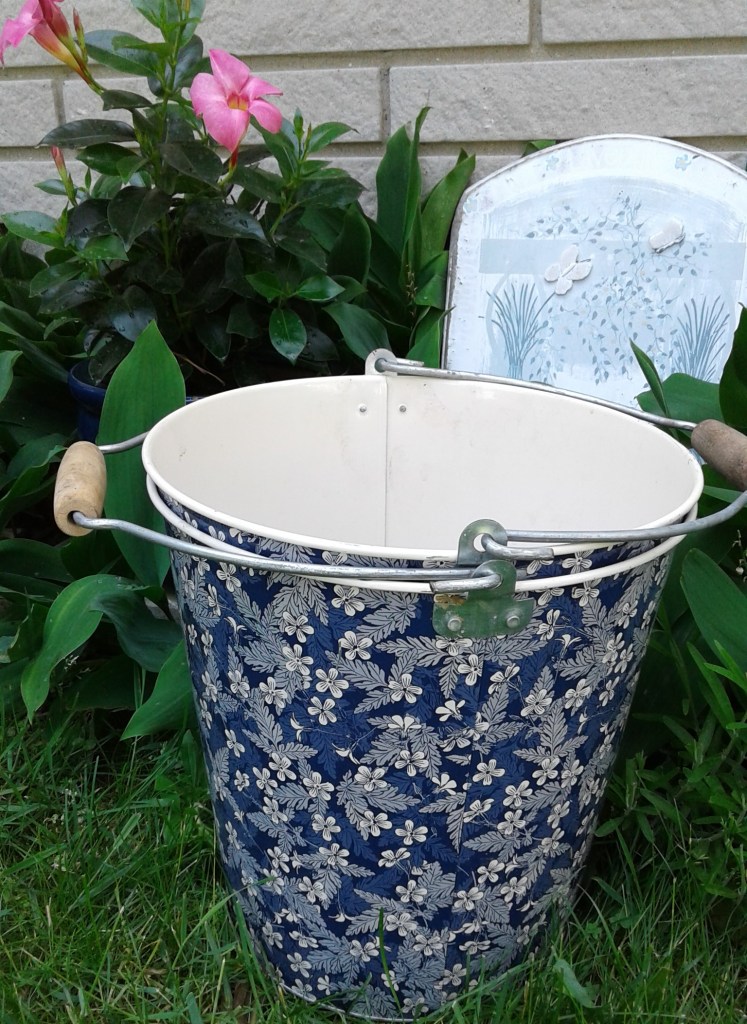
The navy ceramic planter came with a couple of matching pails which I couldn’t pass up. Winners/Homesense had a whole gardening line of the same pattern but the thing about that discount store is if you see something buy it, as if you go home and think about it it’s always gone when you go back.
A floral pail can be a beautiful thing!
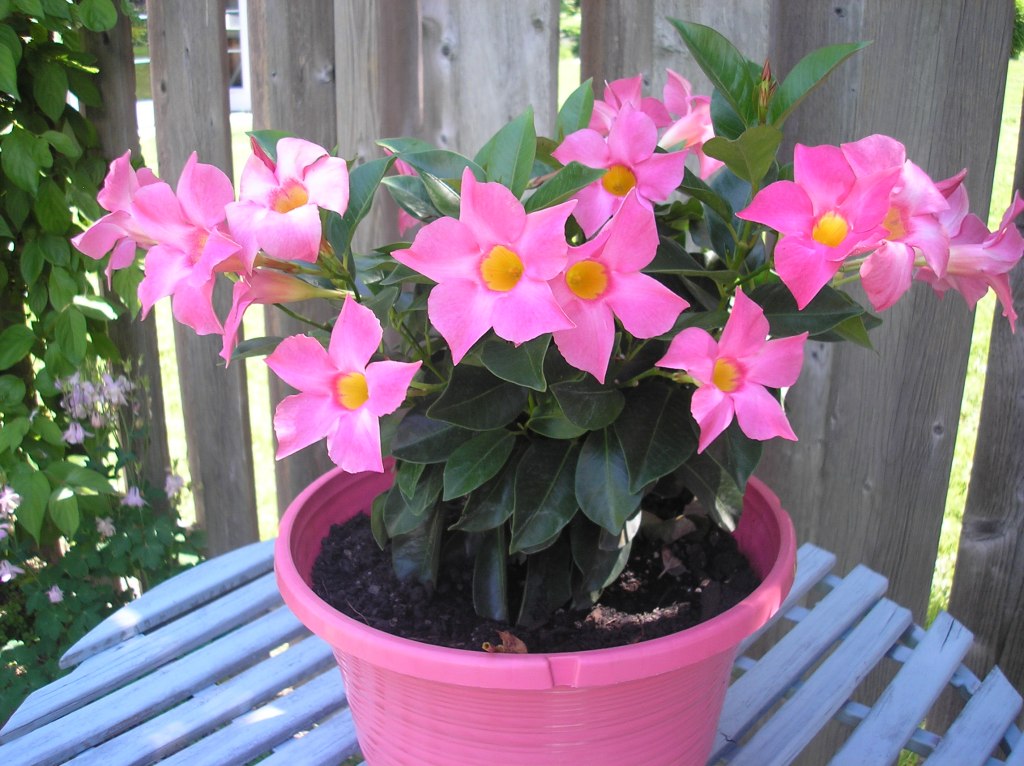
Seeing this colorful pot of pink vinca from my kitchen window every morning is a nice way to greet the day.
The mosaic bistro table was another Homesense find.
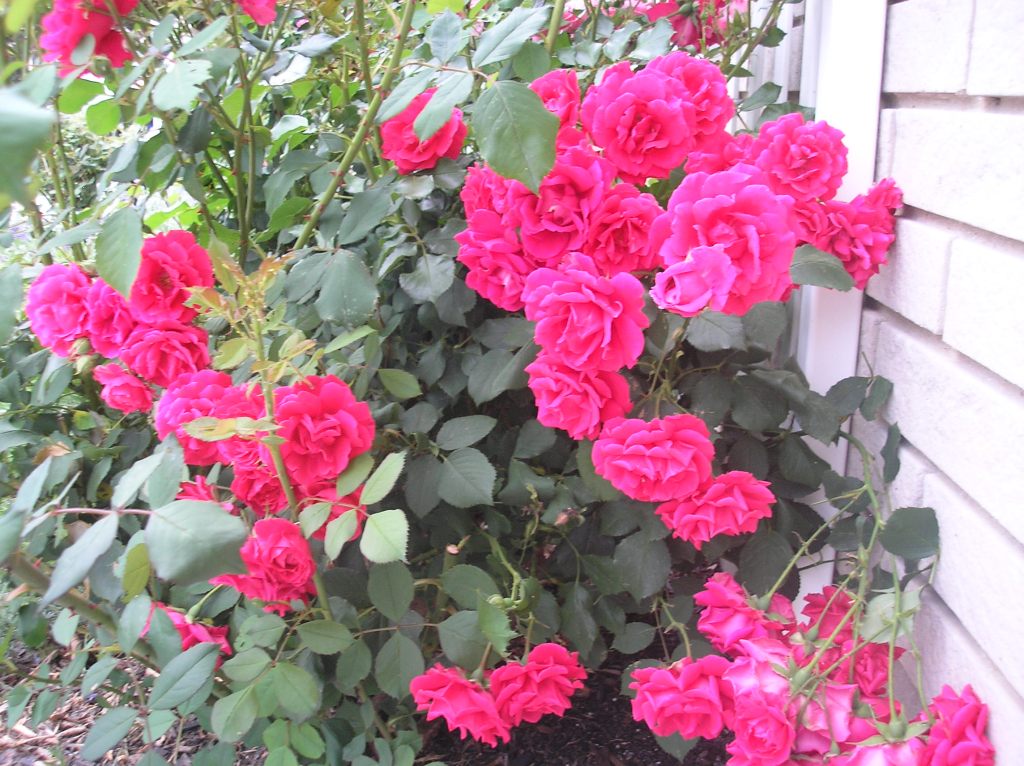
The Subject was Roses: I had to replace one dead Knock-Out Rose from last year when I couldn’t find any stock and I transplanted three others with too much dead wood, so four pink Double Knock-outs went on my list. At $25 per pot these are worth it as they are repeat bloomers and provide beauty all summer. The double pink can be hard to find although there are always plenty of red ones. The ones I moved are doing poorly from transplant shock as they had been in for ten years so I’m not sure if they will survive. (For more on Knock-outs’ check last years post – link) I wish Knock-outs had a climbing rose, but they don’t and the nurseries were all sold out of climbers. I finally located some “John Davis” ones at a pop-up nursery at $8 per pot so bought three for in front of some bare trellis. They’re small and not quite the color I wanted but the other choice was a clematis and I wasn’t happy with that selection either, although I did buy one “The First Lady” a pale lavender, also $8. One upscale nursery had Clematis for $49 per pot! The prices have really skyrocketed this year, (supply and demand), things sold out early and it’s even hard to find bags of garden soil.
The plant in the blue pot above is an Italian Bugloss, a hardy perennial which can grow to four feet, so I planted it in front of a trellis. It likes sun and attracts butterflies. It appealed to me in the nursery because of it’s bright gentian-blue color (I’m partial to blue – see The Blue Garden) so I overlooked the fact that even at $16 it appeared scraggly and half dead from lack of watering. I try and add something new every year, even if it’s something I’ve never heard of. Later I saw it on a list of easy to grow no-maintenance perennial favorites in a gardening magazine.
I’ve discovered the name of this blue plant from last year which I did not remember buying but might have been from the annual horticultural sale. It’s a Virginia Bluebell and bloomed well this year too. It likes shade and blooms in late spring.
I bought two Lavender plants ($4 each) as you can never have too much lavender, although these were an organic Blue lavender instead of my regular English type. I planted one in front of a hole under the deck hoping the smell might deter the mice and/or other creatures from establishing an empire underneath, the other went in a blue pot until I can figure out where to plant it, probably to replace something which will inevitably die.
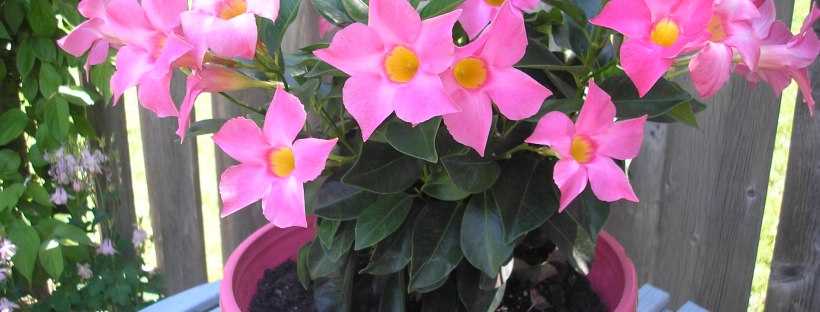
I had good luck with Dipladenias two years ago so I bought three pink ones ($7 each) for my pink recycled plastic pots. I’m always up for a bargain especially with annuals. They’re similar to a Mandevilla, are drought resistant and repeat bloomers, and give the the deck that tropical feel, like you might be on vacation somewhere exotic instead of stuck at home. They come in red and white too.
The lavender is blooming already too.
The Russian sage/lavender/pink knock outs make a nice contrasting mix.
Of course one cannot live on flowers alone, so the vegetable garden went in early too and seems to be thriving….four kinds of lettuce, some from seed and some seedlings, carrots, cucumber and pole beans, plus the everbearing strawberry plants if the birds don’t get them first.
Already harvested and sharing the bounty with neighbours.
And for the first time I planted brussel sprouts as they are supposed to be good for you.
Wish List: for when the end of July nursery sales come on, I’m looking for a rhododendron although they are hard to grow here. I tend to scoop up my perennials on the bargain table.
What I’m Reading: My (virtual) library bookclub is currently reading The Last Garden in England,(link) a three generational story about restoring a historic British garden. A light fluffy read if you’re a garden fan, although the garden was incidental to the story and I don’t think there will be much to discuss.
And last but not least, a study in pink, one of mom’s paintings.
An heirloom rosebush which came with the house. and blooms faithfully and abundantly every year. Behind it near the trellis is a repeat pink climber planted a few years ago. They seem to live in harmony despite the close quarters and clashing colors. Another climber on the back arbor……the one on the other side died from lack of sun. An old pale pink Austen climber which gets too much shade to bloom much. And my favorite repeat bloomer the Knock-Out rose of which I now have 25!
Pink peony greeting the morning sun. Second year for this “August Dessert” bush but the first with substantial blooms Peony at twilight. I was disappointed in this bush the first year it bloomed as they are too pale. This bright pink color is what I ordered. But they’ve grown on me…..and it’s right beside my meditation bench. A crown of peony blooms fit for a June bride.
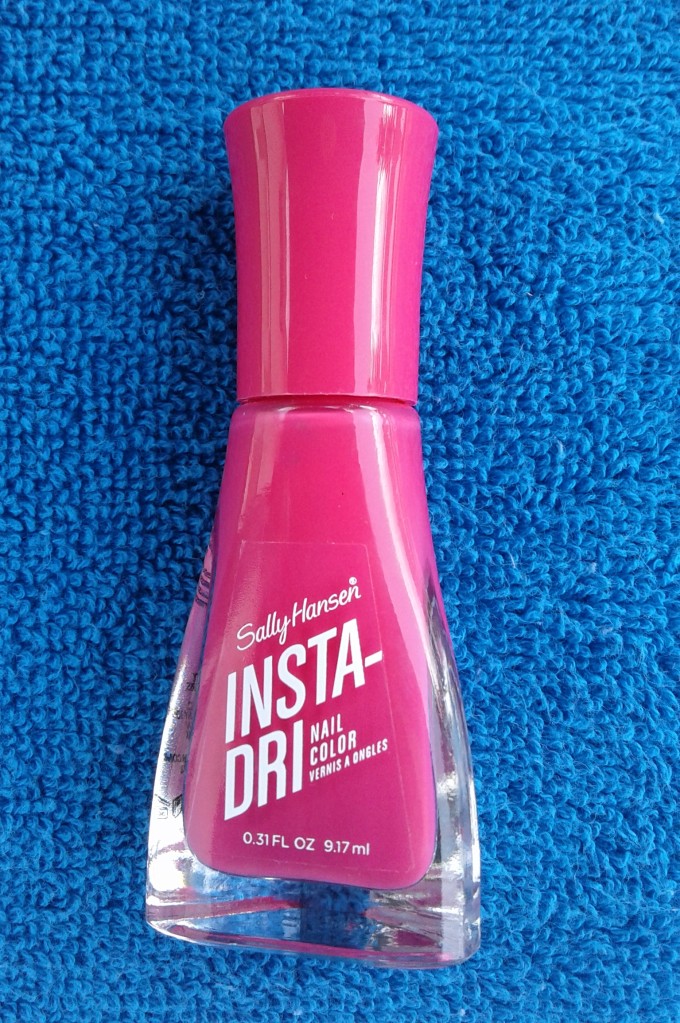
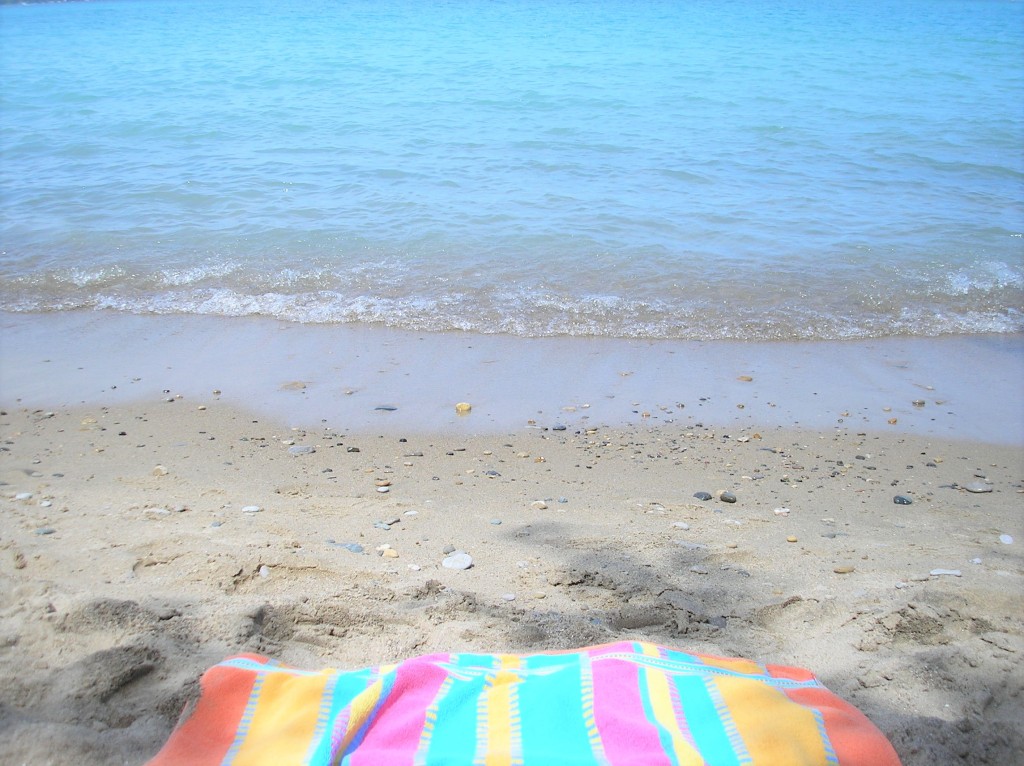
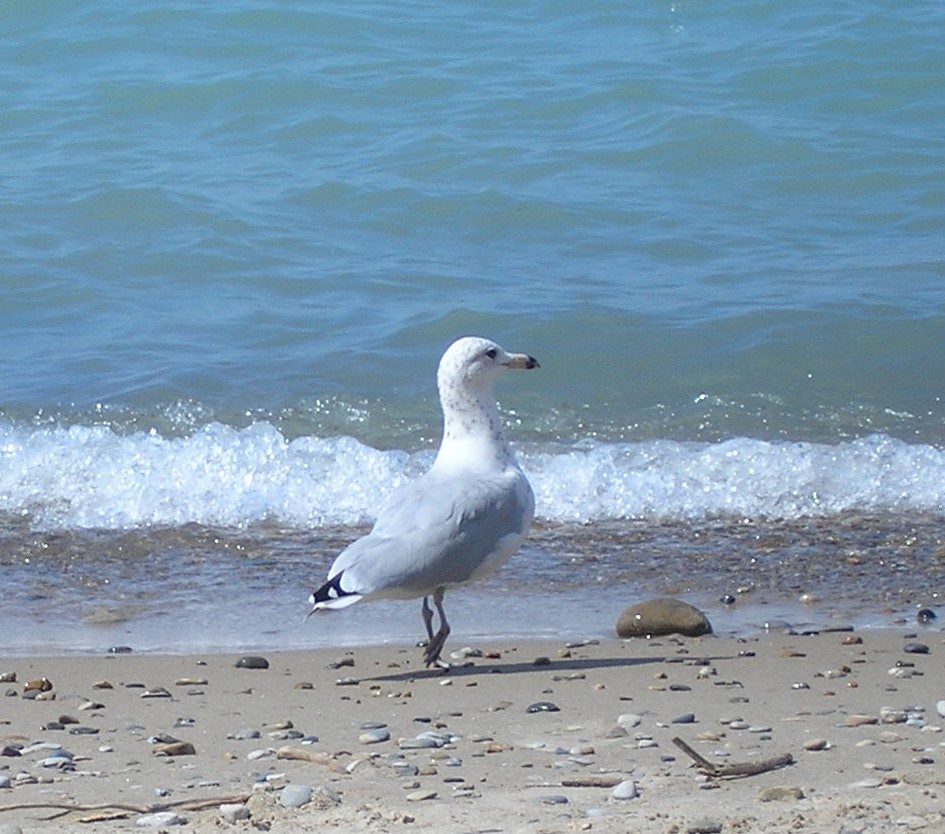
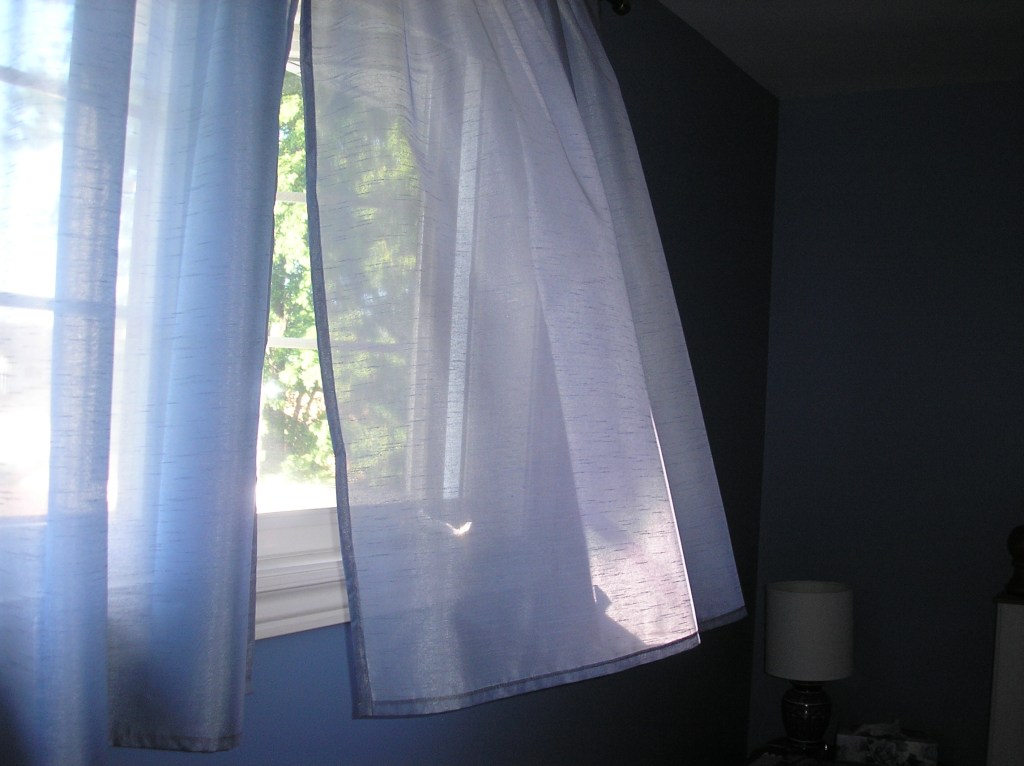
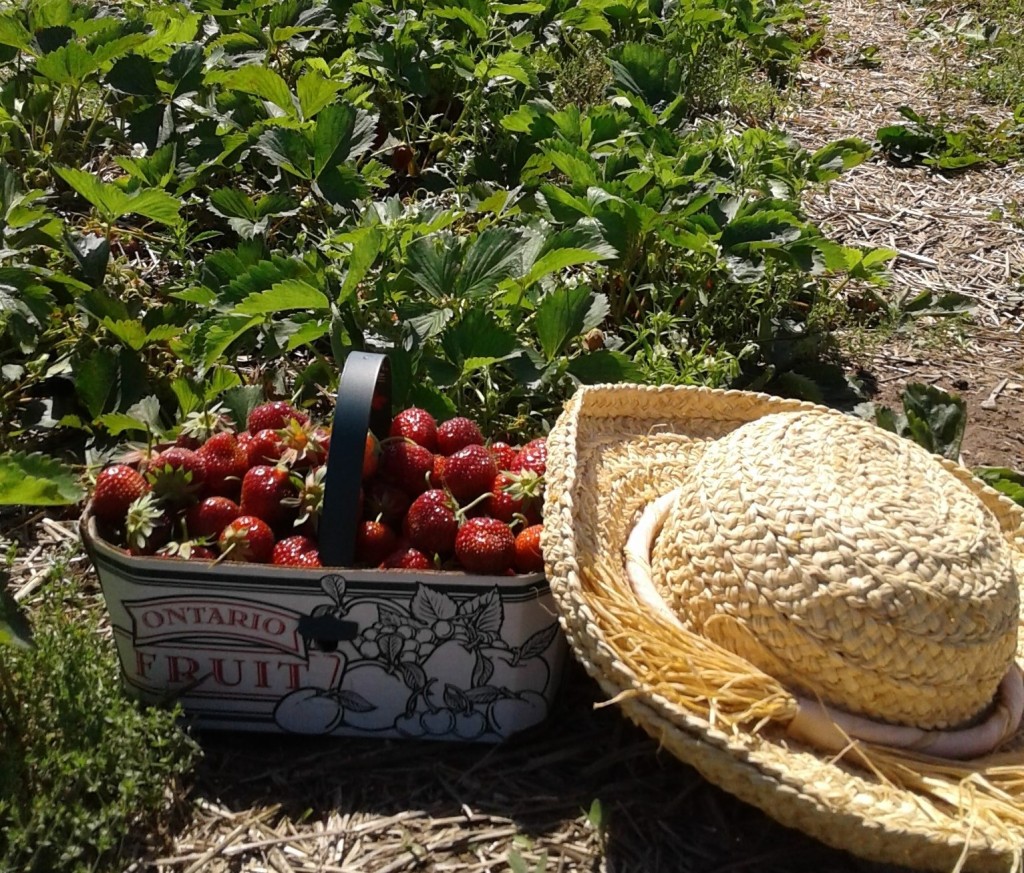
The first trip to the DQ for a milkshake. Because you need fuel to do all that gardening. Scheduling a pedicure with the best nail polish ever. For that first walk on the beach. Grabbing an ice cream cone Shaw’s – a tub full of happiness – where have you been all my life? While watching the seagulls and the waves roll in. Opening all the windows and airing out the house. Smelling the first roses of the season – look at all the buds. Tasting the first strawberries – don’t forget to wear your hat! Happy Summer!
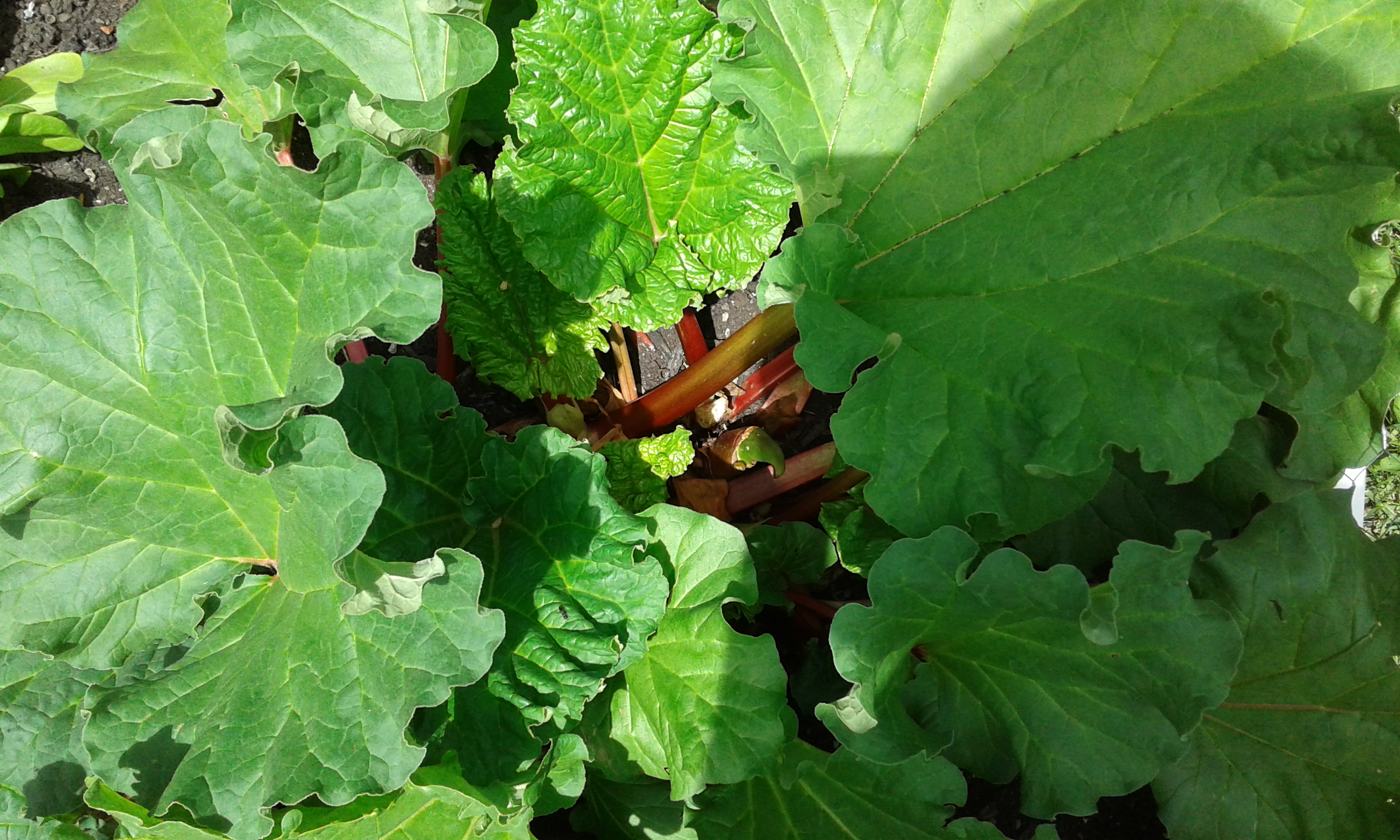
It’s rhubarb season for those of you who are fans of this tart seasonal favorite. Two years ago, I posted a recipe for Rhubarb Lunar Coffee Cake, (recommended for hungry astronauts) and at the end I mentioned that I had just planted some rhubarb. Two years later I have enough of a crop to make my own rhubarb treats. I’ve already harvested twice this year as it got off to an early start and I was able to share some with the neighbors,
and make rhubarb scones.
In that post I also reminisced about our large rhubarb patch on the farm and how it had been there for decades.
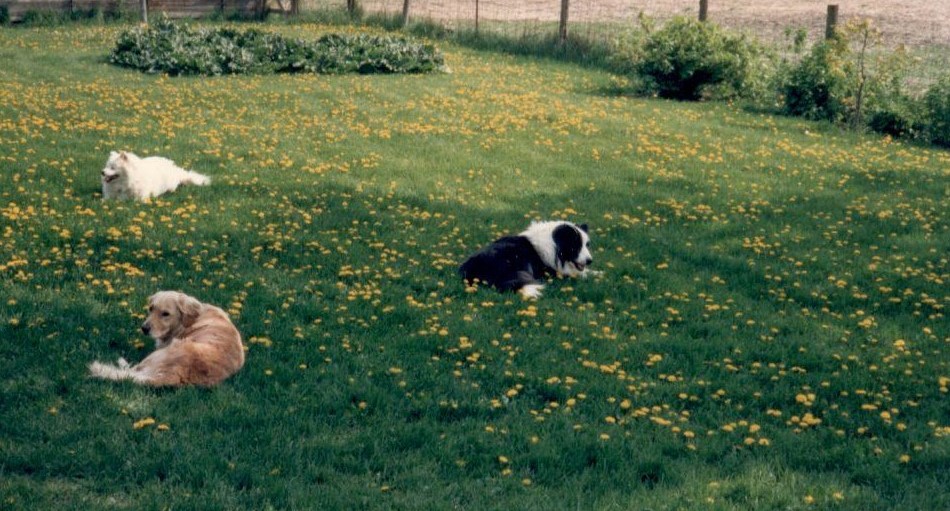
Family dogs guarding the rhubarb patch on a lawn sunny with dandelions.
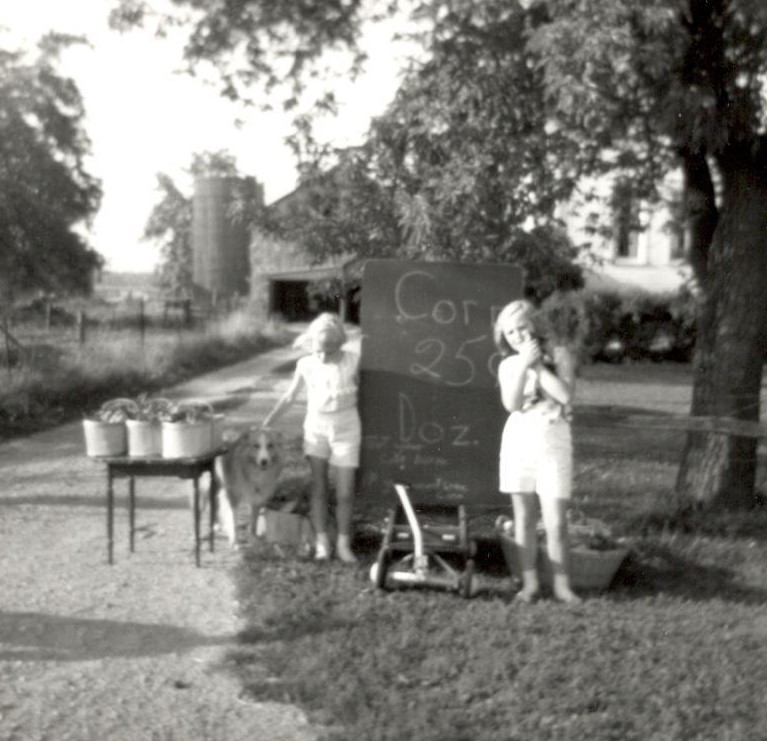
Recently I found the photos of when we set up a rhubarb stand at the end of the driveway under the shade of a big tree.
Four salesmen plus 2 cats and a dog – I’m the blonde beside the dog.
We had a big homemade sign advertising our wares, 25 cents a bunch, similar to this one. It was a quiet country road, so we didn’t have many customers, just a few people out for a Sunday afternoon drive. The profits ($1) were spent on penny candy.
This is making me nostalgic for our dog, King. He was a blonde border collie, (not a Lassie dog like the TV show which was popular at the time but the same color), and I’ve never seen another dog like him since. He wasn’t a cuddly dog, a pat by a stranger was barely tolerated. He was a working dog. His job was to fetch the cows from the back field if they hadn’t come up at milking time (my dad had a dairy farm) and to supervise the children. He was very protective of us, and could be found wherever we were. He could tell time too, as my mother said he would sit at the west side of the house at 3:30 every day like clockwork and wait for the school bus. He was an outside dog and slept in the doghouse or in the barn if it was very cold. One of my earliest memories was of going to pick him out, (I was four) and he died fifteen years later when I was first off to university. He was replaced by the black and white border collie (Shep) in the picture above who was the dumbest dog ever. He was also an outside dog, but the white Samoyed (Ruff), my mother’s empty-nester pet, was allowed inside the house as were later a succession of Golden Retrievers (Fergie, Murphy and Co), who were friendly but annoying in the fact they needed endless attention. I’m also feeling nostalgic about those big old trees which used to line the country lanes before they were all cut down to widen the road. Many farms had horses out in the fields so a drive in the country was a pleasant and scenic experience on a Sunday afternoon.
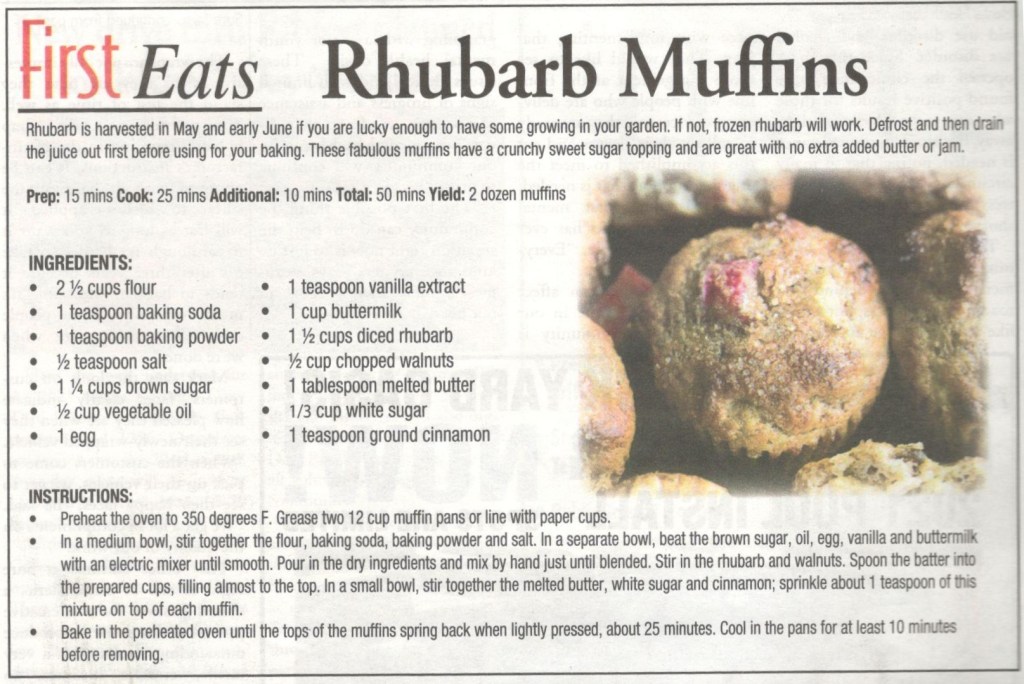
Enough of the memories, back to the rhubarb, as you must be hungry by now. Today’s recipe is for Rhubarb-Walnut muffins, which I adapted from a local magazine. When I say adapted, well you know I sometimes don’t follow a recipe exactly, with mixed results…
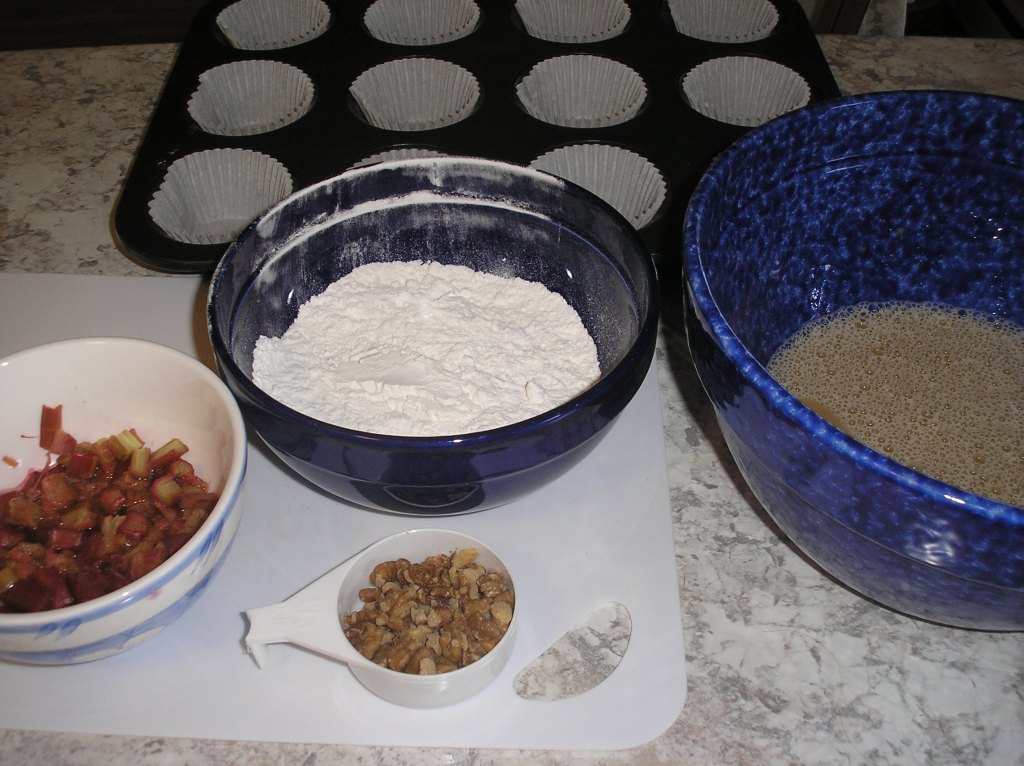
The Ingredients:
I didn’t have any buttermilk and while I know you can sour milk by adding lemon or vinegar I didn’t have any baking soda either, so I just used plain milk and my premixed flour with the baking powder already in it. I halved the recipe, as what do I need with 2 dozen muffins when we’re in month five of lockdown. I also microwaved the diced rhubarb to soften it as I didn’t think it would cook in the 25 minute baking time.
Beat the brown sugar, oil (I used butter), vanilla, egg and milk with an electric mixer until smooth. Add the dry ingredients and mix by hand until just blended. Add the rhubarb and walnut pieces.
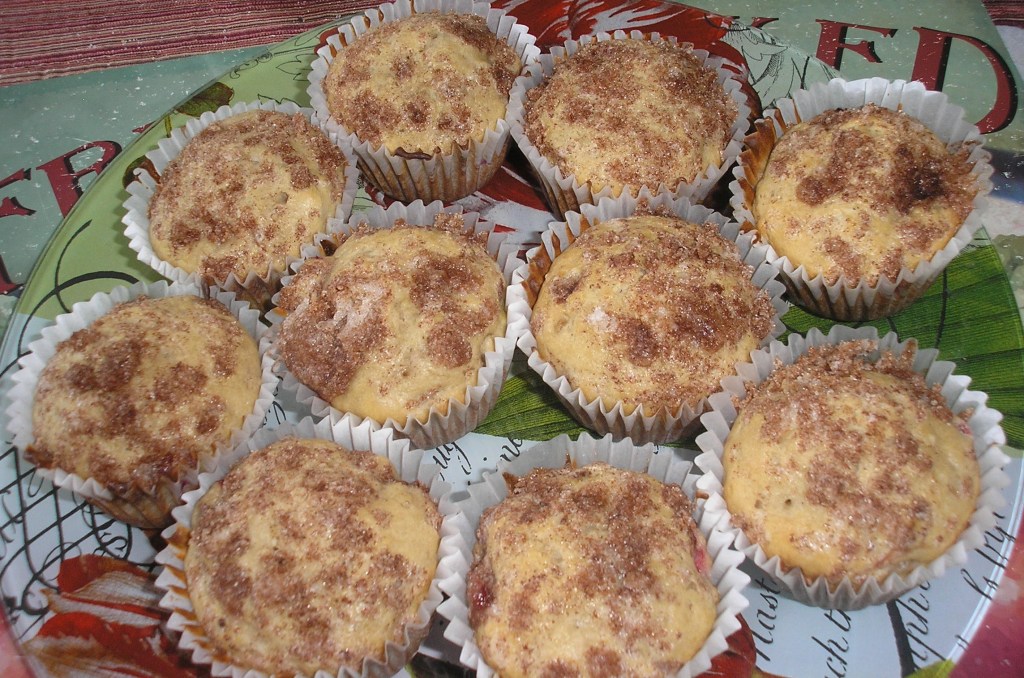
Here’s where things got interesting. The batter seemed too runny so I added some more flour, and not quite sweet enough, so a bit more sugar. Just a few tablespoons, nothing measured, but I still only got ten muffins not twelve. Spoon into muffin tin.
Sprinkle the melted butter/sugar/cinnamon mixture on top.
Bake for 25 minutes at 350 degrees.
They certainly looked pretty and turned out okay, but not great. But then I compare everything to my Rhubarb Lunar Coffee Cake, which is moist (from a whole cup of sour cream) and has a nice contrast between the sweet topping and the tart rhubarb. I found this topping skimpy and it had too much cinnamon plus I missed the brown sugar. I liked the chopped walnuts, as I’ve never added those to muffins before. The rhubarb sort of disappeared, not sure if I nuked it too long before hand and it disintegrated, or there just wasn’t enough of it. Next time I would add more rhubarb, and maybe some strawberries. They were better with some strawberry jam. I tend to be fussy with my food, but I gave some to my neighbors and my grass-cutter and there were no complaints.
Nice with a cup of tea on the deck during a gardening break.
The rhubarb patch is experiencing a third wave so after I have my cholesterol re-checked, (it was a spur of the moment decision so I didn’t fast, but we have been eating very well over the past year), I may make the Rhubarb coffee cake again. Muffins are portable, but that cake was great!
(949 words, about 700 if you eliminate the stuff about the dogs, kind of makes up for last weeks 3000 essay on LLM…..)
L.M. Montgomery, author of Anne of Green Gables (see Part One for the Original Manuscript)kept journals for most of her adult life, starting in 1889 when she was just fifteen until shortly before her death in 1942. She willed them to her younger son Stuart with the express wish that after a suitable time had elapsed, they be published, in accordance with his judgement. Before his death in 1982, he turned over the handwritten journals and a much abridged version which she had typed, as well as her scrapbooks, photographs, and other papers to the University of Guelph. The journals span ten large legal-size volumes of approximately 500 pages each and almost 2 million words.
An often quoted journal entry from a younger Maud….
When Professors of English at the University of Guelph, Mary Rubio and Elizabeth Waterston, first read the journals in the 1980’s, they were surprised by what they found.
But First a Short Biography of Maud’s Life:
Lucy Maud Montgomery was born on Nov. 30 1874 in Clifton, Prince Edward Island. Her mother died of tuberculosis when she was 2 years old and her father was unable to care for her, so she continued to live with her maternal grandparents in Cavendish, who had been looking after her during her mother’s illness. Despite a large network of relatives and cousins, she spent much of her childhood alone and resorted to creating imaginary friends to cope with her loneliness. When she was sixteen, she spent a year out west with her father (they were “chums”) and step-mother (who resented her) but things did not work out so she returned to the island. During that year she made her father proud by publishing her first poem in a Charlottetown newspaper.
When she returned to the island, she obtained her teacher’s certificate and taught in Bideford for a year. Her first story was published in Ladies Journal in July 1895. She attended Dalhousie College in Halifax for a year (all she could afford), then returned to PEI and did two more teaching stints, until her grandfather MacNeil passed away in 1898 and she felt it her duty to return to Cavendish to care for her grandmother. During all those years she published many more stories and poems. Anne of Green Gables was written in 1905, accepted in 1907 and published in 1908.
In 1911 her grandmother died, and Maud, who had been engaged for five years to the Reverend Ewan MacDonald, was married that June. After a wedding trip to England and Scotland, they moved to Leaksdale Ontario for fifteen years, where her husband was the minister at a church. In 1926 they moved to a different ministry in Norval Ontario, until they retired to Toronto in 1936. Maud died in 1942.
These are the facts of her life, but the journals reveal the stories between the lines.
The Journals:
The two professors had been invited by Dr. Stuart MacDonald, LLM’s youngest son, to edit and publish the journals, which they did in four volumes over the subsequent decade. They were astonished by the dichotomy between the cheerful Anne stories and the troubled and often unhappy life of this famous author.
Maud considered them her “grumble books” and was often quite blunt in her opinions of people, hence the forty year publishing delay ensured no one mentioned in them would still be alive.
Recognizing their historical significance, Maud began to recopy the earlier diaries into legal-sized ledgers in 1919. Of note the page recording her first impression of her future husband was cut out and replaced, and it’s difficult to tell how many other entries were altered from the original. Still they read as honest and real. As well they stand as a record of what life was like for women in the early half of the century, a century which saw enormous social and technological change, (from horse and buggy to motor cars), a Depression and two world wars.
It was interesting to see the changes in women’s fashions over the years….
When you read through the journals, especially the first volume from 1889 to 1910, shortly after Anne was published, you can see the seeds of Maud’s stories, in her schooldays and her teaching career. Although Maud always said Anne was not modeled after a real person, including herself, there is a similarity between their “orphan” status, vivid imagination, love of beauty and “purple prose,” and highly sensitive nature.
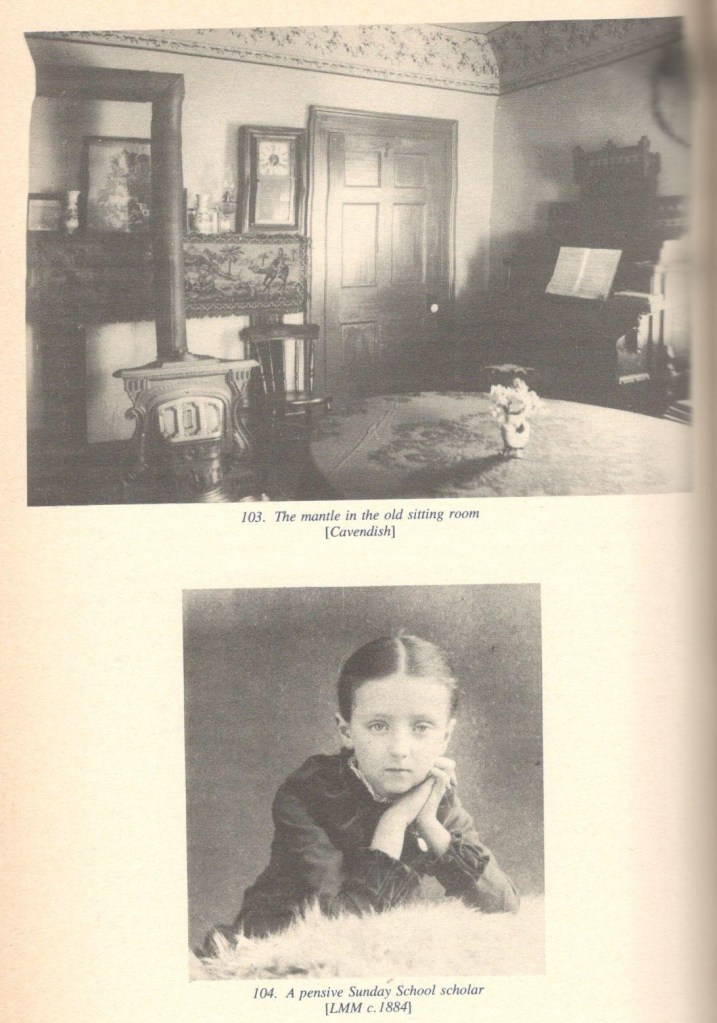
There are many photos in the journals – young Maud reminds me of Anne.
Maud proclaimed Cavendish her favorite place in the world, and it always puzzled me how someone who loved the island so much could stand to leave it? Could her minister husband not have obtained a placement there, or were his mental problems already apparent? Perhaps after her grandmother’s death, there were too many ghosts, and she looked forward to a fresh start in a different province? Although she came back in the summers to visit her cousins it wasn’t the same.
Volume Two – early married life
After her grandmother’s death her uncle inherited the farm, (there is a hint of family politics in one entry where she records that her uncle had not spoken to her grandmother in five years) and then a nine month gap in the journals while Maud is grieving her death and the loss of the only home she has ever known. When she does resume, the record is a particularly anguish filled one. With no home left, Maud stayed with her cousins in Park Corner and was married from there in June of 1911 to a minister, Ewan McDonald, to whom she had been engaged for five years, and whom she was ambivalent about marrying. They seemed to have little in common, she was by far the more intelligent, and he did not share her love of literature or nature.
Maud had had several past love interests, including a broken engagement to a distant cousin, but as she writes she wanted companionship and children. The man she had fallen in love with years earlier, a farm hand she met while she was boarding during one of her teacher placements, was of lower station and education and so she ended the relationship. He died a few years later of the flu and she was grief-stricken.
To marry or not to marry – that is the question…..
Even self-supporting authors were expected to marry back then (Maud made $500 off her writing in 1903, a decent amount for the time), but if you describe your wedding day as “I sat at that gay bridal feast, in my white veil and orange blossoms, beside the man I had married and was as unhappy as ever I had been in my life…..the mood passed. By the time I was ready for going away, it had vanished completely and I was again my contented self.” – well there’s really nowhere to go but down.
The marriage was not a happy one. Ewan suffered from some sort of “religious persecution or melancholia”, where he felt he was dammed to hell, as well as his wife and children. Frequently he was not well enough to preach, and suffered from “nervous breakdowns.” At one point he was so severely depressed he signed himself into a mental sanatorium in Guelph. Several nerve specialists were consulted over the years – although sometimes he had remissions and could appear quite well, at other times he was almost catatonic. It surprised me that “manic-depressive insanity” which was contemplated as a diagnosis by one of the psychiatrists, was known back then. He also had attacks where he heard voices, had delusions and raved obsessively, so there may have been a schizophrenic component. As a minister’s wife, it must have been a burden for Maud to act the ever-cheerful minister’s wife, arranging church suppers and socials, and trying to hide his acute mental health problems, as well as deal with her own issues. She wrote that she regretted marrying him, but divorce would have been scandalous back then and she felt it was her duty as a Christian woman to make her marriage work.
Maud herself struggled with depression and bouts of anxiety during her life, much of which is made evident in her journals, especially the later volumes. There were numerous entries of her pacing the floor at night dealing with insomnia over named and unnamed worries. As a medical person I found the medications prescribed for both of them of historical interest – barbiturates and choral hydrate were still around when I first graduated forty years ago, although fallen out of favor. Perhaps the flip side of having an active imagination, is always imaging the worst, but she often seemed to be in the “depths of despair” as Anne put it.
There was so little understanding of mental illness then and less to treat it with…. Volume Three
Note: I read these back when they were first published,and although I bought the first three, the latter volumes were so depressing that I borrowed the fourth from the library.
Ewan’s mental problems worsened to the extent they had to change parishes, he was sued in a car accident (cars were in their infancy and he was a reckless driver), he refused to assist with raising the children or the household chores, and her son Chester was causing her much grief. As an older mother (she was 36 when she married), she had three sons – Chester, Hugh (stillborn) and Stuart, her “good son” who became a respected doctor. Chester was described as a never-do-well, who lied, stole and manipulated. He failed law school several times and got a young girl pregnant whom he hastily married, but could not support their children. It may have been the flapper era but this was scandalous stuff for a minister’s wife. Maud wrote later that her oldest son had made a mess of his life, and his wife had left him.
Maud was under a lot of pressure and stress, so the cheery Anne sequels, and other novels like Emily of New Moon, must have provided a needed distraction from her everyday life. To shut herself up in her parlor and write for a few hours each day must have been a blessed escape. Although even there was stress, including several legal disputes with her initial publisher Page and Company, whom she had left for McClelland and Stewart in 1917 when she discovered he was cheating her. (She received seven cents off each copy instead of the 19 cents she was entitled to). Page boasted that he had made millions from the Anne books (including the movie rights in 1919), while she made $100,000, a tidy sum but “it’s a pity it doesn’t buy happiness.” She stood her ground and eventually won her court case in 1928.
One wonders how she even found time to write, with her motherhood, household and church duties. She also read extensively and there were committee meetings and public speaking engagements, but Maud was good at multi-tasking and had tremendous work ethic and discipline. During her lifetime she wrote 20 novels, (seven with Anne as the central character), 530 short stories, 500 poems, 30 essays, a book of poetry and a short autobiography. In her later years she had tired of writing about Anne and wanted to try something different, not what the publishers and readers expected – she felt “she had never achieved her one ‘great’ book.” I disagree, although it is a juvenile book, Anne of Green Gables is as close to perfection as can be.
Her declining years were plagued by poor health and mental anguish. In a handwritten journal entry dated July 8, 1941, she wrote “Oh, God, such an end to life. Such suffering and wretchedness.” Then on March 23, 1942, she wrote her final entry “since then [July 8, 1941] my life has been hell, hell, hell. My mind is gone — everything in the world I lived for has gone — the world has gone mad. I shall be driven to end my life. Oh God, forgive me. Nobody dreams what my awful position is.” (quoted from The Gift of Wings – 2008 biography written by Mary Rubio, the definitive biography of LMM). (Note: the comment re the world has gone mad could pertain to her political concerns about WW2 and conscription as she had two young sons.)
On April 24 1942 Maud was found dead in her bed, at the age of 67. The primary cause recorded on the death certificate was coronary thrombosis. However in 2008 her granddaughter Kate revealed in a Globe and Mail article that Maud might possibly have taken her own life through a drug overdose. She had become addicted to barbiturates by then having been given them by doctors to treat her depression. A note was found on her bedside table which read,
“This copy is unfinished and never will be. It is in a terrible state because I made it when I had begun to suffer my terrible breakdown of 1940. It must end here. If any publishers wish to publish extracts from it under the terms of my will they must stop here. The tenth volume can never be copied and must not be made public during my lifetime. Parts of it are too terrible and would hurt people. I have lost my mind by spells and I do not dare think what I may do in those spells. May God forgive me and I hope everyone else will forgive me even if they cannot understand. My position is too awful to endure and nobody realizes it. What an end to a life in which I tried always to do my best.”
An alternative suggestion, presented by Professor Mary Rubio in her 2008 biography, is that Maud may have intended it as an entry in part of a journal now lost, rather than a suicide note. There were typed versions of the journals as explained in this article, Accident or Suicide, posted by the L.M. Montgomery Literary Society. (link)
Rubio believes that the number “176,” written at the top of the note, indicates that it was page 176 in a handwritten journal, which Montgomery would have intended to transcribe by typewriter, as was her custom. The missing 175 pages, which have never been found, may have been taken by Montgomery’s eldest son, Chester Macdonald, who was living in the basement of their Riverdale house, and whose dependency and cruelty reportedly exacerbated his mother’s poor mental health. Or perhaps they were destroyed by her husband? Dr. Stuart MacDonald said that in her last few years she had burned quantities of letters and papers she considered unimportant, and others mysteriously disappeared before he was able to have them removed from the house.
I think I prefer Rubio’s version, that the note serves as instruction regarding the journals, and perhaps forgiveness for hurting people with some of the entries. It jibes with my recollection of the latter entries in the fourth volume which were gloomy and sporadic as she knew her life and her mind were waning. Whatever the cause, she was certainly in poor health and troubled by family problems, and her once bright mind was clouded by medication.
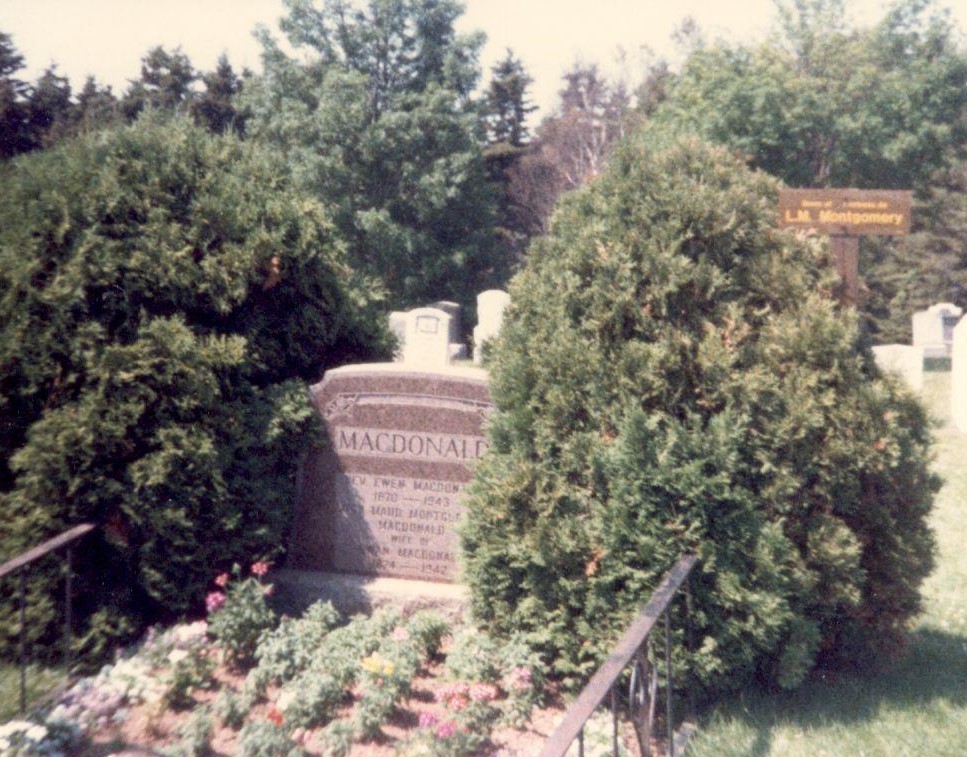
No autopsy was performed, and her son who was a medical intern at the time and her family physician disposed of any evidence. The note was handed to Professor Mary Rubio decades later by her son Stuart Macdonald, who died in 1982 and she did not ask for particulars about it at that time. Ewan MacDonald died a year later. They were both buried in Cavendish, P.E.I. Whatever happened, whether it was an accidental or intentional overdose or death from natural causes, it was a sad ending to a life once so full of hope and joy.
L. M. Montgomery tombstone
I found Maud to be a fascinating person. She was extremely intelligent and articulate, and possessed of an extraordinary imagination and memory, but behind the smiling cheerful face she presented to the world, was an anxious tormented soul.
It would be wrong to assess a life solely from journals, but they do provide a window into the soul. As she had no close confidante, they became a refuge of sorts, a place to air her unhappiness and grievances, but certainly she had more than her fair share of life’s troubles. In addition, there were two world wars to be gotten through, and other deaths including that of her beloved cousin Frede from the Spanish flu. Although there are happier entries, including those of her seeking solace in nature and when her children were young, predominantly I remember the journals overall as having a dark tone. Success doesn’t always guarantee happiness, and she must have looked back on her younger years on the island as the happiest time of her life.
Prince Edward Island:
In the 1980’s I visited the east coast of Canada, but only spent a couple of days in P.E.I. including an afternoon visiting the Green Gables Heritage Place in Cavendish. I have surprisingly few photos. Film was 24 per roll and you rationed it as I recall.
Cavendish is to a large extent the Avonlea of the books. Maud’s grandparent’s house was torn down in 1920 by her uncle as he was tired of people traipsing by to see it. The Green Gables of the book was drawn from the old MacNeil/Webb place, “not so much the house itself as the situation and scenery, and the truth of the description of it is attested by the fact that everybody has recognized it,” Maud recorded.
The home’s period furnishings reflect the novel’s late 1800’s setting. Visitors can stroll the grounds, including Lover’s Lane and the Haunted Woods.
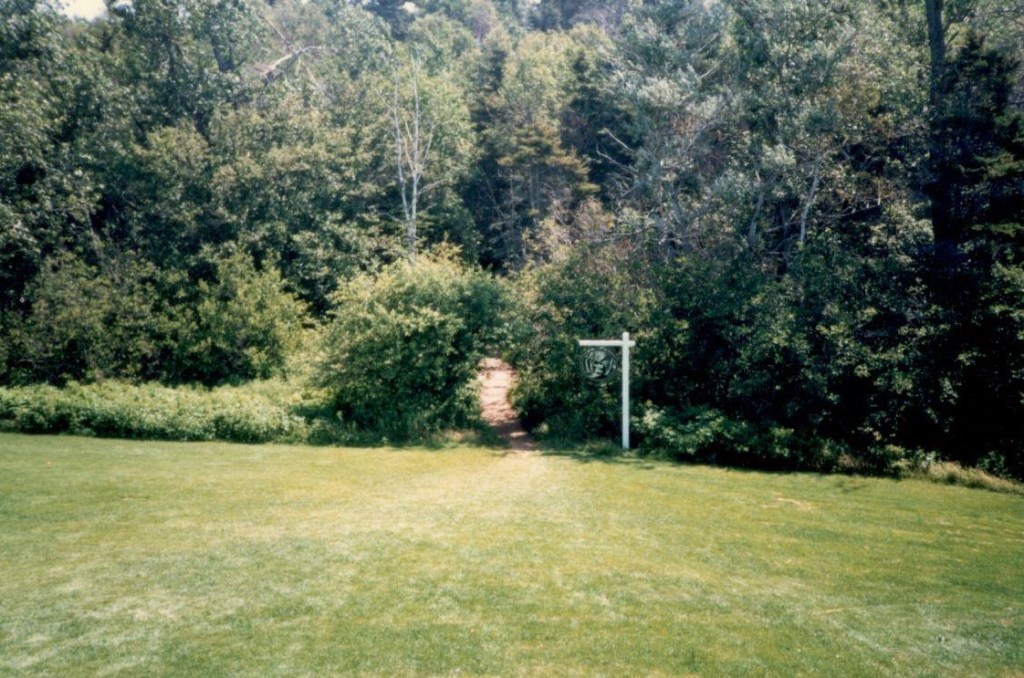
The entrance to the Haunted Woods…..
I was disappointed in the area, as while pretty it just looked like ordinary farmland to me, albeit with red earth and the sea shore nearby. The Haunted Woods did not exactly look spooky on a bright summer afternoon. The Lake of Shining Waters looked like a big flat pond. I did not get a chance to stroll along Lover’s Lane, as it was farther away. Even the remnants of the apple orchard and the famous Snow Queen just looked like gnarled old trees.
Descendants of the Snow Queen?
I’m not sure what I was expecting – the vivid descriptions from the book? Perhaps that is the difference between books and reality – what you imagine or envision in your mind, very seldom ever matches real life. Maybe the same can be said of success. Still it was a nice place to visit if only for a few hours.
PS. I’ve often wondered that about other famous authors, the more tragic figures like Sylvia Path, the Brontes and Jane Austen. If they could have happiness or lasting fame – which would they choose? And why does it so often seem that people can’t have both?
This time of year when the trees are blossoming always reminds me of Anne of Green Gables. Anne declared Prince Edward Island “the bloomiest place ever,”
and there are numerous references to them in the book, from the Snow Queen and the cherry orchard right outside Anne’s bedroom window to the White Way of Delight, where the overarching trees created an avenue of bloom on the buggy ride home from the train station, to a simple arrangement of apple blossoms in a chipped blue jug on the table. Anne Shirley was a fan of nature, and so was her famous creator, Lucy Maud Montgomery.
Last summer I had the delight of re-reading this favorite children’s class, and I enjoyed it just as much as when I first read it as an eleven year old girl, the exact same age as Anne.
My 1965 childhood edition had several illustrations.
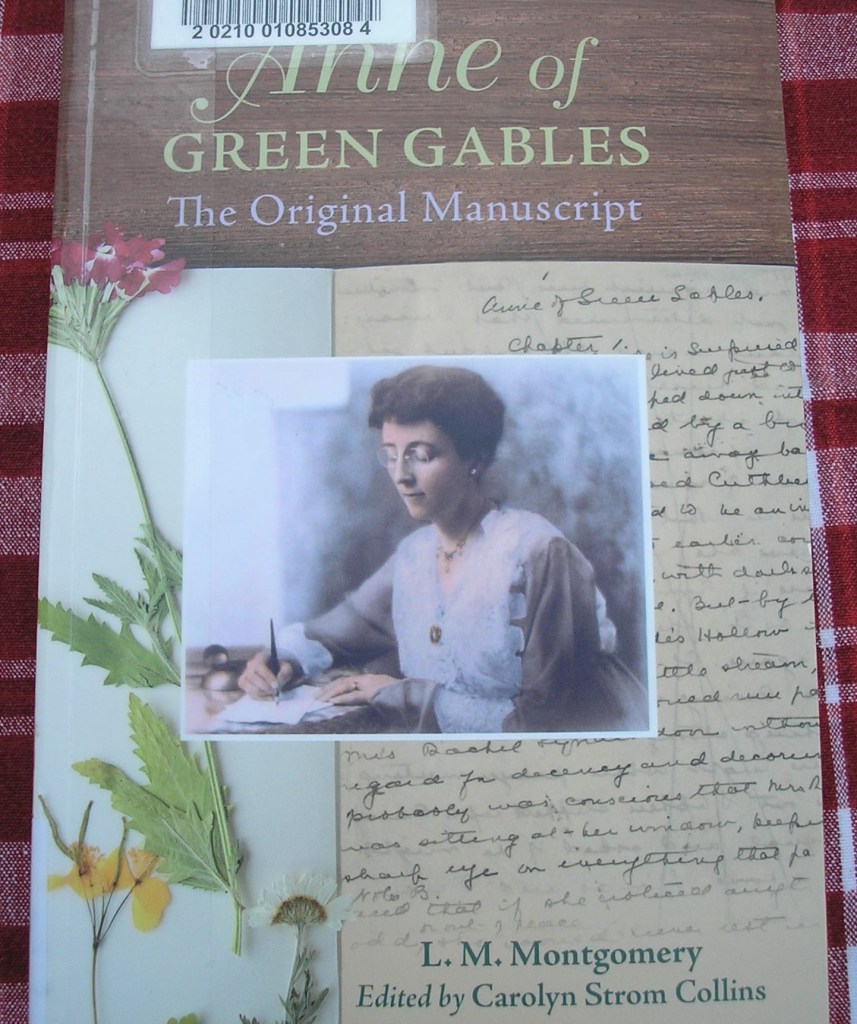
This month’s Literary Salon pick – Anne of Green Gables – the Original Manuscript was released by Nimbus Publishing in Halifax in July of 2019.
The Publishers Blurb:
This fascinating book presents the original text of Montgomery’s most famous manuscript, including where the author scribbled notes, made additions and deletions, and other editorial details. For example: Diana was originally called Laura, and then Gertrude, before the author settled on Diana. L.M. Montgomery scholar Carolyn Strom Collins offers a rare look into Montgomery’s creative process, providing a never-before-published version of the worldwide phenomenon.
Differing from previous versions of Anne, this book provides a transcription of the text and notes from Montgomery’s original manuscript, and shows how they were integrated to form the full novel.
Discussion:
As a life long fan of Lucy Maud Montgomery, our most famous of Canadian authors, being given permission to scan all 844 pages of the original handwritten manuscript must have been a labor of love for editor, Carolyn Strom Collins.
The manuscript is kept in the archives at the Confederation Centre for the Arts, in Charlottetown PEI, in a dark room with no photography allowed as befitting an object of such literary reverence. It is 116 years old now, and Maud kept it all her life, (in her journal she proudly proclaimed it “mine,mine,mine” the day the first copy arrived in the mail), although the typed copy she submitted to the Page Publishing company in Boston in 1907 has since been lost.
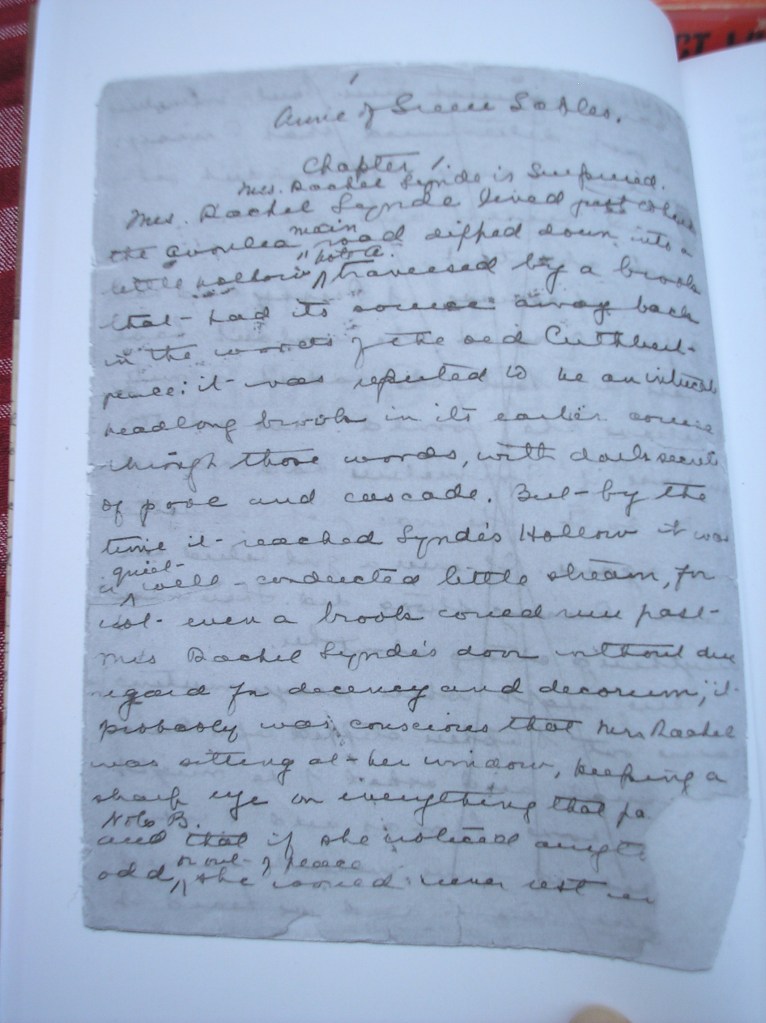
The manuscript is in two parts, the main body of 709 pages and 135 pages of notes, some of them misnumbered. Maud wrote quickly and sometimes overlooked punctuation, especially in the notes section. The pages measure 8.5 X 6.5 inches, considerably smaller than the average typed page, and are about 3 inches thick in total.
In this newly released edition, there is a scanned copy of the first handwritten page at the beginning of each chapter.
Maud was a schoolteacher so her handwriting was fairly easy to read. Paper was scarce so she wrote on both sides, and sometimes on the backs of bills and other stories.
The editor decided to place the changes and additions Maud made in the notes beside the corresponding pages for easy viewing.
I was amazed at how few changes Maud made to the handwritten copy. Likely her stint working as a copy editor and columnist for a Halifax newspaper came in handy. As the typewritten copy she submitted has not survived, it’s unclear whether final changes in the book were made by Maud or the editors, or both. Mostly they had to do with punctuation. Although this was her first book, Maud was an experienced author by then, having published well over 300 short stories and poems in the previous decade, enough to provide a source of income, but I suspect she was also one of the lucky ones whose words just flowed out of her head.
Although she records in her journals “brooding” up her heroine and and blocking out chapters and incidents, if there are any written copies of this prep work they are long gone.
The story behind the book and it’s publication is an interesting one, and lucky for us it didn’t stay in a hatbox.
Anne of Green Gables began as an idea jotted down in a notebook many years earlier, “Elderly couple apply to orphan asylum for a boy. By mistake a girl is sent them.” In the spring of 1905 Maud was searching through the notebook for suitable ideas for a seven-part serial for a Sunday School paper, but as the story progressed Anne took possession of her, and casting morals and lessons aside she decided to write a whole book about her instead. Many of Maud’s own childhood experiences and dreams were worked into it’s chapters. Didn’t we all sigh over Gilbert Blythe who was based on one of her school-chums? Many of the scenes of Avonlea in the book – the Lake of Shining Waters, Lover’s Lane – were based on locales in the small farming community of Cavendish where she lived.
Journal entry – Aug 16 1907
After sketching out the plot outline, she began to write in May 1905, finishing it eight months later, in January 1906. She wrote for a few hours a day, mostly in the evenings after the rest of her work was done, and in longhand with a pen that had to be dipped in ink. “It was a labor of love and nothing I have ever written gave me so much pleasure to write.” She then typed it up on her second-hand typewriter, which didn’t print w at all. (I saw the typewriter, set up on the kitchen table, when I visited the Anne of Green Gables museum many years ago.)
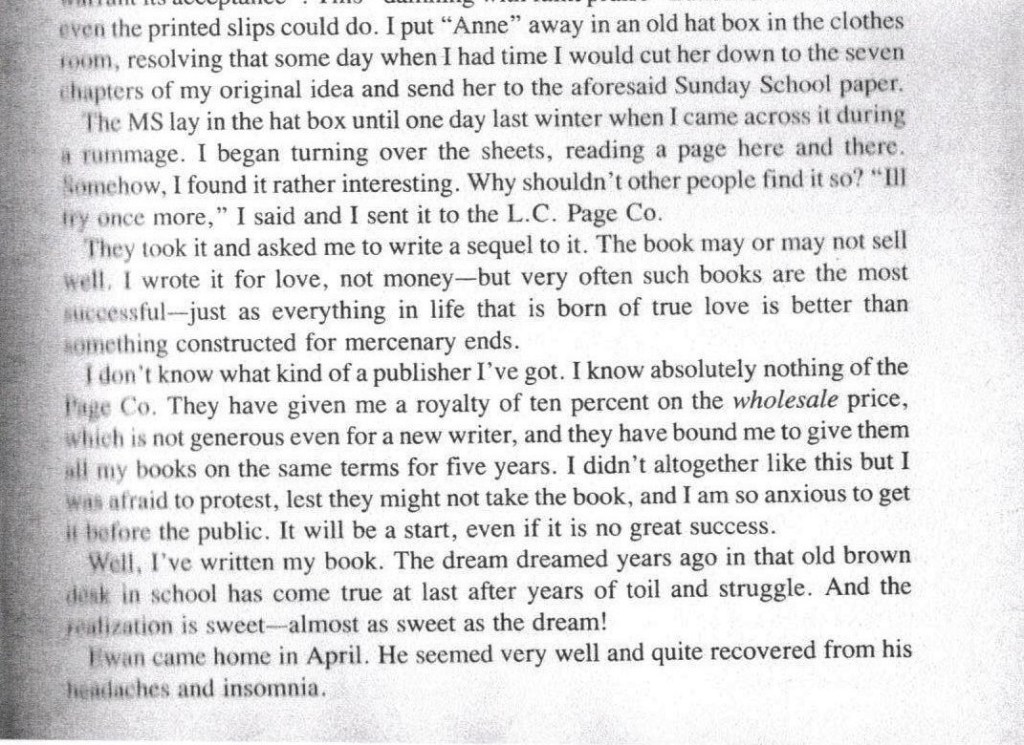
She mailed the typed manuscript out to four American publishers (one new firm, one “betwixt and between” firm, and two old established firms, MacMillan and Henry Holt “some merit but not enough to warrant acceptance”) over the course of 1906, with universal rejection, so she gave up and stored it in a hatbox, where it remained until the winter when she decided to try again, this time with the Boston publisher L.C. Page and Co, a company she admitted she knew nothing about. It was close to rejection again, but a staff member who was from Prince Edward Island, advocated for Anne.
Journal Entry Aug 16 1907
Maud signed a contract for a paltry royalty and five years of any future work, which she agreed to reluctantly, thrilled to have the book accepted, and promptly began work on the sequel – Anne of Avonlea – which was published a year later in 1909. I remember her journals being full of legal disputes with Page & Co. in later years when she had switched to McLelland and Stewart in Toronto.
She was pleased with the final appearance of the book, “lovely cover design, well bound, well printed. Anne will not fail for lack of suitable garbing at all events.”
The book sold well right from the beginning, went through seven printings and 20,000 copies by the end of the first year 1908, and has never been out of print since, with 50 million copies worldwide and over forty translations.
She recorded in her journal, “I can’t believe that such a simple little tale, written in and of a simple P.E.I. farming settlement, with a juvenile audience in view, can really have scored out in the busy world.”
She produced seven more Anne books, ten other novels, two collections of short stories, a book of poetry and many stories, essays and articles before her death in 1942, but it is her first novel that remains the most famous. “It was born of true love and often such books are most successful.”
I enjoyed reading the story again and taking a peak into the author’s creative process. It was interesting to see how a book goes from an idea jotted down to a few chapters to a completed manuscript to a printed copy….with all it’s many sequels. She never seemed to run out of ideas. I can’t imagine having to dip your pen in ink every few lines – we have it so much easier today. But I also wonder when things are so quickly deleted if we will lose this recording of how a book comes about….for it did not spring fully formed, even though her words may have flowed easily.
What lessons can aspiring novelists learn from this?
The best writing is a labor of love.
If you should be so lucky as to be published, don’t be too eager to sign everything away. Research a bit first.
Just to begin, for that is often the hardest part, even for Maud.
“Of late years I have been thinking of it seriously but somehow it seemed such a big task I hadn’t the courage to begin it. I have always hated beginning a story. When I get the first paragraph written I feel as though it were half done. To begin a book therefore seemed a quite enormous undertaking. Besides, I did not see just how I could get time for it. I could not afford to take time from my regular work to write it.”
And most importantly perseverance – many books have been written in just a few hours a day. I hope you have found this tale of how Anne came to be inspiring.
PS. The manuscript will be online in 2022, as part of a digital exhibition entitled Exploring a National Treasure: LMM’s Anne of Green Gables Manuscript, curated by the Confederation Centre Art Gallery and the L.M. Montgomery Institute at the University of PEI. It’s nice they gave the editor of this book, Carolyn Strom Collins, a few years to profit from her efforts.
PS. Next week in Part Two I will blog about The Journals of L.M. Montgomery, published fifty years after her death, which provide a fascinating insight into her successful but often tormented life. Plus a bit about my trip to Cavendish, Prince Edward Island – holy ground for Anne fans – if I can find the photos.













































 thehomeplaceweb