Let your photo(s) tell your story.







Let your photo(s) tell your story.
Imagine being stuck inside, in a small space, for two years, where going out meant risking your life. No, it’s not the pandemic – it’s WW2, and the people in hiding are Jewish.
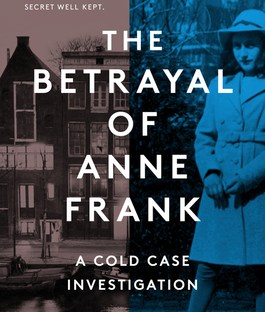
Like many teenage girls of my generation, I read The Diary of Anne Frank, written by a fifteen-year-old Jewish girl in Amsterdam, when I was in grade school. So when I saw The Betrayal of Anne Frank – a Cold Case Investigation by Rosemary Sullivan – on the new releases list, I knew I had to read it, and having read it, I knew I needed to blog about it. The book is a captivating read, and a cautionary one. It’s a timely topic, as with so much political turmoil in the world today, and so much divisiveness and hatred, it seems like history is repeating itself.

Goodreads Publishers Blurb:
Using new technology, recently discovered documents and sophisticated investigative techniques, an international team—led by an obsessed former FBI agent—has finally solved the mystery that has haunted generations since World War II: Who betrayed Anne Frank and her family? And why?
Over thirty million people have read The Diary of a Young Girl, the journal teen-aged Anne Frank kept while living in an attic with her family in Amsterdam during World War II, until the Nazis arrested them and sent Anne to her death in a concentration camp. But despite the many works—journalism, books, plays and novels—devoted to Anne’s story, none has ever conclusively explained how the Franks and four other people managed to live in hiding undetected for over two years—and who or what finally brought the Nazis to their door.
With painstaking care, former FBI agent Vincent Pankoke and a team of indefatigable investigators pored over tens of thousands of pages of documents—some never-before-seen—and interviewed scores of descendants of people involved, both Nazi sympathizers and resisters, familiar with the Franks. Utilizing methods developed by the FBI, the Cold Case Team painstakingly pieced together the months leading to the Franks’ arrest—and came to a shocking conclusion.
The Betrayal of Anne Frank is their riveting story. Rosemary Sullivan introduces us to the investigators, explains the behavior of both the captives and their captors and profiles a group of suspects. All the while, she vividly brings to life wartime Amsterdam: a place where no matter how wealthy, educated, or careful you were, you never knew whom you could trust.
The Author: Rosemary Sullivan is the author of fifteen books, many of which are biographies, and the recipient of many international awards. She is a professor emeritus at the University of Toronto and has lectured worldwide.
Discussion:
I found this book to be a fascinating but disturbing read. Cold cases are always interesting, but a famous cold case which is part of history, even more so, and trying to solve one seventy-five years later when all of the suspects are dead, almost impossible.
Part One, the first hundred or so pages, deals with the background story. For those unfamiliar, Anne Frank and her parents and older sister, along with another Jewish couple and their teenage son, and a local dentist – eight people in total – were hidden for two years in the upper annex of her father’s spice business, with the assistance of four of Otto Frank’s employees who brought them food and supplies. The annex was at the back of the building facing a courtyard with a tree, Anne’s only glimpse of the outdoors for two years. Based on an anonymous tip, the address was raided a few weeks before the liberation of Amsterdam, by a German Gestapo agent and three Dutch policemen. They were all sent to concentration camps, and only her father Otto Frank survived, and later went on to publish Anne’s diary.
Part one introduces us to Anne’s world, and the complex politics of Amsterdam at the time, including the collaborators and the resistance movement. It’s a fascinating look at just how quickly a normal life can deteriorate into one of treachery and survival. It describes the political environment and the raid in detail, and the background and history of the people involved, including the policemen.
Part Two deals with the investigation of who had betrayed them. The investigative team of thirty people, led by the retired FBI detective, narrowed thirty possibilities down to twelve scenarios, and then a further four, until they reached their final theory, based on a random note found in the archives, (no spoilers here) and note it is a theory, as there is no absolute proof which they made clear.
Like any cold case, they looked at three factors – Knowledge, Motive and Opportunity. Knowledge could come from rumors, observations, or resistance people being tortured. Motive could have been for money (there was a bounty of $7.50 guilders or $47 US for each Jew turned in), hatred or self-preservation, trying to stay on the good side of evil. (Which begs the ethical question, could you turn someone else in to save yourself or your own family?) Opportunity was having knowledge and access to the Germans or SD police.
Some suspects could be eliminated as they weren’t in the area at the time. The team systemically went over lists of known collaborators and addresses from extensive war archives, reconstructing a detailed map of the area. They also designed a computer program to handle the masses of data. There was so many archives to wade through that solving the case took several years.
Vince Pankoke, the lead detective said “there was no aha moment to end the investigation – the emergence of the betrayer was a slow coming together of evidence and motive, a jigsaw piece that suddenly undeniably fit. He remarked that there was a weight of great sadness after the case was solved which has stayed with him since.”
Additional Points of Interest:
Originally born in Germany, Otto Frank had served in WW1 but had fled Germany in 1933 and set up a business in Amsterdam, a city known for its tolerance. Yet the Netherlands transported more Jews to their deaths in concentration camps than any other country in Western Europe. Of the 140,000 Jews living there, 107,00 were deported and only 5500 returned. There were an estimated 25,000 in hiding, one third of whom would eventually be betrayed.
We have the greed of the Gestapo agent to thank for the survival of Anne’s diary. During the raid, Anne picked up her father’s briefcase which contained the diary to take with them. The German police officer threw her diary with it’s checkered cover on the floor and filled the briefcase with the valuables and money that Otto and the others had managed to hold onto. Had she taken it with her to the camp, it would have been destroyed. After the raid, the two female employees rescued it and tucked it away for Anne’s return.
It was interesting to note how some of the interviewee’s memories (and their descendants), changed over the years. Sometimes how people remembered things, did not jive with the documented reality, particularly after Anne’s fame grew.
In a particularly poignant section, Otto Frank describes Anne drinking in the natural world that had been denied her for so long, on the last train to Auschwitz. It was summertime and she reveled in the fresh air and sunshine.
In one of the last pages of her diary, Anne writes, “It’s a wonder I haven’t abandoned all my ideals, they seem so absurd and impossible. Yet I keep clinging to them, because I still believe, in spite of everything, that people are truly good at heart.”
It’s something to remember, that feeling of hope, especially at a time when the world seems to be tilting towards intolerance, that things can always be made right again.
One final thought, you don’t have to like someone to help them. My grandmother grew up in a southern rural area of Holland, and I remember her saying that her family had helped refugees during WW1. (The Netherlands remained neutral during WW1 and attracted a flood of refugees.) They were from Turkey, and I also remember her saying that they were not nice people, but they helped them anyway. My grandmother would have been 16 and it is debatable what would constitute not being nice at that age – being made to give up her bed, possibly being leered at, or the fact that they were gypsies, I believe was the word used. Her parents were gone by WW2, although she had many brothers and sisters back home, but I never asked her, to my great regret, for any stories of those years.
PS. You can visit the Anne Frank House and Museum in Amsterdam, (see online website for a one hour history and virtual tour of the annex) but anyone I know who has gone there has not been able to see it because of the long lineups. The Annex was accessed via a secret bookcase, (link to a 2 minute tour) and was fairly small to have housed eight people. Here’s a youtube link to the only known video of Anne Frank on a balcony watching a wedding party.
PS. One of my readers has mentioned that there has since been dissension about the research and conclusion of the book, to the extent that the Dutch and German publishers have suspended publication until they do a further review. Considering their end theory was a shocking revelation, and that Otto Frank (and his secretary) knew who had betrayed them for years and kept silent, and that the Switzerland foundation he set up in her name refused to cooperate in the research, it is not entirely unexpected for the book to be controversial. Readers wishing further information may google for more details.

Last July I did a review of the most memorable books I had read over the previous year – see A Reading Sabbatical. I intended to do a quarterly review going forward, but other blog topics beckoned. Since we’ve nothing much to do this time of year when we’re shut by the weather, here’s a summary of the (mostly) wonderful books I’ve read since. Hopefully there will be something to tempt you to escape to another world for awhile….

Golden Girl – Elin Hilderbrand. The protagonist, author of 13 beach novels and mother of three almost grown children is killed in a hit and run car accident while jogging near her home on Nantucket. She ascends to the afterlife where she meets her guardian angel who allows her to watch what happens for one last summer. She is granted three nudges to change the outcomes of events on earth but with her kids lives full of turmoil must decide when to use them.
I can’t recall any other book where the protagonist was killed in the first chapter, so this was a unique twist on her usual drama-filled beach read. This was intended to the author’s last novel, and seems somewhat semi-autobiographical, considering her bout with breast cancer five years ago. For a swan song, it was a surprisingly good read, although being Elin Hilderbrand not without its annoying immature characters. I wonder what she’ll do next?
Hostage – Clare MacIntosh – You can save hundreds of lives – or the one that matters most. A claustrophobic thriller set on a twenty hour plane flight from London to Australia. The protagonist, a flight attendant with a five-year old daughter and a fracturing marriage back home, is handed a note by a hijacker, who knows exactly how to make her comply. The anonymous skyjacker is part of a radical climate change group, and there is more than one of them seated among the passengers.
If you can get past the premise that post 911, any flight attendant would ever allow anyone into the pilot’s cabin, then this was a very suspenseful read, and well done. Clare MacIntosh at her best. It seems like all my favorite suspense writers had excellent books out last year. Perhaps one blessing of the pandemic was more time to write.
The Rose Code – Kate Quinn A tale about the intertwined lives of three women codebreakers during WW2 and what destroyed their friendship.
I honestly don’t remember much about this book, other than it was a good read. There seem to be so many of these historical fiction books about WW2 lately that it’s hard to keep them all straight.

The Maidens – Alex Michaelides A therapist becomes fixated on The Maidens, a secret society of female students at Cambridge associated with a handsome and charismatic professor of Greek Tragedy, after one of the members, a friend of her niece, is found murdered.
The author’s first psychological thriller, The Silent Patient, was so successful (number one on the 2019 Goodreads mystery and thriller list), that it would be a hard act to follow, which he acknowledges in the notes. This one also involves a therapist, and the author himself went to Cambridge, so perhaps he was writing about what he knows, but while I found it suspenseful, I didn’t find it nearly as good. The whole idea of a secret sorority with slavish devotion to a professor seems like a throwback to the fifties, but then I’ve never been to Cambridge.
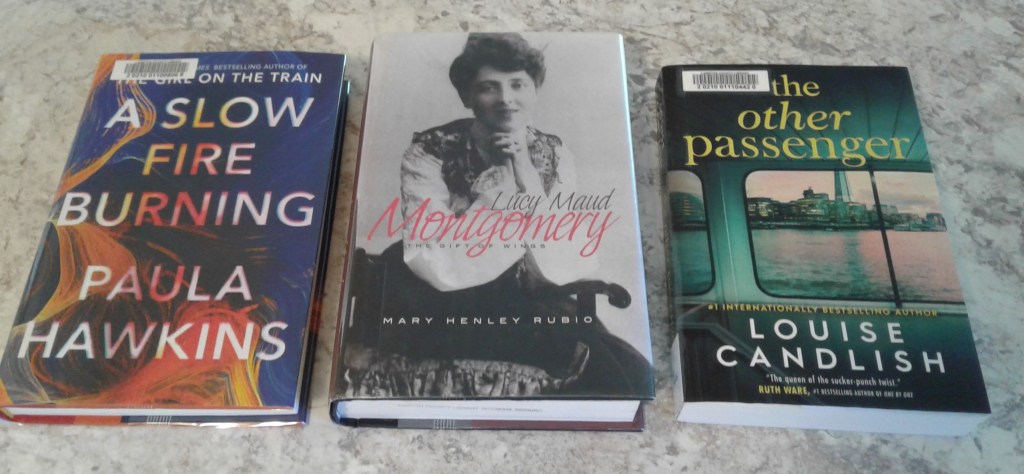
A Slow Fire Burning – Paula Hawkins. Psychological thriller about a young man found murdered on a London houseboat, and the three women who knew and resented him. Laura, the troubled one-night stand last seen on his boat, Carla his grief-stricken aunt, already mourning the death of another family member, and Miriam the nosy eccentric neighbour who lives on an adjacent houseboat.
Paula Hawkins wrote The Girl on the Train, and seems to specialize in damaged characters or misfits, but the character of Laura was so well done, you found yourself cheering for her. It was interesting to read the point of view of someone normally shunned by society. An excellent read with a satisfying ending, this was rated number one in the Goodreads Mystery category for 2021.
L.M. Montgomery – The Gift of Wings – Mary Henley Rubio The definite biography of L.M. Montgomery, by the esteemed author who edited her five published journals and had extensive access to papers and interviews never published before, including with LM Montgomery’s son.
I blogged about the life of L.M. Montgomery back in May (see link), and having read several biographies over the years thought I knew a lot about her, but I found this book absolutely fascinating, especially from a psychological point of view, as Maud was a very complex woman. The depth of research in it was amazing, but then she knew her subject well from decades of study. It’s a 2008 publication, so I had to order it from the library, but it was one of the best non-fiction books I’ve read this year.
The Other Passenger – Louise Candlish Jaime, an older well-off male protagonist meets a group of fellow (“river rats”) passengers during his daily commute on a Thames riverboat in downtown London, including Kit a young hip debt-ridden twenty something, and they go for Christmas drinks. The next time he takes the ferry the police meet him when he disembarks – Kit has been reported missing by his wife Melia and he was the last person to be seen with him…arguing.
Wow, this certainly had a lot of twists and turns. So well done, which just goes to show you can tell a riveting story about the most dislikeable and unrelatable of characters. The dedication at the front of the book said “For all those who think they want more” or words to that effect. This was my first read with this award-winning British mystery author, and I was impressed.
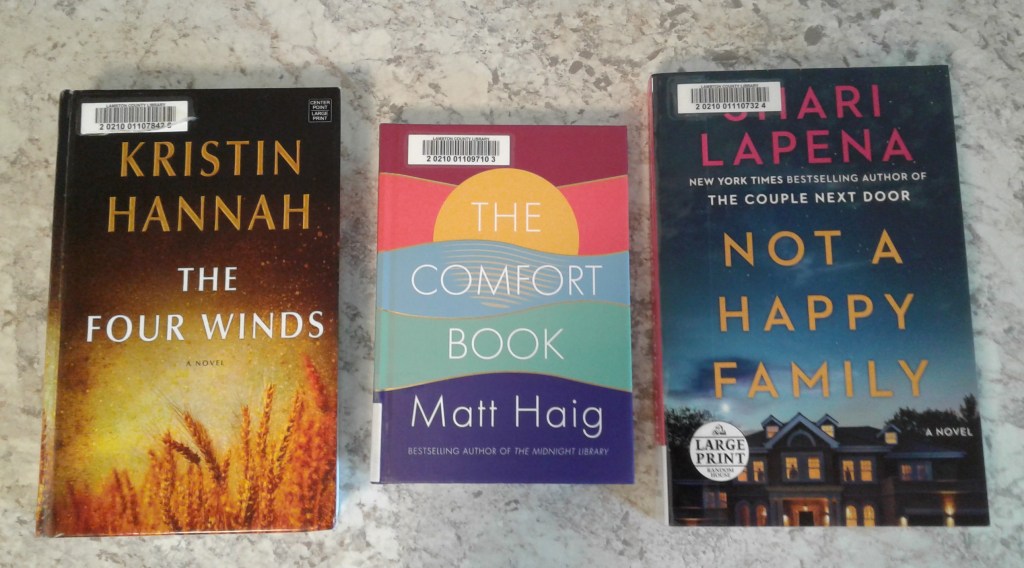
The Four Winds – Kristen Hannah Historical fiction novel set in the Dust Bowl and the Great Depression, with a strong female protagonist who after being abandoned by her husband, goes west with her children in search of a better life.
This was interesting read, but although it’s been compared to The Grapes of Wrath, it’s not Steinbeck. Kristen Hannah wrote The Nightingale (2000), a novel about fleeing Paris during WW2, but I didn’t find this one quite as good, although she is excellent at describing the plight of refugees, and it is a forgotten historical period, one I knew little about. I absolutely hated the ending, although I concede it was probably necessary.
The Comfort Book – Matt Haig A slim collection of one-per-page notes, quotes and observations that serve as gentle reminders that life is not all gloom and doom.
I sometimes enjoy a Philosophy-Lite book, and while I liked his novel, The Midnight Library, I was never able to get into any of his other non-fiction essay type books, most of which deal with depression. Some of the quotes were memorable, and I thought I might write them down, but now I’ve forgotten them.
Not a Happy Family – Shari Lapena When a wealthy couple is murdered the day after a contentious Easter dinner with their three estranged children, they stand to inherit the family fortune, unless one of them is responsible for the murder.
Well, the title says it all. Shari Lapena is one of my favorite murder mystery writers, and I look forward to her annual offering. This was good and certainly well done, but we’ve become so accustomed to unexpected twists at the end, that when there isn’t one, it’s feels somewhat disappointing.
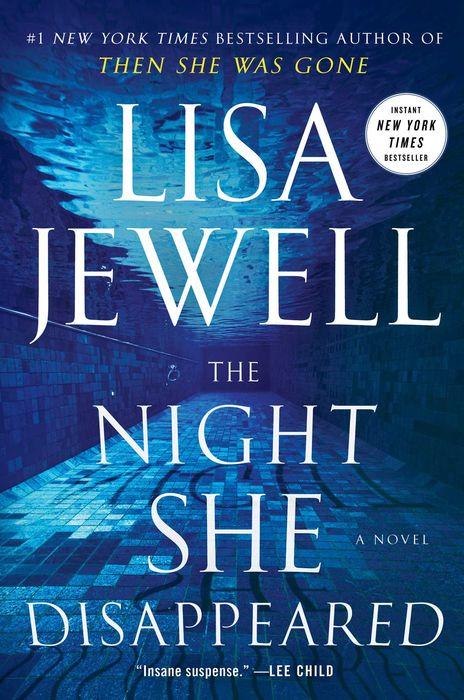
The Night She Disappeared – Lisa Jewell A teenage mother leaves her baby with her mother while she goes out for the evening with friends, and never returns. She was last seen going to a party at a mansion in the woods. A cold case, an abandoned mansion and the kind of dysfunctional family Lisa Jewell does so well.
Lisa Jewell is another of my favorite mystery authors and she’s really outdone herself in this latest one.

World War C – Sanjay Gupta Lessons from the COVID Pandemic.
I debated not reading this, as aren’t we all sick of hearing about the pandemic, but it was quite interesting, but then I like a good science book. His style is immensely readable, and I picked up some facts about the coronavirus I was unaware of. 25% of all mammals in the world are bats, and they tend to have immunity to coronaviruses. Since the book went to press in the summer, it’s already out of date, but still a worthwhile read.
The First Survivors of Alzheimer’s – edited by Dale E. Bredesen MD Seven patients talk about how they recovered life and hope in their own words.
I saw this on the shelf at the library and was curious, especially since I had read Sanjay Gupta’s book about building a better brain and the preventative changes we can make in middle age. It’s edited by a physician who has developed a certain treatment regimen. The patients were in the self-reported early stages of mild cognitive decline. While the patient’s stories were interesting, they never really explained what the regimen involved. I guess you have to buy his first two books for that. After I got to patient seven who was gulping down 40 pills a day, I lost interest. Not recommended at all.
Taste – My Life Through Food – Stanley Tucci Food memoir by the actor Stanley Tucci.
I loved this book and blogged about it in November. (see link) This was my favorite non-fiction read of the year, and you feel like you’ve found a new friend when you’re done.
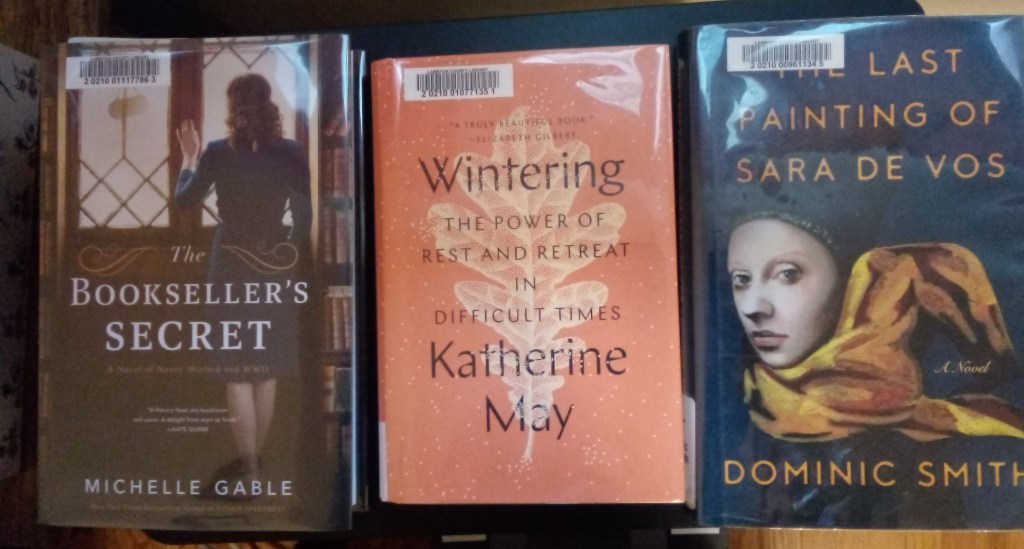
The Bookseller’s Secret – Michelle Gable – A Novel of WW2 and the Mitford sisters
I’m a sucker for any title with a bookstore in it. Another historical WW2 novel involving a modern-day journalist and a forgotten manuscript but as I don’t care about the Mitford sisters I never got past the first few pages.
Wintering – Katherine May – a book of personnel essays about wintering the difficult periods of our lives.
Blogged about it – (see link) – loved it – such wonderful writing. Hope we hear more from this British author.
The Last Painting of Sara De Vos – Dominic Smith A novel about art and forgery, spanning three continents and three time periods. A rare landscape by a female Dutch painter of the golden age, is on a collision course between the inheritor of the work in 1950’s Manhattan and the celebrated art historian in Sydney who painted a forgery of it in her youth.
I would like to know more about the art world and thought this was a good premise for a novel. A good read, nice writing. A prize-winning author, but it’s the first book of his I’ve read.

The Last Thing He Told Me – Laura Dave Wife is handed a note – Protect Her. Mystery about a man living a lie and his new wife and 16-year-old daughter who band together to discover what happened after he suddenly disappears.
This was a selection of my book club and a Reese Witherspoon pick as well. Very well done for one of those how well do you really know your spouse genre mysteries. A satisfying ending.
Wish You Were Here – Jodi Picoult Thirty something art specialist who has her life all mapped out, travels to the Galapagos Islands alone when her surgical resident boyfriend must stay behind in New York to deal with the early days of the COVID crisis (2020), and then starts to re-evaluate her life, job and relationships.
She’s one of my favorite authors, but I’ve barely recovered from her previous disaster The Book of Two Ways – that 400-page tome about death doulas/Egyptian mythology/archeology digs/AI/old boyfriends/parallel universe with the totally ambiguous ending.
First of all, I hate a dumb protagonist. If an island is closed and they tell you to go home, don’t act like a rich entitled tourist and stay and then gripe about it. I was so irritated by the main character and the whole premise that I was going to abandon it, because of course she meets someone on the island, and there are some truly laughable love scenes……but then……around page 190…..it all changes. What a brilliant piece of trickery! So, my advice would be to stick it out, although after the “sudden revelation,” I did guess the ending. I wouldn’t go so far as to say she’s gotten her groove back, but it’s close. I just hope she doesn’t start writing romance novels because love scenes are not her forte.
One word of caution though – do not, repeat, do not read this in the ER dept as I did, (for a non-COVID issue), and also if you have lost someone to COVID or are paranoid of catching it then best to skip it altogether. Her boyfriend’s texts/emails contain way too much ICU detail, and aren’t we all sick of the pandemic anyway – do we really want to read about it, even in a novel?

So curl up with a cat and a cup of tea, and a good book! I hope this wasn’t too long, but for book lovers can there ever be too many books to check out?

January 29th is National Puzzle Day. You sit down intending to just add a few pieces and soon a whole hour has gone by. It’s the kind of mindless activity which is relaxing and meditative in a way.
I used to buy my mother a 1000 piece puzzle every year for Christmas, before she started painting. The puzzle would be spread out all over the end of the dining room table for the whole month of January. I might help out with a piece or two, but never had the time to do more. Now I’m seriously addicted!




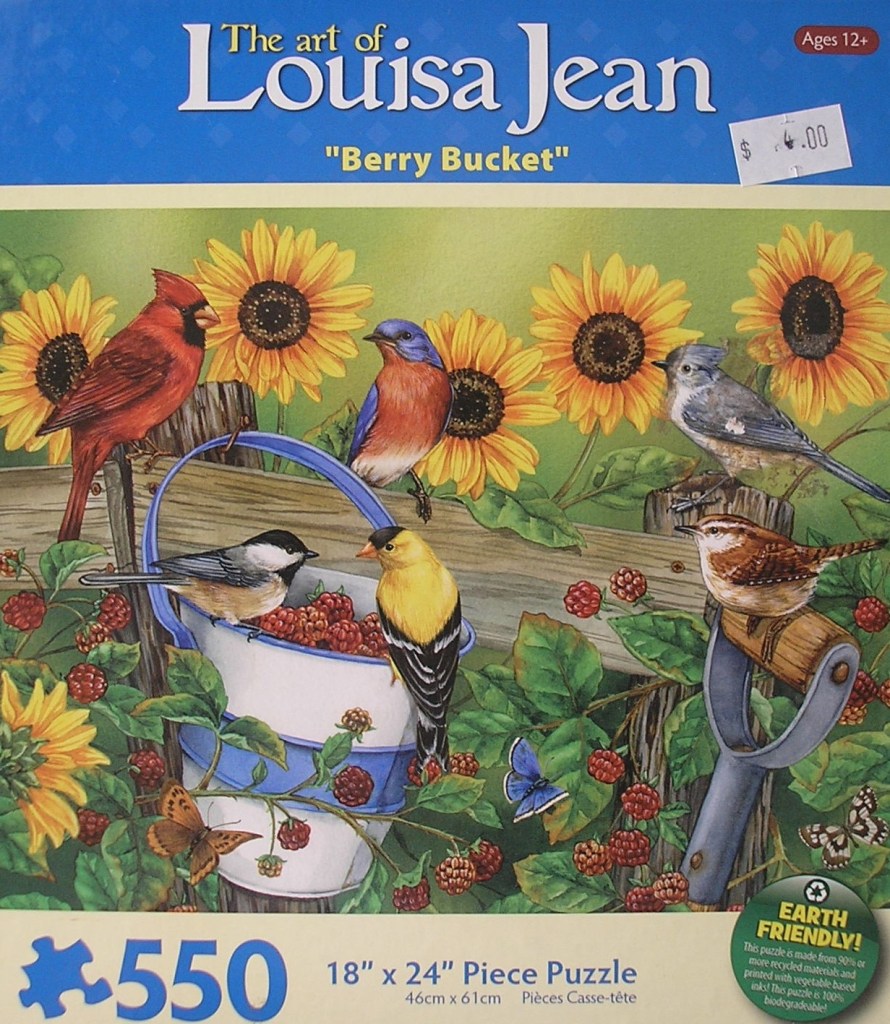


Do you enjoy doing puzzles?

Another Covid winter – I can’t believe I’m writing those words. With the arrival of vaccines last spring who would have thought we would still be in this mess, and getting worse, and now with the Omicron variant spreading faster than a wildfire should we be distancing twelve feet apart instead of six?

Did anyone watch the simulated video where the cloud of Omicron virus emitted from a cough launched itself airborne twelve feet and then hung about in the air like some menacing green Grinch, waiting for an innocent victim to walk by. They then repeated the simulation with a mask on, and those wily particles still escaped from the sides and top. I’ve since upgraded to N95’s, if I can find them, although when I had to visit the ER department with a family member on Boxing Day, they made us remove them and don one of their flimsy blue ones.
Yes, I spent Boxing Day and the day after, in the ER dept, for a non-COVID matter, and we consider ourselves lucky to have escaped with only a six hour wait each day. The second day was for an ultrasound to rule out a blood clot (negative) as they were too busy to do it on the holiday, and then a three hour wait for results – twelve hours in total, in a cubicle breathing in potential COVID germs. It was a scary thought, and I spent the week after counting down the days until we could be considered safe again. This was just before the Omicron tsunami hit, and the staff were barely coping then. I hate to think what will happen when things get worse and they can’t get enough staff…not just in health care but in any essential worker category.
We were lucky enough to get our third COVID shots in early December before Omicron even existed. They allowed me to get mine early, as my mother’s caregiver, although technically my age category wasn’t eligible until two days later, but then a week after they announced anyone over eighteen could, and the Hunger Games of Online Booking began. So, they’re telling people to get boosters, but no one can get one, at least in a timely fashion. Rapid tests are equally scarce. Parents are scrambling to get second doses for their kids before school starts again. I know high risk people who are booked a month from now, and feel fortunate to have gotten that. The health unit ran out of Pfizer and they are substituting Moderna again, which causes a problem when you have to provide proof for travel. Meanwhile the provincial government, in a priceless pass-the-buck news conference suggested to “just walk into” your local pharmacy. Without an appointment? The same pharmacies who are struggling to cope with the Christmas medication rush and flu shots and are already short-staffed? (Have I mentioned lately how glad I am to be retired.) Mine has stopped taking waiting lists – with 250 names already, and only receiving a paltry 60 doses a week, it’s rather pointless.
With only about a third of the population here having received their boosters, it’s hard to know where to lay the blame, the federal government, the provincial government or the local health unit? They are just now starting to add in more clinics to get the essential workers done, including health care workers, long term care, teachers, police, fire, ambulance – to me this seems inexcusable.
Needless to say, I’ve had a few sleepless nights, and am now back to just skimming the news again – you want to be informed, but not deluged with doom and gloom, especially before bed. For those who are struggling with these difficult times, check out last week’s book review – Wintering – by Katherine May.
I do feel somewhat hopeful that things will be better by spring, and that we will have achieved herd immunity, similar to what happened with the Spanish flu – two rough years, then two years of sporadic cases until it ran out of people to infect. Of course, it could mutate again, and we’ll be back at square one – take your pick – depending on if you’re a pessimist or an optimist. Some days I’m both.
It reminds me of studying microbiology in second year. Our lectures were in the old Banting and Best building at U of T in a room filled with rows of wooden desks, which I’m sure were there when insulin was discovered. I always liked being in that lecture hall, as I loved history. I once read a biography of Banting and Best and found it fascinating. Type One diabetes was a death sentence back then – one of their first patients was a 13 year old girl – imagine being able to save someone from the brink of death with a substance you had extracted from an animal pancreas. In my early working years, insulin was still sourced from Beef and Pork. It wasn’t until the 80’s that it was genetically manufactured to match the human type. Anyway, microbiology was taught by an old professor with a thick East European accent who used to snort into the microphone, the occurrence of which used to make us laugh hysterically, but in all seriousness, it was an interesting course and we learned about exponential growth, replication, mutations and all the things in the news these days……it’s funny your recollections forty years later. Science has conquered many things over the years, and will eventually conquer COVID too.
Since cases have skyrocketed here, and there seems to be no stopping it, other than taking the usual precautions and staying in, I’ve armed myself with books, (see next weeks Winter Literary Review), jigsaw puzzles, DVD’s, and even signed up for Netflix – although I’m not that impressed with what’s on – most of the movies they suggest based on My List, I’ve already seen. If anyone has any recommendations please leave a comment.
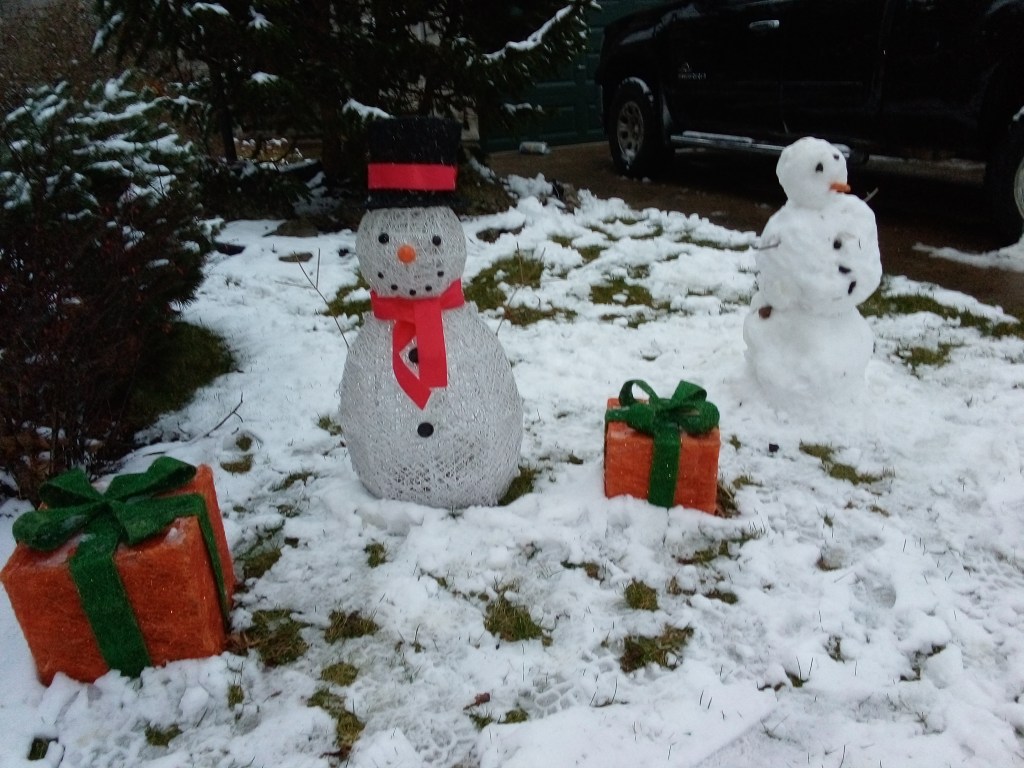
The only good thing about the winter so far is that the weather has been fairly decent, unlike other parts of the country which have been deluged with snow and cold. We’ve had a few inches now and then, barely enough to make a snowman, which melted quickly as many days the temps were in the 30-40’s. A mild December is always a bonus as it shortens up the winter. Now, in the depths of January, it’s been colder but we’ve hardly had any snow, certainly nothing worth shoveling. I like it when it’s not too blizzardy out, as I tend to feel claustrophobic in snow storms. I don’t want to go anywhere, but I like to know I could if I needed to.

They had been predicting such a bad winter that I decided to get new tires for my old Honda – way overdue but the mechanic kept saying they were okay as long as I did do any long-distance driving??? (really – like where?) So my big expedition for the month was hanging out in the relatively deserted waiting room of Canadian Tire (a gigantic hardware store with an automotive division), where I felt reasonably safe, but not brave enough to visit the adjacent mall.

Of course I had to wait for the tires to come in (supply issue – what else is new), and then had them put on the week before Christmas (the mall was a zoo), and then had to go back for the alignment as they were too busy to do it that day, which was a blessing in a way, as I found a car part in the driveway, (never a good sign), which turned out to be a wheel weight, requiring a wheel re-balance. If the snow hadn’t melted I wouldn’t have noticed it. I also had them check the battery. So now I feel safe with my new old car – if only there was someplace to go…

I haven’t set any new goals or bucket list for this year, as I have in the past, as what would be the point, we have so little control over the circumstances. Masks have been mandatory here for two years, and some degree of lock-down depending on the stats, but there’s little to do even when restrictions are lifted.

I’m still walking every day, except for a few slippery days, for the fresh air and exercise but mostly for the immune boost – admiring the decorations and lights, and listening to my daily dose of music.
This catchy tune was on a Lincoln car TV commercial recently. It really has been a most unusual year…..but I have hope for the future.
PS. How are things in your neck of the woods? Do you know anyone who has had COVID? I’m starting to know of a few people who have had it, more friends of friends than people I know specifically.
If wintering is a verb then we all need to learn to winter – to rest and recharge, especially in difficult times. Wintering can be a season to survive, a respite from the busyness of the rest of the year, or a state of mind such as a feeling sad or depressed.
Winter is often a time for retreat – never more so than this year. Usually I don’t mind the month of January, and enjoy the excuse to stay home when the weather turns nasty, but this year it just seems like more of the same. So it was with interest that I saw a review on someone’s blog of a non-fiction book called Wintering, by Katherine May. As I sometimes enjoy a light philosophical read, I ordered it from the library, but found it so interesting and well written that it might go on my purchase list. (I usually only buy books I intend to re-read.)
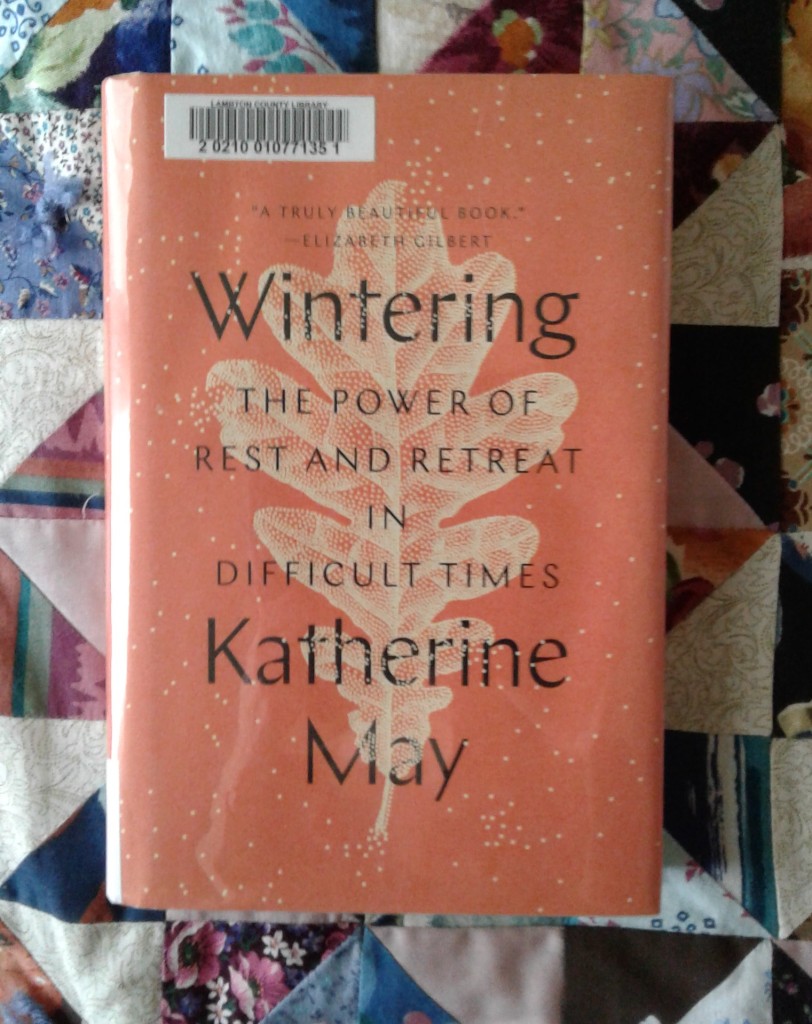
Here’s the Publishers Blurb: Sometimes you slip through the cracks: unforeseen circumstances like an abrupt illness, the death of a loved one, a break-up, or a job loss can derail a life. These periods of dislocation can be lonely and unexpected. For May, her husband fell ill, her son stopped attending school, and her own medical issues led her to leave a demanding job. Wintering explores how she not only endured this painful time, but embraced the singular opportunities it offered.
A moving personal narrative shot through with lessons from literature, mythology, and the natural world, May’s story offers instruction on the transformative power of rest and retreat. Illumination emerges from many sources: solstice celebrations and dormice hibernation, C.S. Lewis and Sylvia Plath, swimming in icy waters and sailing arctic seas.
Ultimately Wintering invites us to change how we relate to our own fallow times. May models an active acceptance of sadness and finds nourishment in deep retreat, joy in the hushed beauty of winter, and encouragement in understanding life as cyclical, not linear. A secular mystic, May forms a guiding philosophy for transforming the hardships that arise before the ushering in of a new season.
About the Author:
Katherine May is a freelance writer of both fiction and nonfiction, and previous creative writing teacher. Her journalism and essays have appeared in a number of publications, including The Times, Good Housekeeping and Cosmopolitan. In the book she reveals she has Asperger’s Syndrome. “I learned to winter young. As one of the many girls of my age whose autism went undiagnosed, I spent a childhood permanently out in the cold.” (page 11)
Discussion:
As we’ve just passed the winter solstice, this is a book to curl up with and enjoy in the deep dark depths of January.
The book is a series of personal essays, divided into chapters, from September to March, with further sub-titles such as Slumber, Light, Midwinter, Snow, Cold Water, and Thaw.
I especially enjoyed the chapters on hibernation, (who knew dormice and bees could be so interesting), slumber (isn’t it always easier to sleep in the winter), and light (seeking out the northern lights in Norway). As the author lives by the sea in England, and has not experienced the full force of a brutal snow-filled winter, she journeyed north to seek the cold and snow and to view the Northern Lights.
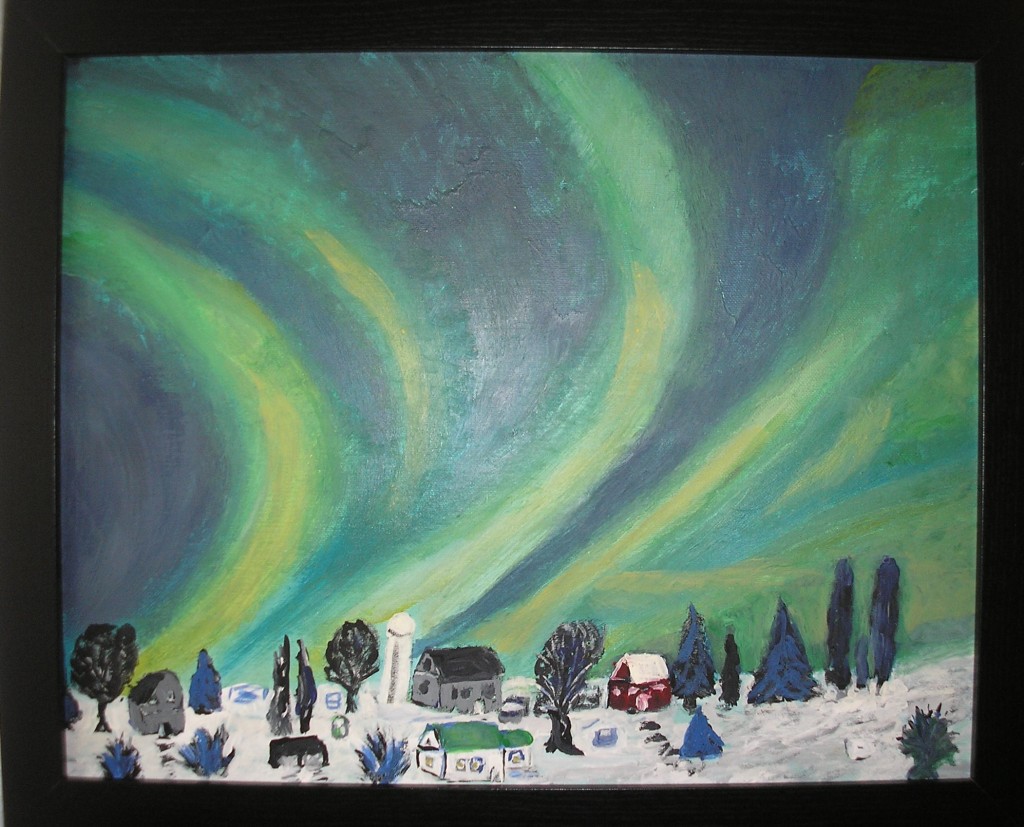
She also visited Stonehenge during the Winter Solstice. There’s a chapter on light (the festival of St. Lucia), on cold water (taking the polar bear plunge) and snow (winter walks in nature are much easier on a British beach than trudging through snowdrifts).
Here’s a Goodreads link to some quotes from the book for a sample of her writing. The prose is so lovely, I would recommend it for that reason alone, even if you weren’t interested in the topic. No wonder Elizabeth Gilbert praised it as “a truly beautiful book.”
She also mentions a poem by Syliva Path titled “Wintering” which I was not familiar with, but I imagine inspired the title of the book.
It’s difficult to sum up what this book is actually about, it’s not advice, or self-help, but more meditative reflections on a season we all must go through.
Let your photo(s) tell your story.

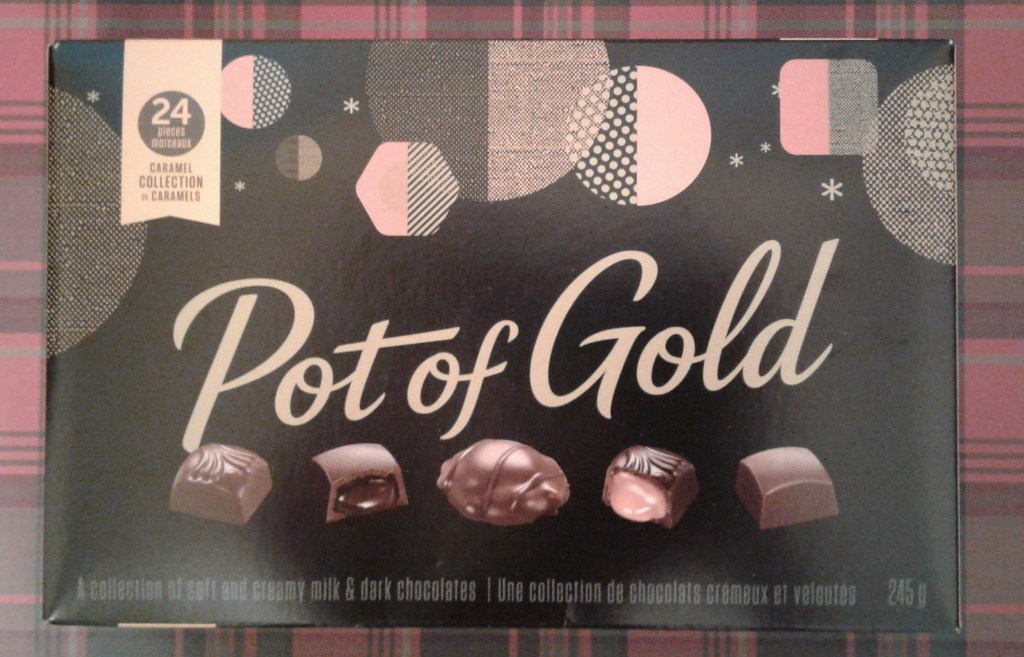



Do you have a favorite or traditional Christmas candy?
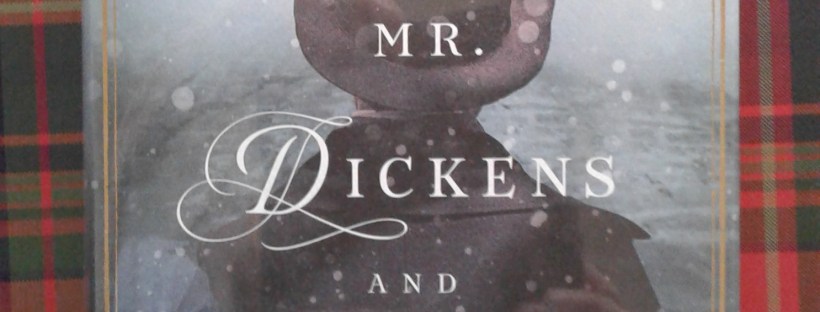
It’s that time of year again – time for me to blog about one of my favorite books, A Christmas Carol by Charles Dickens. Recently, my library book-club chose Mr. Dickens and His Carol by Samantha Silva – a fictionalized account of how this famous book came to be written.

Publishers Blurb: Charles Dickens is not feeling the Christmas spirit. His newest book is an utter flop, the critics have turned against him, relatives near and far hound him for money. While his wife plans a lavish holiday party for their ever-expanding family and circle of friends, Dickens has visions of the poor house. But when his publishers try to blackmail him into writing a Christmas book to save them all from financial ruin, he refuses. And a serious bout of writer’s block sets in.
Frazzled and filled with self-doubt, Dickens seeks solace in his great palace of thinking, the city of London itself. On one of his long night walks, in a once-beloved square, he meets the mysterious Eleanor Lovejoy, who might be just the muse he needs. As Dickens’ deadlines close in, Eleanor propels him on a Scrooge-like journey that tests everything he believes about generosity, friendship, ambition, and love. The story he writes will change Christmas forever.
Discussion: I’ve blogged before (see link) about The Man Who Invented Christmas, by Les Standiford, a non-fiction book which delved into the history of Dickens classic tale, and the inspiration for the plot and characters. Ms. Silva’s book is historical fiction, and common to the genre, she has taken great liberties, first in imagining his muse – a lady he met on the streets of London during his customary night-time wanderings while plotting out his books. Having read several biographies of Dickens life I’m fairly certain no such woman existed, but as he is reputed to have left his wife and ten children for a much younger actress towards the end of his life, perhaps that is where she got the idea? In this book his wife and children depart for Scotland, angry over Dickens decision to pay an impromptu visit to his first love, and he is left alone to ponder his problems. (Serves him right – maybe he was a bit of a player?) Second, we’re a hundred pages in before the woman-of-mystery-muse is introduced, and not one word has yet been written, but as I recall Dickens wrote his novella over the course of six weeks, not two as she says. I guess I like my historical fiction to be somewhat factual. Third, was the inspiration for Scrooge, Dickens himself? The idea is intriguing, and she has a plausible explanation for the age difference, but somehow it just doesn’t translate.
The book jacket describes the author as a writer and screenwriter from Idaho, and she mentions several near misses in selling the script to Hollywood. As this and the Standiford book (a much better book, if a mediocre movie) came out the same year (2017), she decided to adapt it into a novel instead. That must be frustrating for an author – to find out someone else has a similar idea, especially after you’ve poured your heart into it. For a debut novel, it is well-written, in a style somewhat reminiscent of Dickens.
As I’m only half way through, it wouldn’t be fair to critique it too harshly, but it’s light fluffy fare – but then sometimes that’s exactly what you need, especially at Christmas. Save the heavy stuff for the fruitcake. I’m not sure why the book-club chose this, but it’s no fault of the librarians, as they’re limited to the book club kits purchased by someone else. Perhaps it was just a seasonal selection which sounded promising. The chapters are short, the plot thin, and I’m not sure what there would have been to discuss but as the book-club is now virtual, perhaps they just toasted with some hot rum punch and wished everyone a Merry Christmas.
Merry Christmas and God Bless Us Everyone!
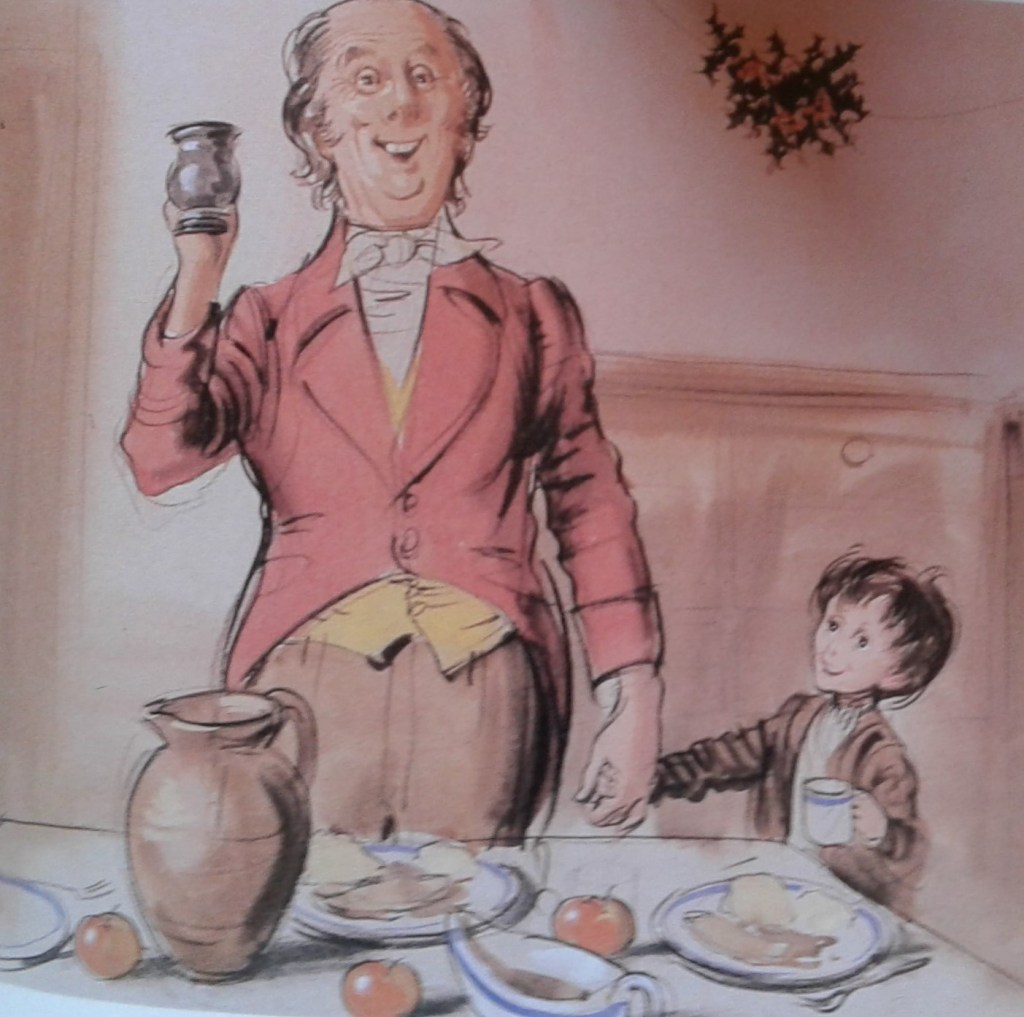
(Edited to add – I stayed up late last night and finished it, and the last fifty pages and ending were surprisingly good! – so I would give it a 3 out of 5)

Although I’m not a granny, I was happy to read that the latest home decorating trend is Grannychic – also known as Cottagecore, or Grandmillenial style.
I first read about this new style, a direct reaction to the popular beige minimalist décor, in the October issue of Susan Branch’s blog. (Here’s a link to her blog.)
Susan Branch she is a cookbook author and watercolor artist, who lives on Martha’s Vineyard. She published a bestselling hand-written cookbook thirty years ago called Heart of The Home (recently re-issued), and has a long list of other cookbooks to her credit. I discovered her a few years ago, after reading a review of her self-published journal, Martha’s Vineyard – Isle of Dreams – which piqued my interest enough to order it. This illustrated journal centers around her adventures buying an old cottage on Martha’s Vineyard while in her 30’s and fixing it up. She also has two other handwritten journals, The Fairy Tale Girl about growing up in California in the 1960’s-70’s, (worth it for the chapter on meeting the Beatles), and A Fine Romance about her three month trip to the English countryside with her husband, (for those who always wanted to rent an English cottage). These gorgeous books are all for sale on her website. You can also sign up for her blog/monthly newsletters, which are always cheery and uplifting.
To me, Susan Branch is a perfect example of Grannychic. She lives in a big old (1849) white house on Martha’s Vineyard, which she bought with the proceeds of her first cookbook, (a far cry from the initial shack). The house itself is my idea of house heaven, complete with a white picket fence and flower gardens. Her husband Joe (he owned a restaurant, they bonded over cooking) is a sweetie, and even her tuxedo-cat, Jack, is a lovable character. In fact, her life is so perfect, that sometimes I’m too envious to read her blogs. She’s not Martha Steward though, she’s more casual and laid back.
So, what is grannychic – antique furniture, shelves full of books, candles, wallpaper, fabrics (chintz and toile and florals), plaid pillows, and lots of color (especially blues, pinks, greens and white). Check, check, check – I have all of those. Although I’ve renovated the outside of my older style home and parts of the inside, I never got around to getting rid of the wallpaper and wainscoting in the dining room and now I don’t have to!

Which just goes to show, if you wait long enough everything comes back in style.
It’s also a way of living – flower gardens, feeding the birds, listening to old music, baking and cups of tea.

It’s cluttered versus bare surfaces, lace doilies, pretty tablecloths, and china. I’m envisioning those who de-cluttered now frequenting thrift shops trying to buy their stuff back.
It’s even Laura Ashley (must check closet). I’m hoping that it invades the fashion world too, so we can all dress up again. I’ve been watching old re-runs of Murder She Wrote lately with my mother, and wow, the clothes, everything so colorful and coordinated. It seems like a different world.
Grannychic is the kind of comfy, classic look which never goes out of style. It’s not that I don’t appreciate the aesthetic of those beige minimalist rooms, it’s just that I don’t think I could relax in them. We’re now into the time of year when the winter winds are howling, so it’s time to draw the curtains (I don’t have to replace those either!) light the candles and get cozy.

Now, if only it extends to Christmas decorating, as I have way too many decorations….
My regular readers may have noticed my lack of baking blogs lately. That’s because I had my cholesterol tested last June and it was borderline. Borderline is worse than bad, as borderline means you should watch it, whereas bad means you absolutely must, but either way you feel guilty when you don’t.
But there’s nothing to say that you can’t read about food. I absolutely devoured this month’s Literary Salon selection – Stanley Tucci’s bestseller, Taste: My Life Through Food. (goodreads link) This is a book for both foodies and non-foodies alike.
I must admit, I didn’t even know who Stanley Tucci was, other than that guy who ate his way through Italy last spring on those CNN TV specials – Searching For Italy, where he would visit a different city each week and explore their food culture, of which I only caught the episodes on Florence and Milan. (It’s been renewed for season two next year) He was sort of a replacement for the late Anthony Bourdain, but they must have known he had the book coming out. (His wife is a literary agent in London.) So when I saw the reviews were unanimously positive, I put it on reserve. As well as being an author, he has starred in 70 movies, although the only ones I can recall are Julie and Julia (where he played Paul Child) and The Devil Wears Prada, and also The Hunger Games. He’s the kind of nondescript actor you can easily overlook, but his book is one of those interesting reads you can’t put down.
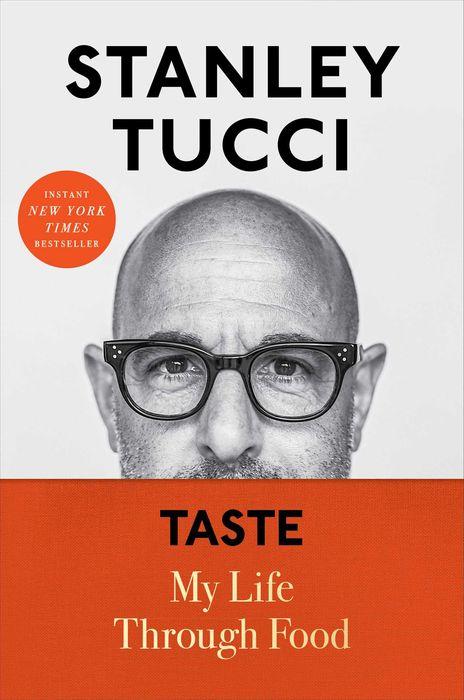
Growing up Italian, food was always important to him, especially pasta. There are a few recipes scattered throughout the chapters, but maybe you have to be a pasta-lover to fully appreciate them. It may be blasphemous, but to me all pasta tastes the same. Yes, I know, the different textures help pick up the various sauces and fillings, but to me it’s all just pasta. But I do have a mild allergy to garlic, so I might not be the best judge.
I had many Italian friends growing up as I attended a Catholic high school. Their food was different than the meat-potato-veg fare we ate at home. Their desserts were different too – I remember in particular a cake so liquor-soaked you could get drunk on it. While Stanley Tucci came from Italian roots, he grew up in the suburbs of New York. I had to laugh when he wrote about his class-mates wanting to trade their peanut butter or baloney sandwiches for whatever tasty leftovers his mother had put in his lunchbox, scoring some extra Twinkies in the process. (My favorite was always those chocolate Hostess cupcakes with the cream filling in the centre, which we did not get very often.)
As Stanley Tucci has just turned sixty, the first few chapters are about growing up in the 60’s and 70’s. When he was thirteen his father took the family to Florence for a sabbatical year, (in the TV episode he took his parents, now in their eighties back to revisit the city), so the first time he ever ate in a restaurant was in Rome. They did not eat out very often in Florence, as a high school art teacher’s salary did not extend to dining in restaurants, but his mother cooked wonderful meals at home.
It’s hard to imagine not eating out in restaurants, but if you grew up in that era, most people didn’t, other than MacDonalds or a diner or burger joint. I was 19 before I ate Chinese food, let alone experience any other culture. My mother’s nod to pasta was spaghetti with Campbell’s tomato soup as the sauce. Ragu was a big improvement. By high school my Italian had stretched to pizza.
There’s a chapter about the food and catering on movie sets (I haven’t quite forgiven him for eating puffin in Iceland, even if there are 8 million of them), and a chapter on cooking during the pandemic while at home with his wife and children – he has two young kids and four over 18. He lost his first wife to breast cancer in 2009. He met his second wife at her sister’s (Emily Blunt) wedding (they bonded over their shared love of food) at “a venue that could be George Clooney’s villa” – there’s some name dropping, but in a fun jesting way. “A man who resembles Colin Firth” was very helpful in taking him to ER when he was nauseated after his chemo treatments. And Ryan Reynolds, what a kind soul to lend him his New York apartment while he was undergoing radiation treatment.
On the tv episodes I often wondered how he stayed so slim? He says he has always had a fast metabolism, but the last chapter of the book deals with his 2017 bout with tongue cancer. For a person so devoted to food, to have such a diagnosis must have been devastating, especially having been through cancer with his first wife, and now having a young family with a two year old and a baby on the way. After surgery, chemo and radiation, he endured 6 months of tube feeding, and then two years of not being able to taste food, and a heightened sensitivity to hot and cold. But he came through it, being all the more appreciative of surviving, and being able to taste once more.
This is an entertaining read, as well as a revealing personal memoir. The descriptions are witty and funny and it’s just lovely writing. One small complaint, which spoiled it for me a bit, was the number of swear words. It seems to be a fad these days, but to me it’s just not literary, and if that is the only adjective you can come up with to describe a dish or restaurant, then you must be channeling Anthony Bourdain. So for that I subtract one star….and maybe another half-star for the lack of any reference to gelato.
And now for the music part – I saw Billy Joel sing this in concert when I was a poor student in the 70’s – back when Italian food was a plate of homemade lasagna and a bottle of Mateus.
“A bottle of white, a bottle of red
Perhaps a bottle of rose instead
We’ll get a table near the street
In our old familiar place
You and I -face to face
A bottle of red, a bottle of white
It all depends upon your appetite
I’ll meet you any time you want
In our Italian Restaurant”
 thehomeplaceweb