Agatha Christie – Some Thoughts on Writing


As I mentioned in Part One, Agatha Christie did not include much about her writing in her autobiography.  There are references sprinkled here and there, and some observations, but no real advice.  It’s as if she regarded the writing to be a minor aspect of her life, necessary but not of that much importance, which is peculiar for such an established and prolific author. I suspect she did not think the details of her craft would be of much interest to her reading audience, as writers were not as common back then, not like now when social media has made everyone a writer.

I can’t imagine coming up with the plot and characters for 66 plus books. I read somewhere that she would put all the characters together at the end and then decide who did it, and then go back and insert the clues, but I can’t substantiate this. While there is little in her autobiography about her technique or what inspired the books, she does tell us how she got started.

Her older sister had written and published a few short stories, and it was an early conversation with her which proved crucial to her own writing career.  Her sister, in an informal bet, dared her to write a detective novel, a popular genre at the time.  She was discouraging, “I don’t think you could do it,” said Madge, who had thought about it herself, but “they were very difficult to do.”  “I should like to try,” was Agatha’s reply.  ‘Well, I bet you couldn’t,” said Madge.  There the matter rested….but the “words had been said….from that moment I was fired by the idea that I would write a detective story…..I didn’t start to write it then, or plan it out but the seed had been sown……the idea had been planted.  Some day I would write a detective story.“    

An earlier attempt at a novel set in Cairo, had been rejected and then critiqued by a neighbour who was a popular novelist, who realizing how shy she was, was kind in his criticism, offering encouragement and some advice about plotting.  

She wrote her first book, The Mysterious Affair at Styles, while her husband Archie was off at war.  The idea was conceived at work in the dispensary, where she was surrounded by professional poisons.  Soon she had a sketchy picture of some of the characters, including her detective, Hercule Poirot, whom she imagined as a meticulous, tidy little man, Belgian like the Belgian refugees in the area, but she wished she had made him younger, considering they were to be together for so many years.  (In later years she found him “insufferable” according to her diary.)  

“In leisure moments, bits of my detective story rattled around in my head.  I had the beginning all settled, and the end arranged, but there were difficult gaps in between.  It made me absent-minded at home.”  Her mother encouraged her, her mother had the usual complete faith that her daughters could do anything.   She wrote it out longhand, and then typed it.  “Up to a point I enjoyed it.  But I got very tired, and I also got cross.  Writing has that effect, I find.”   She had difficulties with the middle, “the complications got the better of me, instead of me being the master of them.”  It was then that her mother made the suggestion that she go away on holiday and write undisturbed.  She booked into a large dreary hotel in the country, walked on the moors and wrote.  She spoke to no one – it would have taken her mind off what she was doing.

She sent it out several times with no success, and had almost forgotten about it as Archie had come home from the war. They were busy looking for a place to live, as flats were in short supply in post-war London, so she was surprised when it was accepted for publication.  They requested a few minor changes, and it was finally published in 1920.   

Like many young authors, she got trapped into a lousy contract promising them her next five books. (After fulfilling her end of the bargain, she changed publishers with no explanation given, although they were willing to bargain by then.)  

“Having given up hope for some years of having anything published, except the occasional short story or poem, I would have signed anything……I would not receive any royalties until after the first 2000 copies had been sold…..none of it meant much to me – the whole point was the book would be published.  I didn’t even notice there was a clause binding me to offer him my next five novels……I signed with enthusiasm…..In spite of the clause about the next five novels, this was to me a single and isolated experiment.  I had been dared to write a detective story, I had written a detective story.  It had been accepted and was going to appear in print.  There, as far as I was concerned, the matter ended.  Certainly at that moment, I did not envision writing any more books.”  

Her child Rosaland was born.   She was worried about keeping Ashfield, her family home as her mother still lived there.  Her husband suggested she write another book.  

She started making money and had an unexpected request from the Income Tax people about her literary earnings.  She had not thought of herself as an “established author” and had not kept track of the royalties, so she got herself a literary agent – a young man named Edmund Cork – and a friendship which lasted for 40 years.   

 “The nice thing about writing in those years was that I directedly related it to money.  If I decided to write a story, I knew it would net me L45, deducting income tax.  This stimulated my output enormously.  How different from the last ten or twenty years of my life.  I never know what I owe. I never know what money I have…..or shall have next year.” 

In 1927 she went to the Canary Islands to get away from the publicity of her disappearance and pending divorce, and managed to write the best part of a new book,  but admitted she had no joy in writing it. “I had worked out the plot, a conventional plot….I knew where I was going, but I could not see the scene in my mind’s eye, and the people would not come alive.  I was driven desperately on by the desire, indeed the necessity, to write another book and make some money.  That was the moment when I changed from an amateur to a professional.  I assumed the burden of a profession, which is to write even when you don’t want to, don’t much like what you are writing, and aren’t writing particularly well.  I have always hated The Mystery of the Blue Train, but I got it written, and sent it off to the publishers  It sold just as well as my last book – though I cannot say I have ever been proud of it.” 

By the time she remarried in 1930 she had written ten books.  

Surprisingly, she never had a room of her own to write in.  “I suppose I was enjoying myself so much in ordinary living that writing was a task which I performed in spells and bursts.  I never had a definite place which was my room or where I retired specially to write.  All I  needed was a steady table and a typewriter.   I had begun now to write straight on to the typewriter, although I still used to do the beginning chapters and occasionally others in long-hand and then type them out.”  Many friends had said to her, “I never know when you write your books, because I’ve never seen you writing, or even seen you go away to write.” 

She never felt any desperation as to whether she could think of one more book to write.  “There is always of course, that terrible 3 weeks or a month which you have to get through when you are trying to get started on a book……when you think you can’t do it.”   She admitted to talking to herself, while working out bits of dialogue.    

Later she branched out into writing plays – she was good with dialogue – and it was a new adventure, along with her annual Christie for Christmas.  She discusses how Three Blind Mice became The Mousetrap and her feeling of happiness when the audience enjoyed it so much, and its long run on the stage, and, the dread she felt about having to make a speech for a party at the Savoy on it’s tenth anniversary.  She hated public speaking, crowds, large parties, and fuss.  I don’t think there were as many author interviews back then and it was not as necessary to promote your book the way it is now when there is so much competition. 

She doesn’t state how long it took her to write a book, or how many drafts or revisions she went through, but mentions that she once wrote a book in 3 days flat – Absent in the Spring, under her pseudonym, Mary Westmacott.  It was a fiction novel she had always wanted to write, about a woman whose image of herself was completely mistaken, an idea that had been clear in her mind for some time, and the one book which satisfied her completely.  She wrote the first chapter, and then the last because she knew so clearly how it was going to end, then wrote straight through, calling in sick to work, so frightened was she of interrupting the flow, then she slept for 24 hrs.    

Of her detective books, the two that satisfied her best are Crooked House and Ordeal by Innocence. “No book was exactly as I wanted it to be, and I was never quite satisfied with it.”

Regarding any piece of creative work she wrote, “There always has to be a lapse of time after the accomplishment of a piece of work before you can in any way evaluate it.   You start into it, inflamed by an idea, full of hope, full indeed of confidence (about the only times in my life when I have been full of confidence).  If you are properly modest, you will never write at all, so there had to be one delicious moment when you have thought of something, know just how you are going to write it, rush for a pencil, and start in an exercise book buoyed up with exaltation.  You then get into difficulties, don’t see your way out, and finally manage to accomplish more or less what you first meant to accomplish, though losing confidence all the time. Having finished it, you know that it is absolutely rotten.  A couple of months later you wonder whether it may not be all right after all.”   (I find this is true, it’s difficult to evaluate your own work.)

To sum up, after reading her autobiography, I know more about her life, but I don’t feel that I really know her any better as a person or as a writer, although I enjoyed reading and can relate to many of her observations on writing.  I found her to be a complex person, contradictory in some ways, but that might just be because she was a product of her time and the times had changed.

It seems as if the writing was just a sideline to her marvelous and enjoyable life. She wrote mostly for herself – that you could make money from it and that other people liked it was a bonus.  Of course, in her later years, when she was expected to produce a book every year it could be drudgery and work – but by then she had assumed the mantel of a professional writer and she had her plays as a diversion.  Like any other job, writing has its good days and its bad days.  So perhaps there is some advice here, for those of us slogging away putting words on a page, after all.

PS. I watched the new Kenneth Branagh version of Death on the Nile recently. It was nicely filmed but just okay, casting and plot-wise. The usual quota of dark- haired men and very thin women. I guessed the ending about 20 minutes in, and there were way too many dead bodies for me.

Agatha Christie – An Autobiography

     I sometimes find writers lives more interesting than their books.  Such is the case for me with Agatha Christie, whose autobiography I was inspired to order after reading The Christie Affair (see link – A Tale of Two Mysteries), a fictionalized account of her famous eleven-day disappearance in 1926.  I wanted to know more about her life, and what an interesting life it was.  I found her autobiography fascinating, both from a historical point of view (think Downton Abbey in print), and a literary one.  It’s a long book at 532 pages so I’ll split this review into two posts, the first dealing with her life, and the second with some of her thoughts on writing.     

Agatha Christie started working on her memoirs in 1950 when she was 60 years old and finished them in 1965 when she was 75.  Although she had further successes after that, she felt that 75 was a good place to stop.  She didn’t actually write, but dictated and then had a typist transcribe them.  Her grandson found a box of the tapes when he was cleaning out her house Greenway, after his mother had died, but as she reused the tapes, they only pertain to the last quarter of the book.  Only a handful of recordings of her voice exist, so the 2014 reissue of the autobiography contains a code to listen to a selection of excerpts from the tapes on Audible, in which she talks mainly about her life as a writer, which ironically is probably more of interest to the rest of us than it was to her.  The link did not work for me, but there may be something similar online.         

Agatha Christie was born in 1890, so she had a typical upper middle class Edwardian childhood, and a good third of the book deals with that.  There is less about her older adult life, and even less about her writing, although bits and pieces are sprinkled through out the narrative.

Although she says they were not rich, they had cooks and maids and nannies, and a big house named Ashfield.  She was educated at home, and later there was a succession of finishing schools.  She showed an interest in music and took voice lessons with the aim of becoming a professional singer, but realized she did not have the temperament for it.   She considered herself shy.

Her father, to whom she was close, did not work and eventually lost the family fortune, and after a period of ill health, died when she was 11, leaving her mother in much reduced circumstances.  She considered this the end of what had been a happy childhood. 

I found her opinions on working women of interest, but perhaps they reflected what was commonly thought at the time, such as this excerpt.

“There seems to be an odd assumption that there is something meritorious about working……The position of women over the years has definitely changed for the worse.  We have clamoured to be allowed to work as men work.  Men, not being fools, have taken kindly to the idea.  Why support a wife?  She wants to do it….she can go on doing it…….You’ve got to hand it to Victorian women – they got their menfolk where they wanted them.   They established their frailty, delicacy, sensibility – their constant need of being protected and cherished…..all of my grandmother’s friends seem to me in retrospect to be resilient, and almost invariably successful in getting their own way.  They were tough, self-willed and remarkably well-read and well-informed……Mind you they admired their men enormously – they genuinely thought men were very splendid fellows – dashing, inclined to be wicked, easily lead astray.  In daily life a woman got her own way whilst paying lip service to male superiority, so that her husband should not lose face.”

Of course, this reflects her privileged upbringing – I’m sure the scullery maids did not share the same point of view on the necessity of work – but it’s also interesting, considering the profits of her publishing paid for many of the perks in her married life, as neither of her husbands were particularly well off.  She considered her writing as a fun thing to do, despite its periods of drudgery and commitment, so perhaps she didn’t regard it as work.

Her main aim, like most women of her generation, was to marry.

“In fact, I only contemplated one thing – a happy marriage.  About that I had complete self-assurance – as all my friends did.  We were conscious of all the happiness that awaited us.  We looked forward to love, to being looked after, cherished and admired, and we intended to get our own way in the things which mattered to us, while at the same time putting our husband’s life, career and success before all, as was our proud duty.  We had our own personal disappointments – moments of unhappiness, but on the whole life was FUN.  Perhaps it is fun for girls nowadays – but they certainly don’t look as if it is.”

After this section, she goes on to discuss how modern-day anxiety, and anxiety about education have strangled hope, including the bizarre statement that some people enjoy being the drama of being melancholy.  I seem to recall it being a characteristic of the young to be optimistic and hopeful, and maybe that is somewhat missing now, even more so than in the 1960’s when she was writing this, but perhaps it would be best to conclude that she was lucky to be possessed of a happy disposition, a fact she admits, for she had a great sense of enjoyment of life.  In the preface by her long-time publisher, he wrote that few people have extracted more intense or more varied fun from life and that she was a testament to the joy of living.

I find the above statements difficult to juxtaposition with my feminist image of her, for she lived a very adventurous life – and no, flappers were not mentioned, not even once, but it was an era of rapid progress, and much had changed since her sheltered childhood.  She went on an early airplane ride (with her mother’s approval) in the infancy of flight, describes the thrill of riding in a car for the first time, then buying her own car and learning to drive it.  She loved to travel and went on a ten month around the world trip with her husband – they went surfing in Hawaii.  She also traveled by herself frequently, including to the Middle East after the break-up of her first marriage.  Perhaps the world was a safer place then.  

Egypt was a regular tourist destination for wealthy Britons, and she went to Cairo with her mother when she was 17,  “Cairo, from the point of view of a girl, was a dream of delight.  We spent three months there, and I went to five dances every week.”   There were regiments stationed there, and polo, and lovely inexpensive hotels.  When they returned to London, she went for weekends at country houses, riding horses during the hunt, side saddle of course which was “wonderfully safe.”  She was a slim pretty girl and there were many flirtations, as well as an engagement to someone older, a major away for 2 years, when she met Archie Christie.  She broke off the engagement and after an on-off relationship they married  in 1914 during WW1.  She wrote her first novel, the Mysterious Affair at Styles, while Archie was off at war, and she was working at a hospital dispensary to help out, her evenings being free. 

After the war, her only child Rosalind was born.  She was worried about keeping her childhood home, Ashfield (her mother was still living there), so Archie suggested she write another book.

Archie took a new job which required travelling around the world, so she went with him, leaving her young child in the care of her sister.  A wife’s first duty was to her husband, and her daughter seemed to prefer her favorite aunt.  (This reminded me of Downton Abbey where the parent saw their children at least one hour a day for afternoon tea.)

She started making money from her books, and bought her own car, a gray Morris Cowley, a suggestion made by Archie, although she says they were not rich in those post-war years. 

 “We were prepared to have a nurse and a servant as a necessary extravagance, but would never have dreamed of having a car.  If we went to theatres it would to the pit.  I would have one evening dress and that a black one so as to not show the dirt.  We would never take a taxi anywhere.  There is a fashion in the way you spend your money – it made for less luxury, plainer food, clothes and all those things.  On the other hand, in those days you had more leisure, to think to read, and to indulge in hobbies and pursuits.  I think I am glad I was young in those times.  There was a great deal of freedom in life, and much less hurry and worry.”

Celebrities did not write tell-all biographies back in the 1960’s.  It was not the fashion it is now to be too revealing and people in general were more reserved, so the next chapter of her life is summed up by a single sentence, “The next year of my life is one I hate recalling.”  

Her mother had died, and as Archie was in Spain she had to deal with the funeral alone.  “Archie, I had always realized that he had a violent dislike of illness, death and trouble of any kind.”  He left her to clear up Ashfield by herself, deal with her mother’s and grandmother’s things, as well as the leaky roof and general state of disrepair.  He finally returned but stayed in London and when she suggested he come down for the weekend, he made excuses – she suspected he did not want to miss his Sunday golf game, although they made plans to go to Italy later.  So, there was grief and sorrow over losing her mother, until her sister, who was dealing with her own matters, eventually joined her.  When Archie finally arrived, he asked for a divorce.  He had fallen in love with a colleague’s secretary. “With those words that part of my life – my happy, successful, confident life – ended.”   “Archie said, I can’t stand not having what I want, and I can’t stand not being happy.  Everybody can’t be happy – somebody has got to be unhappy.”   My mother had always said he was ruthless. He was ruthless because he was fighting for his happiness.”  Agatha had previously admired his ruthlessness as it was offset by his many acts of kindness, but this was a total shock.    

Of her mysterious eleven day disappearance there is no direct mention, although she does allude to her fragile state while cleaning out her mother’s house.  She was ill, lonely, not sleeping or eating, subject to crying spells, feeling confused, muddled and suffering from poor memory – all signs of a nervous breakdown.  There was speculation that she had suffered an episode of amnesia and could not recall how she ended up staying at a hotel registered under the name of her husband’s mistress.  She said later that she was unaware how a period of unhappiness, worry and overwork could affect your physical health.

She hoped the affair would blow over, and finding life in England unbearable, departed to the Canary Islands with Rosaland and the governess who was also a friend. She dated her revulsion with the press, her dislike of journalists and crowds from that period.  “I felt like a fox hunted….but I came back to England myself again.”

After agreeing to the divorce, fate intervened.  She sat beside someone at dinner one night who was talking about Baghdad and the Persian Gulf and how nice it was.  He suggested she go by train via the Orient Express, something she had always wanted to do.   So she changed her travel plans from the West Indies and Jamaica and booked the Orient Express to Istanbul, Damascus, and then across the desert to Baghdad.  “Trains have always been one of my favorite things.”

She mentions taking the Orient Express so many times back and forth to digs in Syria and Iraq that I lost count.  It was cheaper then but no wonder she set one of her most famous books on it.  (Just once I would like to take the Orient Express – see link for prices most for only one night)

“Not until you travel by yourself do you realize how much the outside world will protect and befriend you – not always quite to one’s own satisfaction.”   She suffered the good intentions and advice of fellow travelers, you must see this and that, or don’t stay there it is too dangerous, as there were friends of friends and British everywhere.  So travelling all by herself to the Middle East may not have been as adventurous as it seems.

In Iraq, she met archeologist Leonard Woolley and his wife, and then when she returned the following year, she met Max, his assistant.  A quiet young man, they set off sight-seeing, staying in some rather rough conditions.  He decided right then that she would make an excellent wife for him – “there was no fuss, you didn’t complain.  You took things in stride, not getting in a state.”  They were comfortable together.

She had a hard time deciding whether to marry him or not when he proposed back in England.  She was 13 years older, a huge difference back then.  “We were friends, close friends.If I had considered Max a possible husband when I first met him, I should have been on guard, I should never have slipped into this easy, happy relationship.”  Her young daughter approved, and soon she felt it was the only thing to do.  They married in 1930 and the last quarter of the book deals with her life with Max, their travels and life on archaeological digs in Iraq and Syria.  She later wrote the book, Come, Tell Me How You Live, about those years. (I read this many years ago, but don’t recall much about it.)

By the time she remarried in 1930 Agatha Christie had written ten books.  But writing wasn’t her only source of income. She loved old houses and decorating and at one time had bought and renovated 8 of them – ”broken down slummy houses in London, renovating, decorating and furnishing them.”  WW2 came and they were separated for a time.  She updated her skills and went back to work in the hospital dispensary, finding more bottles ready made this time.

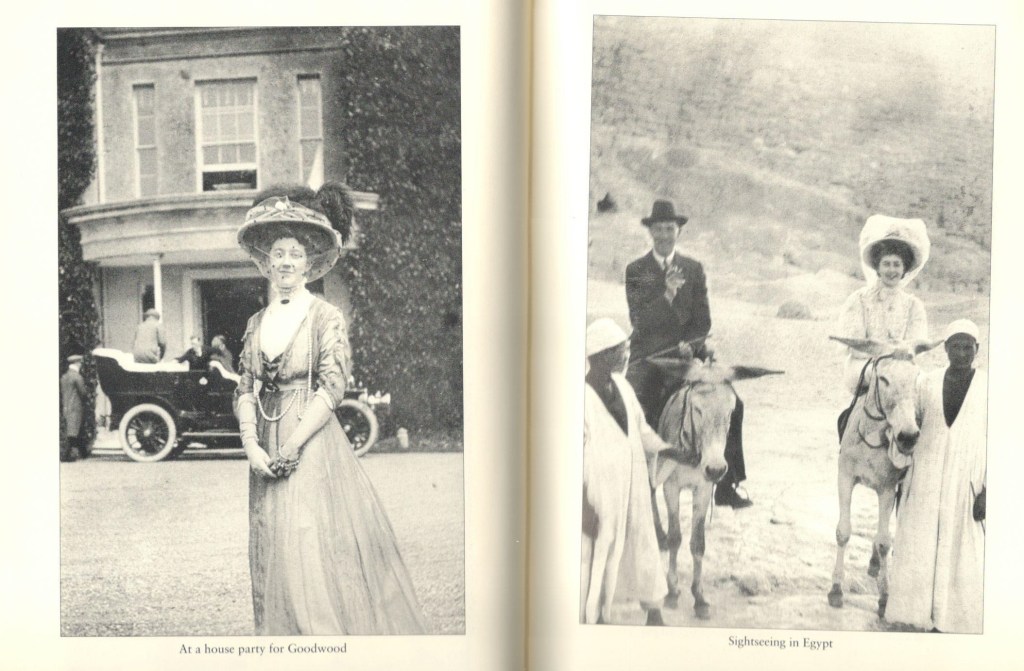
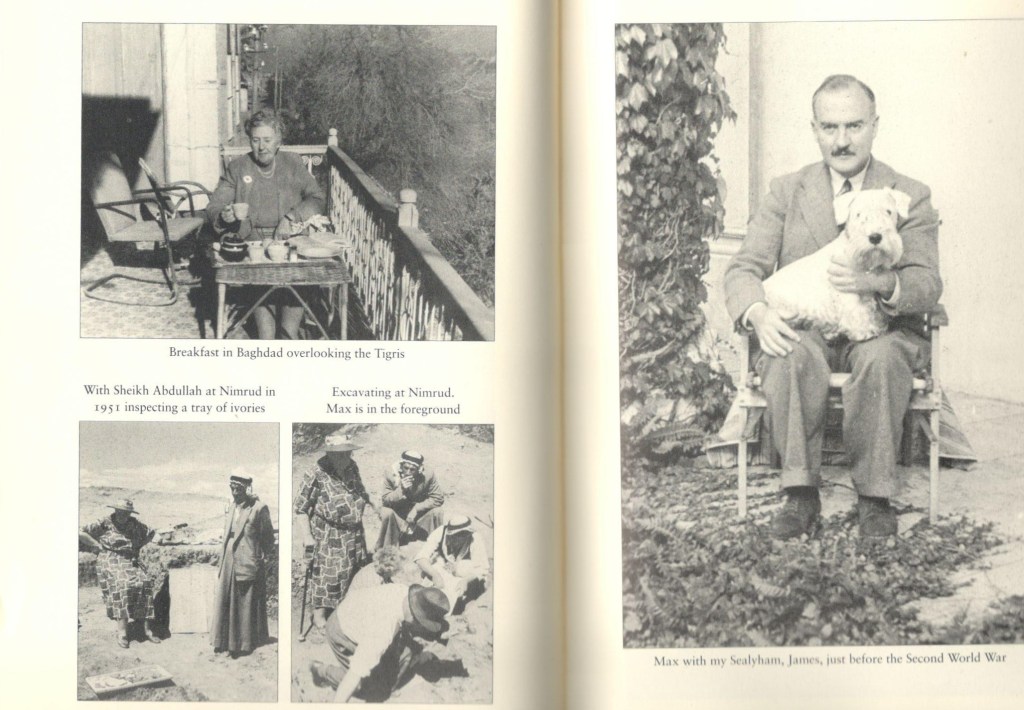
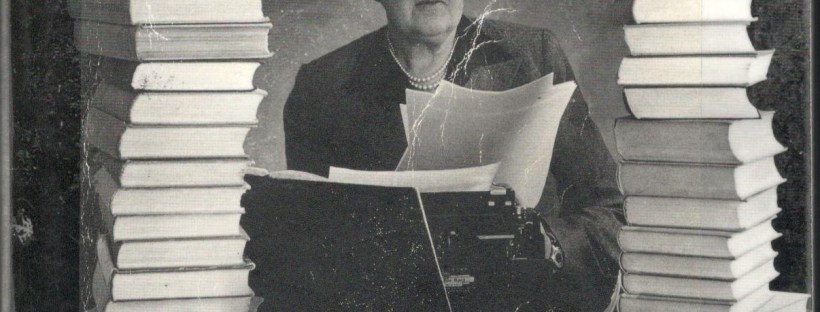
After the war she settled comfortably into middle age.  I always thought of Agatha Christie as the stout grandmotherly person she was in her old age, not the slim stylishly dressed girl in the photos so I enjoyed seeing the photos in the book, although I think the photo on the book cover is not a flattering one.

“I have enjoyed greatly the second blooming that comes when you finish the life of the emotions and of personal relations, and suddenly find, at the age of fifty say, that a whole new life has opened before you, filled with things you can think about, study or read about.  You find that you like going to picture exhibitions, concerts and the operas, with the same enthusiasm as when you went at 20 or 25.  For a period, your personal life has absorbed all your energies, but now you are free again to look around you.  You can enjoy leisure, you can enjoy things.  You are still young enough to enjoy going to foreign places.  It is as if a fresh sap of ideas and thoughts was rising in you.  With it of course, goes the penalty of increasing old age – the discovery that your body is always hurting somewhere…..these things happen and have to be endured.  But one’s thankfulness for the gift of life is I think stronger and more vital during those years than it ever has been before.” 

I enjoyed reading this book, but I didn’t get a real sense of what she was like as a person, as it’s not a revealing kind of autobiography, full of feelings and emotion, but more of a factual record of a very interesting life. It was written when she was older and looking back on what was for the most part a happy and comfortable life. She took great pleasure in reliving her memories  She started it in Nimrud, Iraq while on a dig with Max.  Not hurrying herself, writing a few pages from time to time – a task which will she predicted would go on for years….and it did – fifteen.  She died in 1976, and it was not published until the following year.  Her husband Max died a year later.

“I like living. I have sometimes been wildly despairing, acutely miserable, racked with sorrow, but through it all I still know quite certainly just to be alive is a grand thing.”

“I have been singularly fortunate.  I have with me my husband, my daughter, my grandson, my kind SIL, the people who make up my world.”

“What can I say at 75.  Thank God for my good life, and for all the love that has been given to me.”

See next week for Part Two – some of her thoughts on writing.

#May Flowers – Wordless Wednesday

Lately I’ve been taking pictures while walking in the neighborhood
These purple irises deserve a a second shot
I’ve never seen a peony with multi-colors like this one before
The owner said it’s a woody shrub not a bush, and blooms earlier than other peonies.

She said this is catnip – a lovely sight if you’re a cat!
My rescue basket of pansies post CPR – the nursery was going to throw them out but all they needed was some water.
My Virginia bluebells are always nice but one strand came up albino this year.
It’s right beside the lily of the valley, so maybe I’ve created a new species?
Inhale the scent!
Lilacs over my neighbor’s fence.
Make for a nice place to sit and read a book!

#Yellow and Purple – Wordless Wednesday

Yellow and purple are complimentary colors
Common in the first flowers of spring – like crocus
and Hyacinths
Which contrasts nicely with yellow daffodils
Cheerful pansies in bright
and pale shades
Violets sprinkled across the lawn
make the dandelions look sunny
Bright purple vinca stands out
as does the regal purple iris.
And last but not least forsythia – the welcome sign of spring!

The Little Library

As a reader, I’ve always loved libraries. I remember when the library opened in my small town. I was eight and the teacher took us there on a class trip and I thought it was the most wonderful place.  We didn’t have a lot of books at home, just the usual Dick and Jane and Golden Book series, and here was a whole building full of books you could take home for several weeks. I read my way through the children’s side and had graduated to the adult section by age eleven. My mother would take us to the library every Saturday to stock up, and I read my way through many a long hot summer.  I still remember the familiar smell of books and the waft of cool air that hit you walking through the door, as the library was one of the few places in town with air conditioning.  Of course living in the country, we needed a ride there, so imagine the convenience of having a free little library in your own neighbourhood.    

This one is certainly eye catching.

Free little libraries are small neighbourhood boxes where you can borrow, take, donate or share a book…..all kinds of books.  They have been popping up all over lately, just like the spring flowers, but as they are a year round venture, they must be weatherproof and snow proof.  There are at least 30 registered locations in my county alone – one of the most utilized ones is near a local campsite.

I’ve been thinking about having a little library since the beginning of the pandemic, which the libraries were all closed and I found myself lending out books to neighbours I met while walking, who complained about having nothing to read, and is there anything worse for a reader. 

It’s a nice way to share your love of reading, expand book access, and meet and get to know your neighbours. Last year the local Literary organization was so stockpiled with donated books that they offered temporary pop-up libraries at parks and beaches when the weather was nice, using plastic recycling blue boxes. 

The Free Little Library organization (take a book, share a book) has a website, (see link) where you can officially register as a book steward (with a plaque number) if you wish, but I think I would prefer to just put one up and see how it goes.  My neighbourhood is an old established one, with a mixture of retired folks and young families, but it’s a cul-de-sac, and I don’t want too much of a commitment until I see how much it will be used.

Their website says they have over 100,000 registered stewards in over 100 countries around the globe.  They also have a page where they sell pre-made libraries and kits – see link – averaging around $350 plus another $175 for the spike and post.  I like this blue one made out of composite so it doesn’t need painting, but it’s sold out.

These are their revenue generators, but a bit pricey, but they also have a page with a list of ideas for making your own, (see link – little libraries on a shoestring budget) such as this one here, which appears to be a storage cupboard propped up on a stool.

 The local literacy organization was partnering with volunteers and high school shop classes to make some of these book sharing boxes. They were sponsoring a contest, which I didn’t win, but garage sale season is coming up, so I’ll keep my eyes open for something suitable….and books of course.  They can hold up to 40 books, so I have some book shopping to do.

Annual pop-up book sale

Thrift stores are good sources for books, plus I went to the big Rotary Book sale last month, for the $10 stuff a bag day and stocked up.  I bought mostly books that I have read and enjoyed, although the children’s selection was picked over by then. 

Some book club discussion books
Some classics

Warm weather will be here soon, and I’m looking forward to reading outside again on the deck.

Porch season – this month’s puzzle
Happy Spring!

A Tale of Two Mysteries

     One hundred years later, Agatha Christie remains the most famous of mystery writers, with a prolific output of 66 detective novels, 14 short story collections, six fiction novels under a pseudonym and the theater’s longest running play, The Mousetrap.  One of the highest selling authors of all time (2 billion copies) her books are still in print and movie versions abound even today.  I recently saw Crooked House on Netflix (mixed opinion on that one) and Death on the Nile is on my to-see list.  

   As I’ve only read a couple of her books, Murder on the Orient Express, and And Then There Were None, I can’t say that I’m a big fan.  The flaw I find in her writing is the sheer number of characters in some of them, it’s hard to keep them all straight, especially when she gives such a small amount of description and background about them.  In my opinion, we never really get to know the people in her books, except perhaps for the recurring ones, like Miss Marple and Hercule Poirot and I’ve always disliked that ridiculous mustache.

    The same with the movie adaptations, on both Crooked House and the 2017 version of The Orient Express, there were so many actors with similar appearance – the same tall dark looks (the men) and thin with bobbed hair (the women) that it was hard to keep them all straight.  In Crooked House, the filming was so dark and the camera so distant that we seldom got enough of a close-up of a face to be able to distinguish between them.  This is perhaps a problem with casting and scripts however, not the books.  

     I know only the barest outline of her life – her first marriage to a husband who left her for another woman, and who, it was reputed, never bothered to read any of her books after the first, (good riddance to him), her second marriage to a younger archaeologist, her stints as an apothecary’s assistant during both world wars, which resulted in her extensive knowledge of poisons.  (I can’t say I share that expertise despite my forty years experience, but medication was mainly compounded from scratch back in the day.)  But one thing has always puzzled people – her disappearance for eleven days in 1926.   While all of England searched for her, she was holed up in a hotel, registered under the name of her husband’s mistress.  Her mother had died earlier in the year and rumors abounded that her husband had asked for a divorce. Had she suffered a nervous breakdown, or perhaps intended to embarrass him? There was even speculation it might have been a publicity stunt.  Once found, they got back together again, but she eventually left him and he married his mistress.

So it was with interest that I read the new release, The Christie Affair, by Nina de Gramont – a fictionalized account of her mysterious disappearance. The reviews were great, and it did not disappoint.  I would consider this one of the best books I’ve read this year, deserving of being a Reese Book Club selection, which is not always the case.

The writing was excellent and suspenseful, and I am in awe of how the author spun the various stories together, with a very satisfactory ending, and of course there was a crime to solve, although it wasn’t the main focus.  I can’t say too much because of spoilers, but I do wonder how they got this book past the Christie estate because of that one pivotal detail. It’s all pure fiction of course, but masterfully done.  In short, it’s difficult to summarize this book, it’s historical fiction, it’s a suspense novel, but it’s mainly it’s just a very good story.

I’m not familiar with the author, but she has five other books I will check into. This book has also inspired me to read more about Agatha Christie’s life.  She never discussed the disappearance the rest of her life, only mentioning it briefly in her autobiography as “So, after illness, came sorrow, despair and heartbreak. There is no need to dwell on it.”

Contrast this to my experience a week later reading Lucy Foley’s latest – The Paris Apartment – a modern day locked room mystery. 

Goodreads Publisher’s Blurb: Jess needs a fresh start. She’s broke and alone, and she’s just left her job under less than ideal circumstances. Her half-brother Ben didn’t sound thrilled when she asked if she could crash with him for a bit, but he didn’t say no, and surely everything will look better from Paris. Only when she shows up – to find a very nice apartment, could Ben really have afforded this? – he’s not there. The longer Ben stays missing, the more Jess starts to dig into her brother’s situation, and the more questions she has. Ben’s neighbors are an eclectic bunch, and not particularly friendly. Jess may have come to Paris to escape her past, but it’s starting to look like it’s Ben’s future that’s in question. The socialite – The nice guy – The alcoholic – The girl on the verge – The concierge. Everyone’s a neighbor. Everyone’s a suspect. And everyone knows something they’re not telling.

Reading this book a week after The Christie Affair, I couldn’t help but compare the two.  Lucy Foley also wrote the previous locked room mysteries, The Guest List (destination wedding on an island off the coast of Ireland) and The Hunting Lodge (a Scottish lodge during a snow storm).  Now I have to admit I’m not the demographic the author is writing for (young, lots of beverage imbibing and bad language, some of it in French) but in my opinion any book which starts with an offensive opening sentence has nowhere to go but more of the same. Where were the editors?  Is there anything wrong with a simple “Ben, answer your phone – I’m freezing out here.”  No, but in a modern day mystery, it seems we must use explicit adjectives, and maybe that is the way young people talk, but I almost closed the book after the first page.  I was discussing this with the librarian when I returned it, and she argued that the author was trying to establish that the protagonist was from a disadvantaged background. I suppose there’s that….but she’s also unlikable.  It seems to be the fashion now to have an unlikable protagonist, but really, none of the characters were likable.  Which made me think – do I really want to spend 300 pages with these people? Still, I persisted….because I know Lucy Foley can spin a good tale.

It’s not a bad book, suspenseful, more character development than what Agatha Christie was prone too, but that is to be expected today.  We must have multiple motives, and in order to have motives you must reveal something about your characters, disagreeable or not.  I’m a sucker for any book with Paris in the title, but it’s like the author threw everything stereo-typically French – thin chic women afraid to eat, lots of wine, extramarital affairs and a rather sleazy descent into the seedier side of Moulin Rouge – into a pot and this is the plot she came up with.  There isn’t really even that much about Paris in it, it could be an apartment building anywhere, as that is where the majority of the story is set, although I think she ate a croissant, despite her dwindling cash reserves? I can see it being a Hollywood movie – lots of passion and sizzle, a rather thin plot, but a suspenseful ending.   It was somewhat better the last hundred pages, and was certainly a fast paced read for a book where nothing much happens, but will it stand the test of time?  That remains to be seen.   

Both were good books, in their own way, but my preference was for The Christie Affair – tell me an interesting story along with my dose of suspense.  

Which begs the question, does every mystery author eventually succumb to being dated?  Have you read any good mysteries lately?

The Mediterranean Diet

There are many reports on the health benefits of the Mediterranean Diet. It’s one of the most recommended diets for its ability to reduce the risk of heart disease, metabolic syndrome, diabetes, certain types of cancer, as well as to help prevent cognitive decline and dementia especially vascular dementia. See link from Harvard Health newsletter, A Practical Guide to the Mediterranean Diet.

With it’s emphasize on plant foods, including fruits, vegetables, whole grains, nuts, and legumes which are minimally processed, seasonally fresh and locally grown, olive oil as the principal source of fat, fish and poultry instead of red meat, cheese, yogurt and wine in low to moderate amounts, and fresh fruit for dessert, with limited sweets, it sounds like a healthy way to eat.

And then there’s the whole Mediterranean thing…because of course the traditional Mediterranean diet is based on foods available in countries that border the Mediterranean Sea.…where the sun shines and life is la dolce vita. (less stress, less inflammation)  But I live in Canada, where it’s cold half the year and hearty meals abound. Things like chili and chicken pot pie have been staples on my diet this winter but does my latest favorite dish, chicken and mushroom crepes, count as the French Rivera is on the Mediterranean?

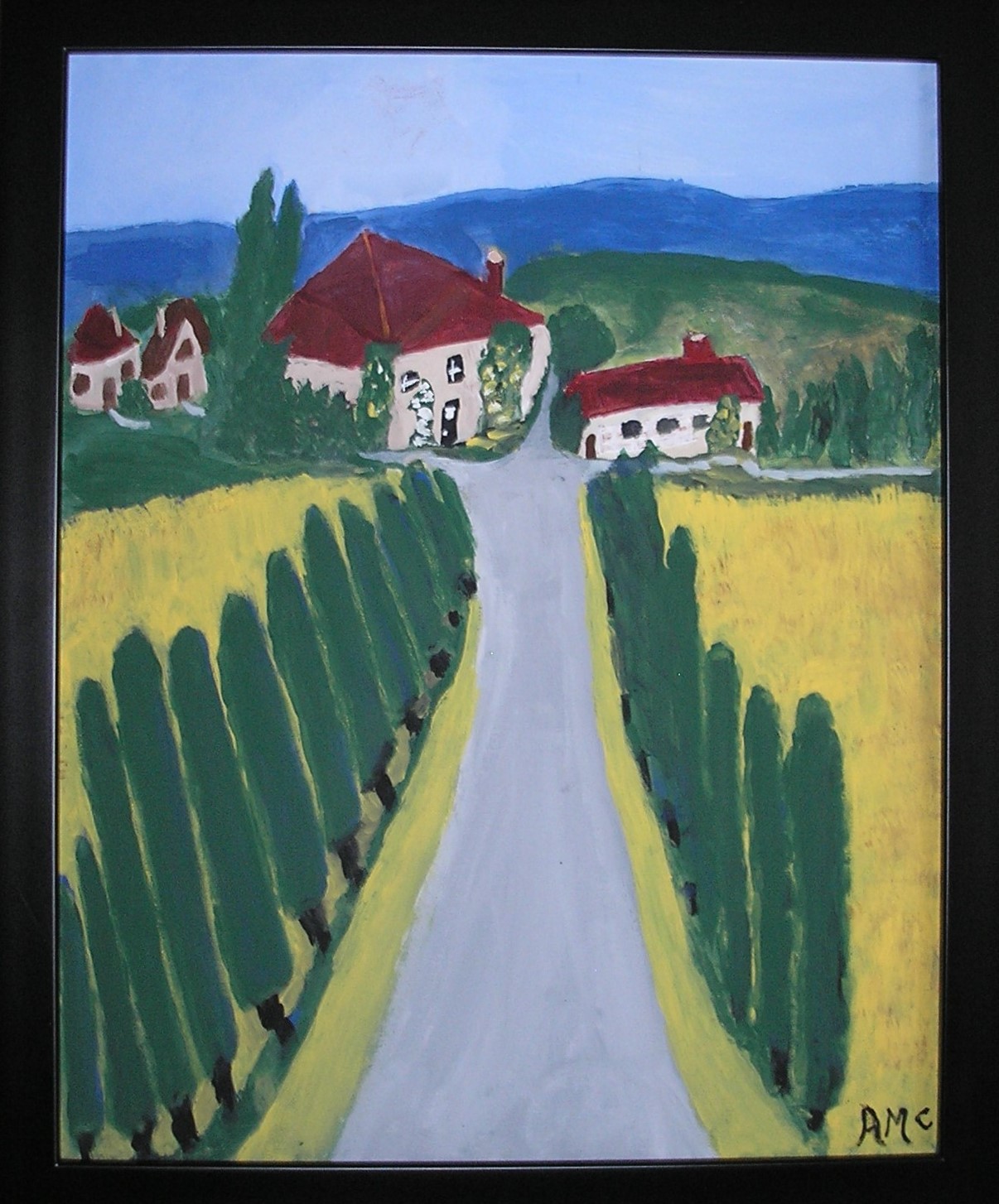
Italian Villa – 2015 – one of my mother’s paintings

Still the Mediterranean diet is something I aspire to, if only in the frozen food aisle.

Not crazy about edamame= green soybeans
This was surprisingly good for a ready-to-serve lentil soup, but does the sodium content cancel out any benefit?

So it was some anticipation that I read Debbie Travis’s latest book Joy – Life Lessons from a Tuscan Villa.  (You knew there was going to be a book in here somewhere.)

I was only vaguely aware of Debbie Travis (a decorating guru and pioneer of painting techniques) and I don’t usually read lifestyle books, (she’s written eleven), but it had a pretty cover and gorgeous pictures of the 13th century villa she restored over five years and now rents out for relaxing retreats.

Here’s a link to the Villa Reniella, should you have some extra cash to spare. It was hard to figure out the pricing, as while googling I saw various listings in different currencies, but they were all expensive.

There was a time in my life when the idea of a week at such a place would have seemed wonderfully idyllic.  Now I’d probably be bored. My retirement life is already pretty low stress.  Yoga looking out over a row of Cypress trees is still yoga and I hate yoga. 

Stairway to Tuscany – 2018

And I have no desire to stay in a room which was previously a pigsty – wouldn’t it still reek of pigs?   According to the book, the family stays in the original three story villa, but there are 12 individual well-appointed Porcilaia suites for rent, plus a renovated horse barn.  

Only a rich celebrity would buy a run-down villa with livestock living on the ground floor and no running water – the village turned it off 30 times before they dug a well. The original building was surrounded by pigsties that were transformed into suites, each with its own private entrance and garden.  Not to mention the 1200 olive trees which needed pruning and harvesting, an old non-productive vineyard and nightly battles with a herd of wild boor.  She only mentions these in passing, and also introduces us to the previous owner (an elderly Tuscan man who surely must be laughing all the way to the bank), but I would have been more interested in reading about her experiences renovating the place than perusing a bunch of stylized photos of food I’m probably never going to make nor have any desire to eat.  I don’t even like the taste of olive oil. (Edited to add – apparently there is a six episode series on youtube – La Dolce Debbie – for those who would prefer a documentary about the renovations. I have not watched it yet but here’s the link.) (April 21 – edited to add – I watched it and found it very enjoyable but it must have cost them a fortune – I highly recommend it if you’d prefer a visual tour!)

There’s a section on the villa’s extensive kitchen garden, which produces a multitude of herbs and vegetables with accompanying recipes.  Kale, artichokes, beets, (no), leeks, peas, asparagus, mushrooms, tomatoes, radicchio (yes), zucchini (boring), fava beans, eggplant, celeriac (never tried them).    

My own kitchen garden will be coming soon…it’s so much easier to eat healthy in the summer.

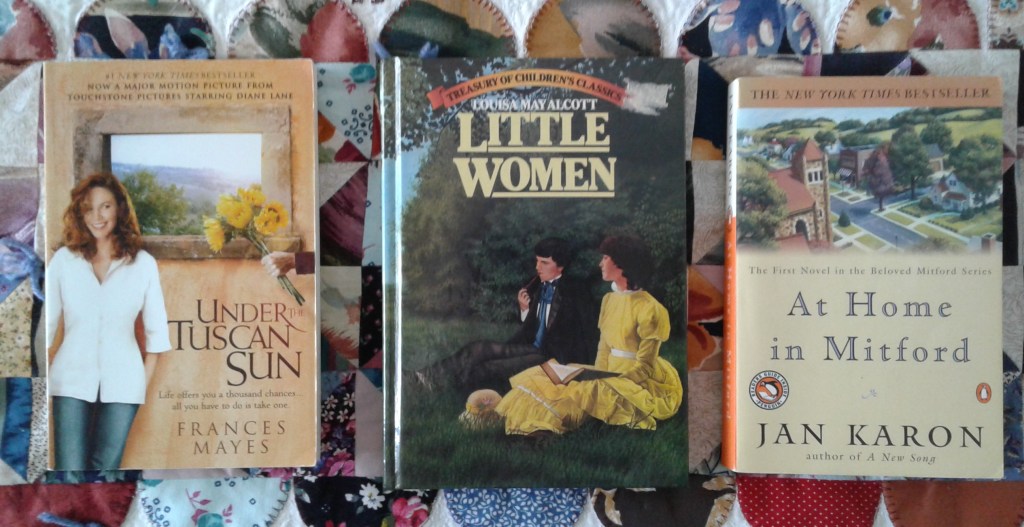
I found the book entertaining but also very light and fluffy – it’s certainly no Under the Tuscan Sun. I wonder though if the health benefits of the Mediterranean diet can be partially attributed to a different lifestyle, and the book does give us a peek into the Tuscan way of life with their emphasize on family and socializing, their coffee culture, aperitivos (pre-dinner drinks and nibbles) and the Passeggiata – a long promenade before dinner.  Yes, I could see myself strolling around the village square with a glass of Prosecco in hand…a good way to get those steps in, if you don’t drink too much and stumble over the cobblestones. Plus, any country whose shuttered shops and businesses allow you to take a long afternoon nap has my vote. Perhaps they are just healthier because they get more sleep?    

There were lots of recipes and pretty pictures of food, most of which I would probably not make because I’m not big on quinoa, chickpeas or legumes for my protein.  The Limoncella recipe sounded interesting, as I always wanted to have a lemon tree, although not necessarily a whole grove.  I like pasta and tomatoes occasionally, but she assures us the pasta (with fibre-rich grains, obesity is rare) and tomatoes taste different there, and their bruschetta is made with their own sun-ripened tomatoes.   If anyone wants to lend me five thousand pounds, so I could find out, I believe this may require more research…..maybe in June during the Classic Car Rally? Now driving a vintage car around the scenic hills of Tuscany sounds like my kind of retreat.

PS.   In the meantime Stanley Tucci’s – Season Two of Searching for Italy starts Sunday May 1 on CNN.   I believe he is eating his way through Venice and Umbria.

Tuscan Farmhouse – 2015 – one of my mother’s paintings
The March Hare boycotting the Mediterranean diet….and I even added carrots? Maybe he is waiting for the chocolate? Happy Easter Bunny!

The Maid – The Literary Salon

     One of the pleasures of staying in a hotel room is someone else cleans up, but do we ever really think about that person?  We may see them moving their trolleys up and down the hallway, and hopefully we leave them a tip, but it’s a job a lot of people take for granted.  It’s hard work, plus, you’d have to like cleaning.   

     Thankfully, Molly, the protagonist in the new bestseller, The Maid, loves her job and takes great pride and enjoyment in returning the rooms at the Regency Hotel to “a state of perfection” as their training program emphasizes. When she happens to clean away some murder evidence which along with her unusual behavior makes her a prime suspect, that provides an interesting premise for a murder mystery.    

Reading is better than spring cleaning…

Here’s the Publisher’s Blurb:

Molly Gray is not like everyone else. She struggles with social skills and misreads the intentions of others. Her gran used to interpret the world for her, codifying it into simple rules that Molly could live by.

Since Gran died a few months ago, twenty-five-year-old Molly has been navigating life’s complexities all by herself. No matter—she throws herself with gusto into her work as a hotel maid. Her unique character, along with her obsessive love of cleaning and proper etiquette, make her an ideal fit for the job. She delights in donning her crisp uniform each morning, stocking her cart with miniature soaps and bottles, and returning guest rooms at the Regency Grand Hotel to a state of perfection.

But Molly’s orderly life is upended the day she enters the suite of the infamous and wealthy Charles Black, only to find it in a state of disarray and Mr. Black himself dead in his bed. Before she knows what’s happening, Molly’s unusual demeanor has the police targeting her as their lead suspect. She quickly finds herself caught in a web of deception, one she has no idea how to untangle. Fortunately for Molly, friends she never knew she had unite with her in a search for clues to what really happened to Mr. Black—but will they be able to find the real killer before it’s too late?

A Clue-like, locked-room mystery and a heartwarming journey of the spirit, The Maid explores what it means to be the same as everyone else and yet entirely different—and reveals that all mysteries can be solved through connection to the human heart.

About the Author: 

Nita Prose is a longtime editor, serving many bestselling authors and their books. She lives in Toronto, Canada, in a house that is only moderately clean.

 As an longtime editor, Nita Prose obviously had publishing connections, but this book is so good and so unique I’m sure it would have been found a home anyway.  I suspect the hotel in the book is based on The Royal York in Toronto, where I have stayed on occasion when work was footing the bill, (it’s handy to Union train station, but when I have to pay, I stay at the pleasant but cheaper Marriott) or it could be any one of those grand old dames with an impressive lobby which pride themselves on style and service.   

Discussion:    I loved everything about this book – the protagonist, the plot-line, the descriptions, the dialogue – it’s just a charming story.  I was already casting it in my head, when I read on Amazon that it is in development as a major motion picture produced by and starring Florence Pugh. I don’t know enough about this English actress to say whether she would suit the role or not, but it’s the kind of quirky movie the British do best.  Hollywood would probably Hollywoodize it, with sexy uniforms and lots of bed-hopping.

One thing to note, this murder mystery has nothing to do with the Netflix series of the same name, which is a totally different story. I haven’t watched it, but believe it deals with the struggles of a single mother working a minimum wage job. I don’t know what the pay is for hotel maids but personal maid services here charge $35/hr with $25 going to the maid, and even home care agencies charge $25 for light housekeeping, but the bigger hotel chains may be closer to minimum wage $15 as they are often staffed by people whose English is a second language. This is addressed in the book, as one of the employees does not have the proper immigration papers and Molly herself has difficulty making her big city rent. (These rates may even have gone up given the low unemployment rate and difficulty in attracting employees.)

Molly is such a memorable character that you can’t help but root for her.  Alone in the world after her grandmother’s death, she is unable to understand or read social cues, and takes everything at face value. The book is written in first person, which I often find annoying, but which works here as we are seeing the world from the point of view of someone whose thinking and behavior would be considered outside of normal. Although the author is very careful not to label her, she is probably somewhere on the spectrum, possibly Asperger’s Syndrome with a good dose of OCD thrown in.  She seems literally clueless when it comes to interpreting other people’s words and actions which leads her into trouble.  (I wonder if people who fall prey to obvious financial scams might be struggling with the same perceptive difficulties.)      

The dialogue is clever, (hence the movie), and the descriptions creative – her nest egg which was stolen is her “Faberge”, her restaurant date was “the Tour of Italy”( which made me want to eat at an Olive Garden, if only we had one here).

The plot was fast-paced, although but I had a small problem with the ending, but understand why it had to happen that way.  Overall, the book was a brilliant debut and also a gentle reminder that there are many “invisible” people in society, whose perceptions of the world may be somewhat different than our own.  

PS.  I use a maid service for my mother’s house, and also occasionally for myself for bigger jobs like windows, as I simply don’t have the energy to keep up two houses.  What I like about them is they send two, occasionally three, people so they are in and out in a couple of hours, so you’re not in their way all afternoon. They do an excellent job, but cleaning houses all day is hard work, so many of them don’t last long, although the head cleaner is always the same. She told me she loves to clean, as did the Molly Maid franchise owner I used before. I’m grateful that some people do…now if I could only find someone who loves ironing. Vacuuming is my second hated task, but give me something to organize and I’m happy.  While I used to enjoy the feeling of satisfaction after cleaning my house from top to bottom, now that I’m older I prefer that someone else return my house to “a state of perfection.”  If only it would stay that way.     

PS. Cleanliness in a hospital is a priority, so I would like to add a note of thanks to the hospital cleaners who have to deal with the COVID-units. I remember the floors in my rural hospital being so clean and shiny you could eat off them.

Do you enjoy cleaning? Any hated household tasks?

#March Madness – Wordless Wednesday

A photo recap of March.

First sign of spring – pussy willows for sale
Reading The Maid – a charming murder mystery with a maid turned sleuth – instead of spring cleaning!
Leftovers from the Mediterranean Diet
A March hare munching on the Mediterranean diet.
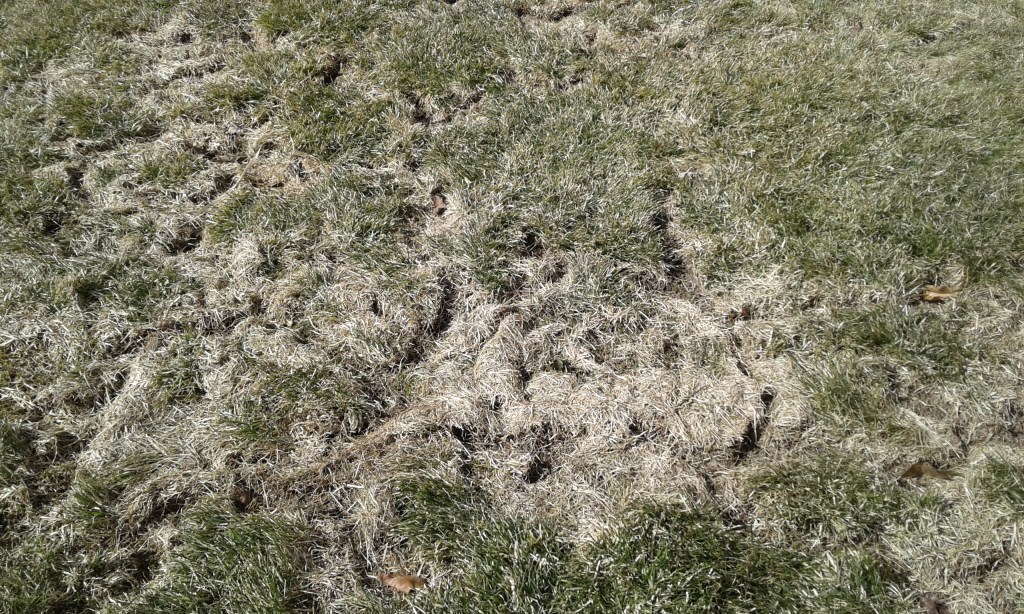
Lawn damage from the Merry Band of Moles who wintered under the front deck.
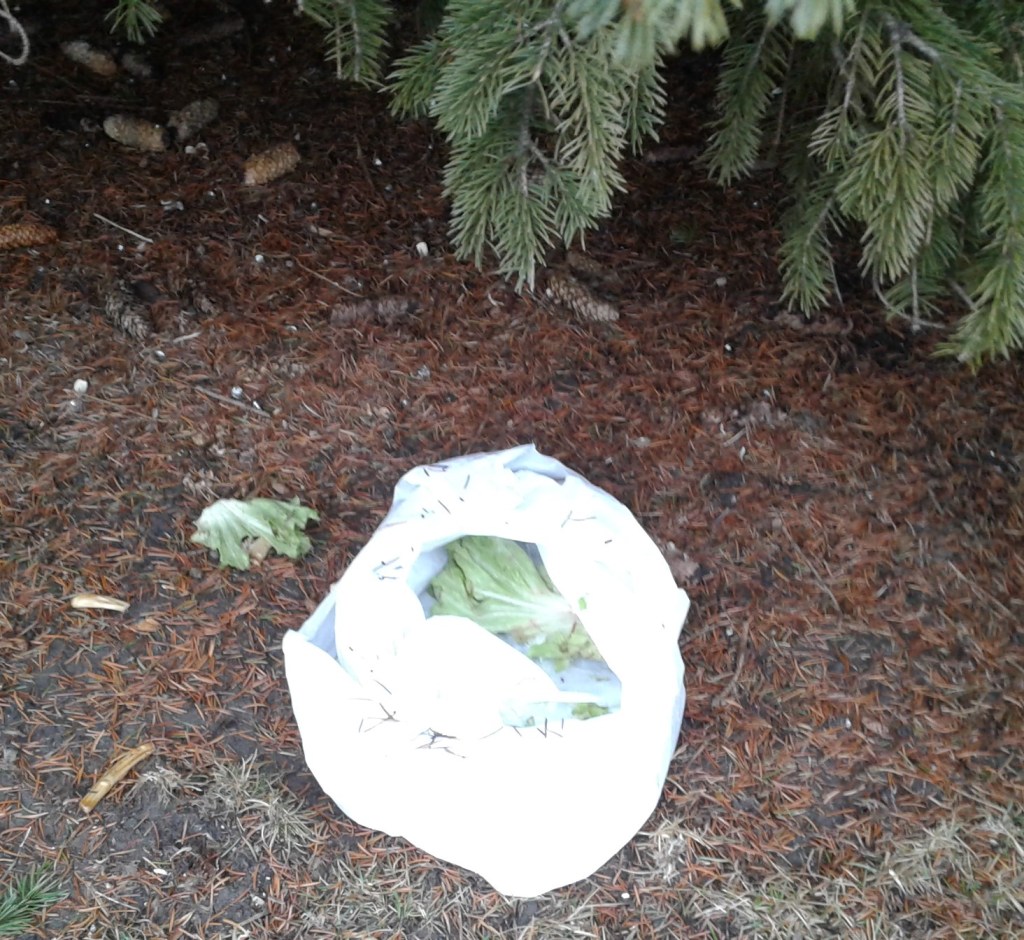
Anxiously awaiting those 80 bulbs I planted last fall. Note the piece of dryer lint the moles have scavenged for lining their nests so they can go forth and multiply….
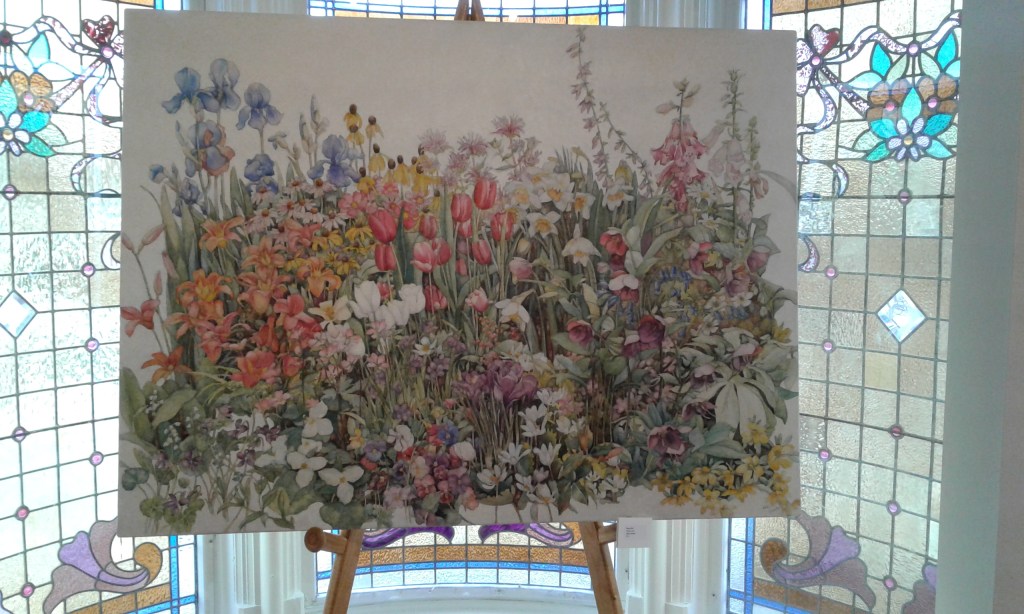
Saw this magnificent spring garden painting by a local artist at a gallery opening.
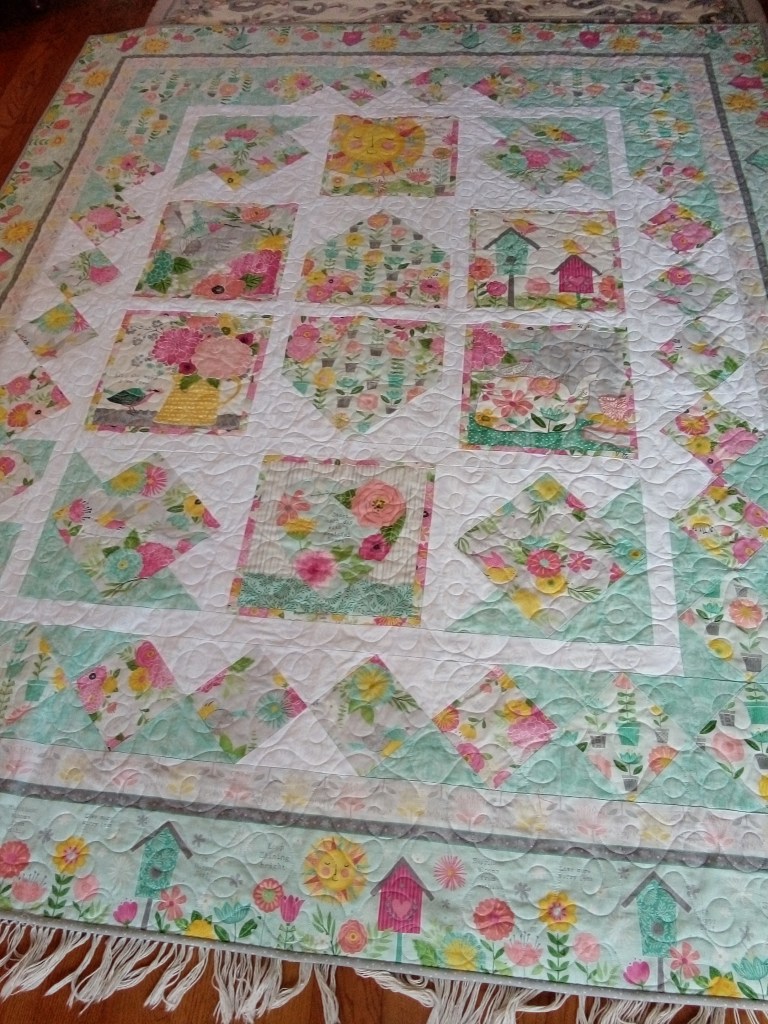
A friend’s spring-like quilt – if it hadn’t already been spoken for I would have bought it….like I need another quilt….
This week’s excuse for not writing a blog post – that second dose was wicked.
This week’s excuse for not walking. It’s hard to find a spring jacket in a nice color. Plus there’s freezing rain forecast to send March out like a lion, which is kind of what that mustard color reminds me of….
Better to stay in and do a cozy puzzle….this one has it all…..fire, cat, dog, book, drink, snacks – what more could you want.
And for true March madness – imagine being shot in a lineup while buying bread. I remember reading the book The Cellist of Sarajevo. It’s sad and disturbing to see history repeating itself – prayers for Ukraine.

#Ireland Paintings – Wordless Wednesday

A selection of my mother’s paintings of Ireland.

Irish Cottage – an older oil painting which has darkened over the years
Irish Cottage – Acrylic – 2019
Irish Cottage – 2019 Framed in blue like the door.
You can never have too many Irish cottages – this one has lots of texture.
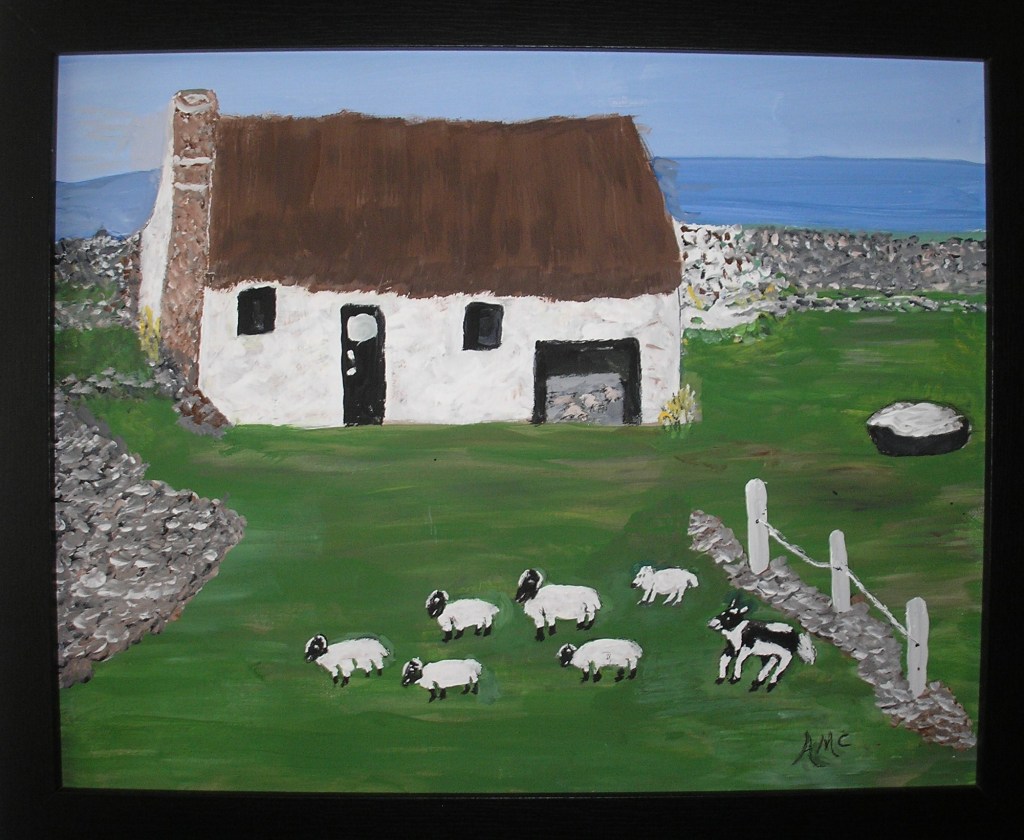
Shep, the Sheep Dog – 2018
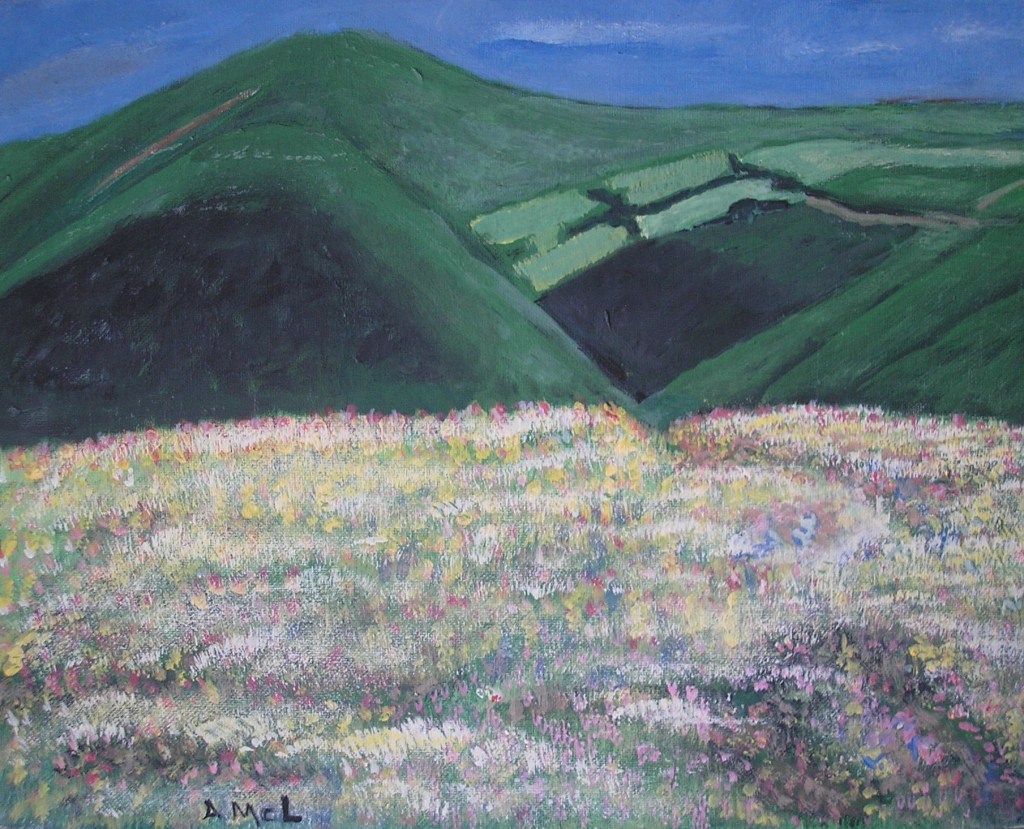
When Sunshine’s in the Meadow
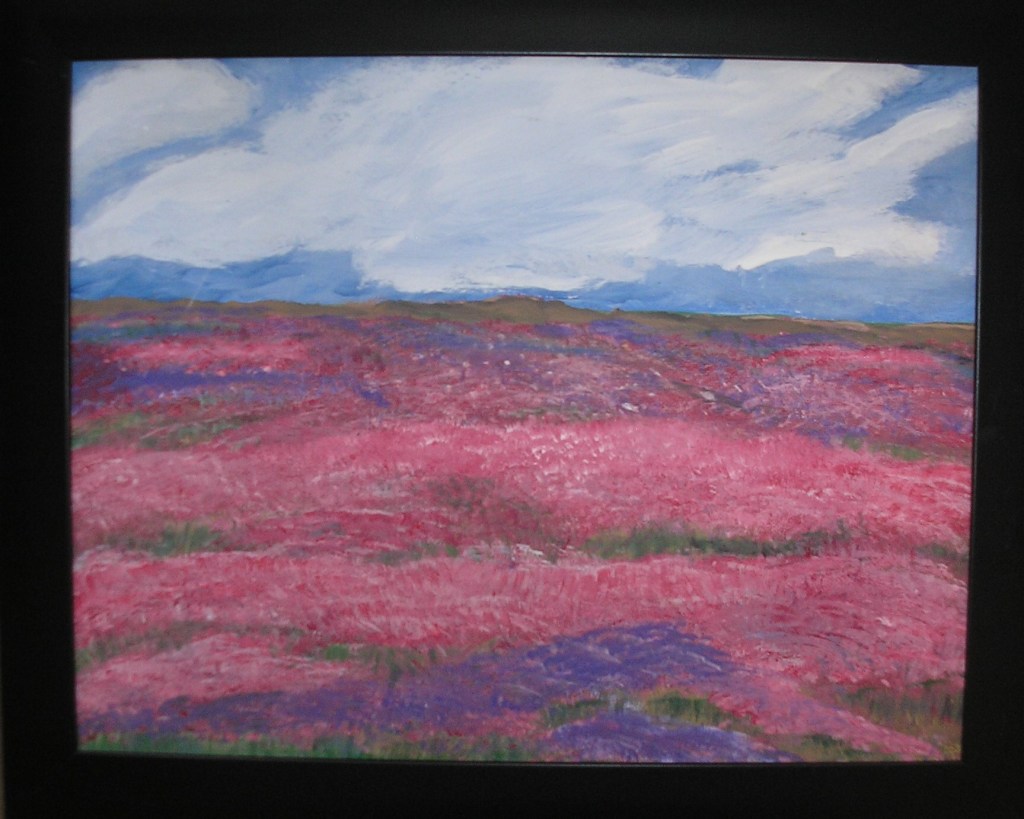
Heather – 2018
More heather
The Lakes of Killarney
Happy St. Patrick’s Day!