As a reader, I’ve always loved libraries. I remember when the library opened in my small town. I was eight and the teacher took us there on a class trip and I thought it was the most wonderful place. We didn’t have a lot of books at home, just the usual Dick and Jane and Golden Book series, and here was a whole building full of books you could take home for several weeks. I read my way through the children’s side and had graduated to the adult section by age eleven. My mother would take us to the library every Saturday to stock up, and I read my way through many a long hot summer. I still remember the familiar smell of books and the waft of cool air that hit you walking through the door, as the library was one of the few places in town with air conditioning. Of course living in the country, we needed a ride there, so imagine the convenience of having a free little library in your own neighbourhood.
This one is certainly eye catching.
Free little libraries are small neighbourhood boxes where you can borrow, take, donate or share a book…..all kinds of books. They have been popping up all over lately, just like the spring flowers, but as they are a year round venture, they must be weatherproof and snow proof. There are at least 30 registered locations in my county alone – one of the most utilized ones is near a local campsite.
I’ve been thinking about having a little library since the beginning of the pandemic, which the libraries were all closed and I found myself lending out books to neighbours I met while walking, who complained about having nothing to read, and is there anything worse for a reader.
It’s a nice way to share your love of reading, expand book access, and meet and get to know your neighbours. Last year the local Literary organization was so stockpiled with donated books that they offered temporary pop-up libraries at parks and beaches when the weather was nice, using plastic recycling blue boxes.
The Free Little Library organization (take a book, share a book) has a website, (see link) where you can officially register as a book steward (with a plaque number) if you wish, but I think I would prefer to just put one up and see how it goes. My neighbourhood is an old established one, with a mixture of retired folks and young families, but it’s a cul-de-sac, and I don’t want too much of a commitment until I see how much it will be used.
Their website says they have over 100,000 registered stewards in over 100 countries around the globe. They also have a page where they sell pre-made libraries and kits – see link – averaging around $350 plus another $175 for the spike and post. I like this blue one made out of composite so it doesn’t need painting, but it’s sold out.
These are their revenue generators, but a bit pricey, but they also have a page with a list of ideas for making your own,(see link – little libraries on a shoestring budget)such as this one here, which appears to be a storage cupboard propped up on a stool.
The local literacy organization was partnering with volunteers and high school shop classes to make some of these book sharing boxes. They were sponsoring a contest, which I didn’t win, but garage sale season is coming up, so I’ll keep my eyes open for something suitable….and books of course. They can hold up to 40 books, so I have some book shopping to do.
Annual pop-up book sale
Thrift stores are good sources for books, plus I went to the big Rotary Book sale last month, for the $10 stuff a bag day and stocked up. I bought mostly books that I have read and enjoyed, although the children’s selection was picked over by then.
Some book club discussion books Some classics
Warm weather will be here soon, and I’m looking forward to reading outside again on the deck.
One hundred years later, Agatha Christie remains the most famous of mystery writers, with a prolific output of 66 detective novels, 14 short story collections, six fiction novels under a pseudonym and the theater’s longest running play, The Mousetrap. One of the highest selling authors of all time (2 billion copies) her books are still in print and movie versions abound even today. I recently saw Crooked House on Netflix (mixed opinion on that one) and Death on the Nile is on my to-see list.
As I’ve only read a couple of her books, Murder on the Orient Express, and And Then There Were None, I can’t say that I’m a big fan. The flaw I find in her writing is the sheer number of characters in some of them, it’s hard to keep them all straight, especially when she gives such a small amount of description and background about them. In my opinion, we never really get to know the people in her books, except perhaps for the recurring ones, like Miss Marple and Hercule Poirot and I’ve always disliked that ridiculous mustache.
The same with the movie adaptations, on both Crooked House and the 2017 version of The Orient Express, there were so many actors with similar appearance – the same tall dark looks (the men) and thin with bobbed hair (the women) that it was hard to keep them all straight. In Crooked House, the filming was so dark and the camera so distant that we seldom got enough of a close-up of a face to be able to distinguish between them. This is perhaps a problem with casting and scripts however, not the books.
I know only the barest outline of her life – her first marriage to a husband who left her for another woman, and who, it was reputed, never bothered to read any of her books after the first, (good riddance to him), her second marriage to a younger archaeologist, her stints as an apothecary’s assistant during both world wars, which resulted in her extensive knowledge of poisons. (I can’t say I share that expertise despite my forty years experience, but medication was mainly compounded from scratch back in the day.) But one thing has always puzzled people – her disappearance for eleven days in 1926. While all of England searched for her, she was holed up in a hotel, registered under the name of her husband’s mistress. Her mother had died earlier in the year and rumors abounded that her husband had asked for a divorce. Had she suffered a nervous breakdown, or perhaps intended to embarrass him? There was even speculation it might have been a publicity stunt. Once found, they got back together again, but she eventually left him and he married his mistress.
So it was with interest that I read the new release, The Christie Affair, by Nina de Gramont – a fictionalized account of her mysterious disappearance. The reviews were great, and it did not disappoint. I would consider this one of the best books I’ve read this year, deserving of being a Reese Book Club selection, which is not always the case.
The writing was excellent and suspenseful, and I am in awe of how the author spun the various stories together, with a very satisfactory ending, and of course there was a crime to solve, although it wasn’t the main focus. I can’t say too much because of spoilers, but I do wonder how they got this book past the Christie estate because of that one pivotal detail. It’s all pure fiction of course, but masterfully done. In short, it’s difficult to summarize this book, it’s historical fiction, it’s a suspense novel, but it’s mainly it’s just a very good story.
I’m not familiar with the author, but she has five other books I will check into. This book has also inspired me to read more about Agatha Christie’s life. She never discussed the disappearance the rest of her life, only mentioning it briefly in her autobiography as “So, after illness, came sorrow, despair and heartbreak. There is no need to dwell on it.”
Contrast this to my experience a week later reading Lucy Foley’s latest – The Paris Apartment – a modern day locked room mystery.
Goodreads Publisher’s Blurb: Jess needs a fresh start. She’s broke and alone,and she’s just left her job under less than ideal circumstances. Her half-brother Ben didn’t sound thrilled when she asked if she could crash with him for a bit, but he didn’t say no, and surely everything will look better from Paris. Only when she shows up – to find a very nice apartment, could Ben really have afforded this? – he’s not there. The longer Ben stays missing, the more Jess starts to dig into her brother’s situation, and the more questions she has. Ben’s neighbors are an eclectic bunch, and not particularly friendly. Jess may have come to Paris to escape her past, but it’s starting to look like it’s Ben’s future that’s in question. The socialite – The nice guy – The alcoholic – The girl on the verge – The concierge. Everyone’s a neighbor. Everyone’s a suspect. And everyone knows something they’re not telling.
Reading this book a week after The Christie Affair, I couldn’t help but compare the two. Lucy Foley also wrote the previous locked room mysteries, The Guest List (destination wedding on an island off the coast of Ireland) and The Hunting Lodge (a Scottish lodge during a snow storm). Now I have to admit I’m not the demographic the author is writing for (young, lots of beverage imbibing and bad language, some of it in French) but in my opinion any book which starts with an offensive opening sentence has nowhere to go but more of the same. Where were the editors? Is there anything wrong with a simple “Ben, answer your phone – I’m freezing out here.” No, but in a modern day mystery, it seems we must use explicit adjectives, and maybe that is the way young people talk, but I almost closed the book after the first page. I was discussing this with the librarian when I returned it, and she argued that the author was trying to establish that the protagonist was from a disadvantaged background. I suppose there’s that….but she’s also unlikable. It seems to be the fashion now to have an unlikable protagonist, but really, none of the characters were likable. Which made me think – do I really want to spend 300 pages with these people? Still, I persisted….because I know Lucy Foley can spin a good tale.
It’s not a bad book, suspenseful, more character development than what Agatha Christie was prone too, but that is to be expected today. We must have multiple motives, and in order to have motives you must reveal something about your characters, disagreeable or not. I’m a sucker for any book with Paris in the title, but it’s like the author threw everything stereo-typically French – thin chic women afraid to eat, lots of wine, extramarital affairs and a rather sleazy descent into the seedier side of Moulin Rouge – into a pot and this is the plot she came up with. There isn’t really even that much about Paris in it, it could be an apartment building anywhere, as that is where the majority of the story is set, although I think she ate a croissant, despite her dwindling cash reserves? I can see it being a Hollywood movie – lots of passion and sizzle, a rather thin plot, but a suspenseful ending. It was somewhat better the last hundred pages, and was certainly a fast paced read for a book where nothing much happens, but will it stand the test of time? That remains to be seen.
Both were good books, in their own way, but my preference was for The Christie Affair – tell me an interesting story along with my dose of suspense.
Which begs the question, does every mystery author eventually succumb to being dated? Have you read any good mysteries lately?
There are many reports on the health benefits of the Mediterranean Diet. It’s one of the most recommended diets for its ability to reduce the risk of heart disease, metabolic syndrome, diabetes, certain types of cancer, as well as to help prevent cognitive decline and dementia especially vascular dementia. See linkfrom Harvard Health newsletter, A Practical Guide to the Mediterranean Diet.
With it’s emphasize on plant foods, including fruits, vegetables, whole grains, nuts, and legumes which are minimally processed, seasonally fresh and locally grown, olive oil as the principal source of fat, fish and poultry instead of red meat, cheese, yogurt and wine in low to moderate amounts, and fresh fruit for dessert, with limited sweets, it sounds like a healthy way to eat.
And then there’s the whole Mediterranean thing…because of course the traditional Mediterranean diet is based on foods available in countries that border the Mediterranean Sea.…where the sun shines and life is la dolce vita. (less stress, less inflammation) But I live in Canada, where it’s cold half the year and hearty meals abound. Things like chili and chicken pot pie have been staples on my diet this winter but does my latest favorite dish, chicken and mushroom crepes, count as the French Rivera is on the Mediterranean?
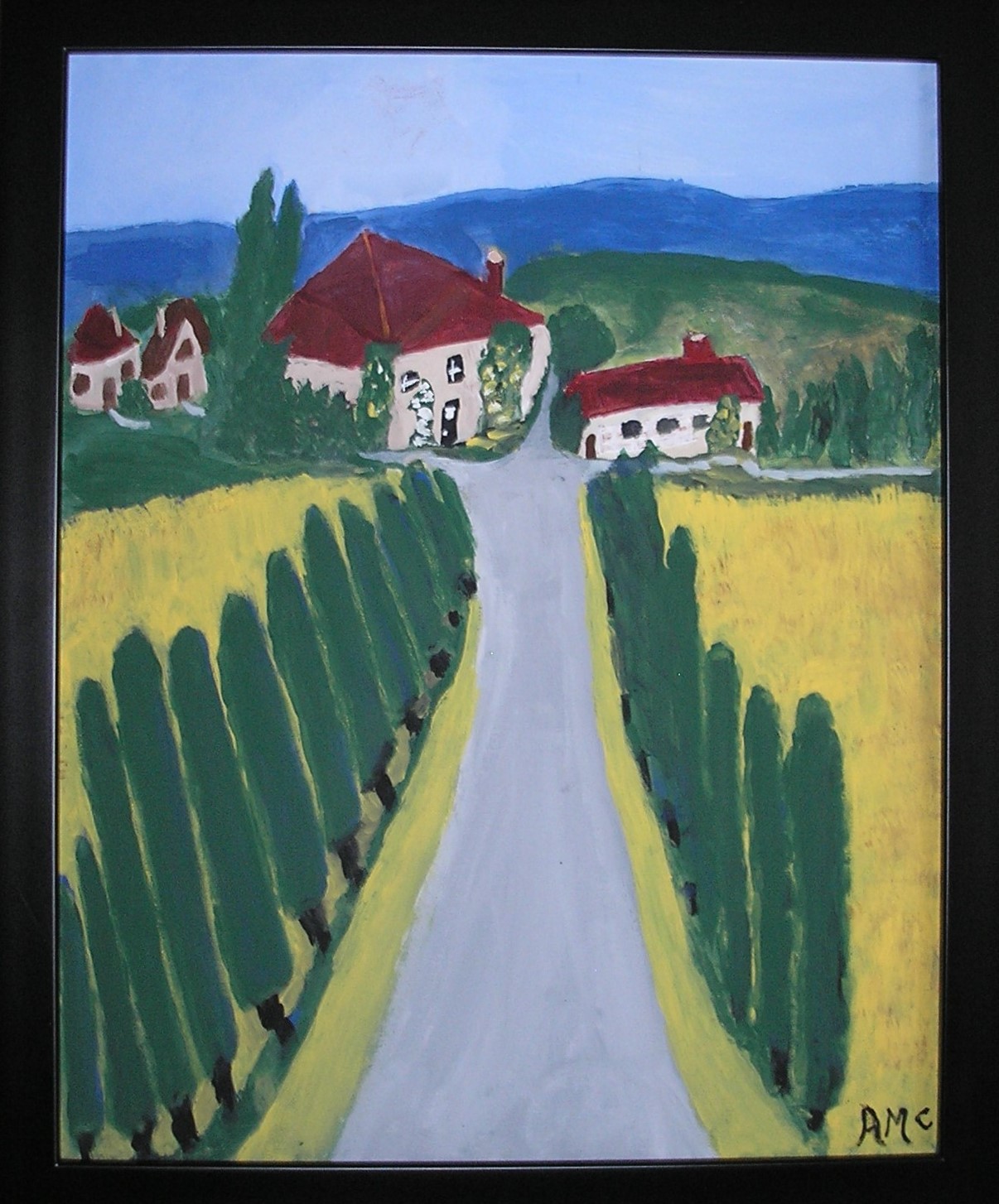
Italian Villa – 2015 – one of my mother’s paintings
Still the Mediterranean diet is something I aspire to, if only in the frozen food aisle.
Not crazy about edamame= green soybeansThis was surprisingly good for a ready-to-serve lentil soup, but does the sodium content cancel out any benefit?
So it was some anticipation that I read Debbie Travis’s latest bookJoy – Life Lessons from a Tuscan Villa. (You knew there was going to be a book in here somewhere.)
I was only vaguely aware of Debbie Travis (a decorating guru and pioneer of painting techniques) and I don’t usually read lifestyle books, (she’s written eleven), but it had a pretty cover and gorgeous pictures of the 13th century villa she restored over five years and now rents out for relaxing retreats.
Here’s a link to the Villa Reniella, should you have some extra cash to spare. It was hard to figure out the pricing, as while googling I saw various listings in different currencies, but they were all expensive.
There was a time in my life when the idea of a week at such a place would have seemed wonderfully idyllic. Now I’d probably be bored. My retirement life is already pretty low stress. Yoga looking out over a row of Cypress trees is still yoga and I hate yoga.
Stairway to Tuscany – 2018
And I have no desire to stay in a room which was previously a pigsty – wouldn’t it still reek of pigs? According to the book, the family stays in the original three story villa, but there are 12 individual well-appointed Porcilaia suites for rent, plus a renovated horse barn.
Only a rich celebrity would buy a run-down villa with livestock living on the ground floor and no running water – the village turned it off 30 times before they dug a well. The original building was surrounded by pigsties that were transformed into suites, each with its own private entrance and garden. Not to mention the 1200 olive trees which needed pruning and harvesting, an old non-productive vineyard and nightly battles with a herd of wild boor. She only mentions these in passing, and also introduces us to the previous owner (an elderly Tuscan man who surely must be laughing all the way to the bank), but I would have been more interested in reading about her experiences renovating the place than perusing a bunch of stylized photos of food I’m probably never going to make nor have any desire to eat. I don’t even like the taste of olive oil. (Edited to add – apparently there is a six episode series on youtube – La Dolce Debbie – for those who would prefer a documentary about the renovations. I have not watched it yet but here’s the link.) (April 21 – edited to add – I watched it and found it very enjoyable but it must have cost them a fortune – I highly recommend it if you’d prefer a visual tour!)
There’s a section on the villa’s extensive kitchen garden, which produces a multitude of herbs and vegetables with accompanying recipes. Kale, artichokes, beets, (no), leeks, peas, asparagus, mushrooms, tomatoes, radicchio (yes), zucchini (boring), fava beans, eggplant, celeriac (never tried them).
My own kitchen garden will be coming soon…it’s so much easier to eat healthy in the summer.
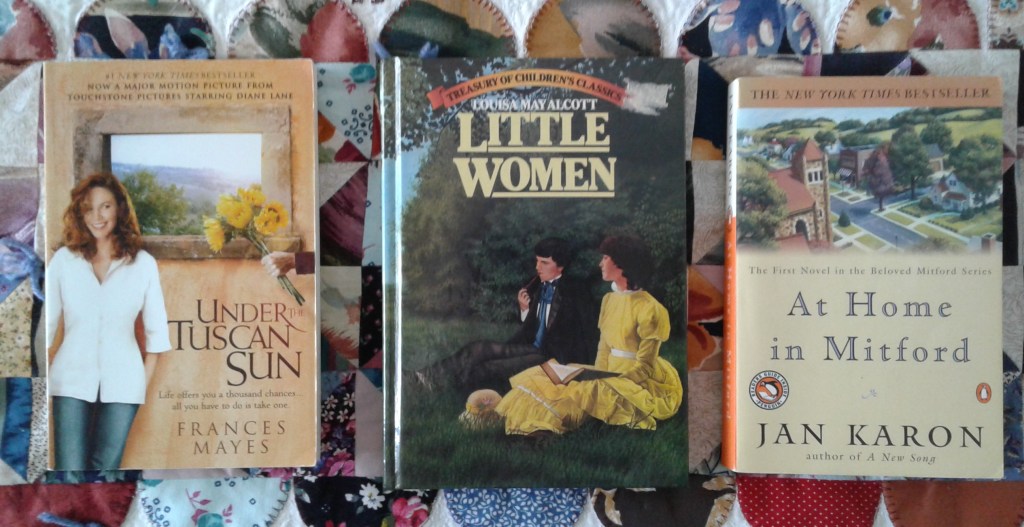
I found the book entertaining but also very light and fluffy – it’s certainly no Under the Tuscan Sun. I wonder though if the health benefits of the Mediterranean diet can be partially attributed to a different lifestyle, and the book does give us a peek into the Tuscan way of life with their emphasize on family and socializing, their coffee culture, aperitivos (pre-dinner drinks and nibbles) and the Passeggiata – a long promenade before dinner. Yes, I could see myself strolling around the village square with a glass of Prosecco in hand…a good way to get those steps in, if you don’t drink too much and stumble over the cobblestones. Plus, any country whose shuttered shops and businesses allow you to take a long afternoon nap has my vote. Perhaps they are just healthier because they get more sleep?
There were lots of recipes and pretty pictures of food, most of which I would probably not make because I’m not big on quinoa, chickpeas or legumes for my protein. The Limoncella recipe sounded interesting, as I always wanted to have a lemon tree, although not necessarily a whole grove. I like pasta and tomatoes occasionally, but she assures us the pasta (with fibre-rich grains, obesity is rare) and tomatoes taste different there, and their bruschetta is made with their own sun-ripened tomatoes. If anyone wants to lend me five thousand pounds, so I could find out, I believe this may require more research…..maybe in June during the Classic Car Rally? Now driving a vintage car around the scenic hills of Tuscany sounds like my kind of retreat.
PS. In the meantime Stanley Tucci’s – Season Two of Searching for Italy starts Sunday May 1 on CNN. I believe he is eating his way through Venice and Umbria.
Tuscan Farmhouse – 2015 – one of my mother’s paintingsThe March Hare boycotting the Mediterranean diet….and I even added carrots? Maybe he is waiting for the chocolate? Happy Easter Bunny!
One of the pleasures of staying in a hotel room is someone else cleans up, but do we ever really think about that person? We may see them moving their trolleys up and down the hallway, and hopefully we leave them a tip, but it’s a job a lot of people take for granted. It’s hard work, plus, you’d have to like cleaning.
Thankfully, Molly, the protagonist in the new bestseller, The Maid, loves her job and takes great pride and enjoyment in returning the rooms at the Regency Hotel to “a state of perfection” as their training program emphasizes. When she happens to clean away some murder evidence which along with her unusual behavior makes her a prime suspect, that provides an interesting premise for a murder mystery.
Reading is better than spring cleaning…
Here’s the Publisher’s Blurb:
Molly Gray is not like everyone else. She struggles with social skills and misreads the intentions of others. Her gran used to interpret the world for her, codifying it into simple rules that Molly could live by.
Since Gran died a few months ago, twenty-five-year-old Molly has been navigating life’s complexities all by herself. No matter—she throws herself with gusto into her work as a hotel maid. Her unique character, along with her obsessive love of cleaning and proper etiquette, make her an ideal fit for the job. She delights in donning her crisp uniform each morning, stocking her cart with miniature soaps and bottles, and returning guest rooms at the Regency Grand Hotel to a state of perfection.
But Molly’s orderly life is upended the day she enters the suite of the infamous and wealthy Charles Black, only to find it in a state of disarray and Mr. Black himself dead in his bed. Before she knows what’s happening, Molly’s unusual demeanor has the police targeting her as their lead suspect. She quickly finds herself caught in a web of deception, one she has no idea how to untangle. Fortunately for Molly, friends she never knew she had unite with her in a search for clues to what really happened to Mr. Black—but will they be able to find the real killer before it’s too late?
A Clue-like, locked-room mystery and a heartwarming journey of the spirit, The Maid explores what it means to be the same as everyone else and yet entirely different—and reveals that all mysteries can be solved through connection to the human heart.
About the Author:
Nita Prose is a longtime editor, serving many bestselling authors and their books. She lives in Toronto, Canada, in a house that is only moderately clean.
As an longtime editor, Nita Prose obviously had publishing connections, but this book is so good and so unique I’m sure it would have been found a home anyway. I suspect the hotel in the book is based on The Royal York in Toronto, where I have stayed on occasion when work was footing the bill, (it’s handy to Union train station, but when I have to pay, I stay at the pleasant but cheaper Marriott) or it could be any one of those grand old dames with an impressive lobby which pride themselves on style and service.
Discussion: I loved everything about this book – the protagonist, the plot-line, the descriptions, the dialogue – it’s just a charming story. I was already casting it in my head, when I read on Amazon that it is in development as a major motion picture produced by and starring Florence Pugh. I don’t know enough about this English actress to say whether she would suit the role or not, but it’s the kind of quirky movie the British do best. Hollywood would probably Hollywoodize it, with sexy uniforms and lots of bed-hopping.
One thing to note, this murder mystery has nothing to do with the Netflix series of the same name, which is a totally different story. I haven’t watched it, but believe it deals with the struggles of a single mother working a minimum wage job. I don’t know what the pay is for hotel maids but personal maid services here charge $35/hr with $25 going to the maid, and even home care agencies charge $25 for light housekeeping, but the bigger hotel chains may be closer to minimum wage $15 as they are often staffed by people whose English is a second language. This is addressed in the book, as one of the employees does not have the proper immigration papers and Molly herself has difficulty making her big city rent. (These rates may even have gone up given the low unemployment rate and difficulty in attracting employees.)
Molly is such a memorable character that you can’t help but root for her. Alone in the world after her grandmother’s death, she is unable to understand or read social cues, and takes everything at face value. The book is written in first person, which I often find annoying, but which works here as we are seeing the world from the point of view of someone whose thinking and behavior would be considered outside of normal. Although the author is very careful not to label her, she is probably somewhere on the spectrum, possibly Asperger’s Syndrome with a good dose of OCD thrown in. She seems literally clueless when it comes to interpreting other people’s words and actions which leads her into trouble. (I wonder if people who fall prey to obvious financial scams might be struggling with the same perceptive difficulties.)
The dialogue is clever, (hence the movie), and the descriptions creative – her nest egg which was stolen is her “Faberge”, her restaurant date was “the Tour of Italy”( which made me want to eat at an Olive Garden, if only we had one here).
The plot was fast-paced, although but I had a small problem with the ending, but understand why it had to happen that way. Overall, the book was a brilliant debut and also a gentle reminder that there are many “invisible” people in society, whose perceptions of the world may be somewhat different than our own.
PS. I use a maid service for my mother’s house, and also occasionally for myself for bigger jobs like windows, as I simply don’t have the energy to keep up two houses. What I like about them is they send two, occasionally three, people so they are in and out in a couple of hours, so you’re not in their way all afternoon. They do an excellent job, but cleaning houses all day is hard work, so many of them don’t last long, although the head cleaner is always the same. She told me she loves to clean, as did the Molly Maid franchise owner I used before. I’m grateful that some people do…now if I could only find someone who loves ironing. Vacuuming is my second hated task, but give me something to organize and I’m happy. While I used to enjoy the feeling of satisfaction after cleaning my house from top to bottom, now that I’m older I prefer that someone else return my house to “a state of perfection.” If only it would stay that way.
PS. Cleanliness in a hospital is a priority, so I would like to add a note of thanks to the hospital cleaners who have to deal with the COVID-units. I remember the floors in my rural hospital being so clean and shiny you could eat off them.








 thehomeplaceweb